
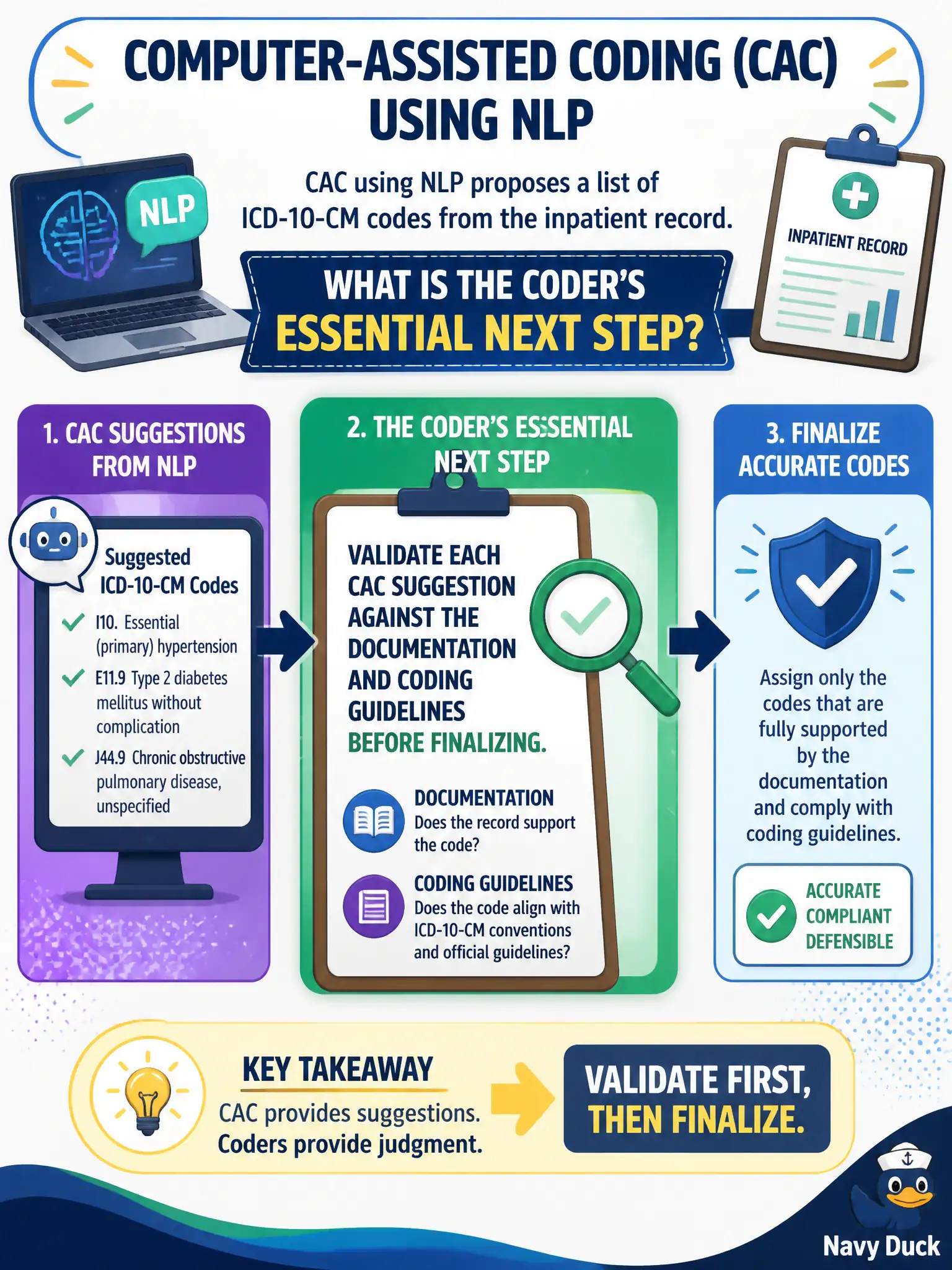
Computer-assisted coding (CAC) using NLP proposes a list of ICD-10-CM codes from the inpatient record. What is the coder’s essential next step?
Select an answer to reveal the explanation.
Short Explanation
CAC is a helpful first draft, not a signed chart. Every suggested code still needs a human eyeball against the record and the guidelines.
Full Explanation
When computer-assisted coding using NLP proposes ICD-10-CM codes from an inpatient record at a municipal hospital, the coder's essential next step is to validate each CAC suggestion against documentation and coding guidelines before finalizing. Civic automation accelerates drafts; it does not certify abstracts. Exporting all CAC proposals to the bill without opening the chart treats NLP as final coding. Accepting only green-checkmarked codes while ignoring Official Guidelines when CAC is enabled subordinates national rules to vendor UI. Disabling CAC permanently because AHIMA supposedly forbids automated assistance misstates professional practice—tools are allowed with human validation. Exam caveat: CAC is assistive; human validation remains mandatory. Operational check: open the record, accept only supported suggestions, reject negation and uncertainty errors, query when unclear, and feed systematic false positives back to CAC tuning. Treat encoders, groupers, and CAC as assistants inside civic HIM: useful for speed, never a substitute for documentation review, Official Guidelines, or PHI safeguards. Re-read the authenticated record before finalizing whenever tools, payers, or dashboards push a result the documentation does not support.