
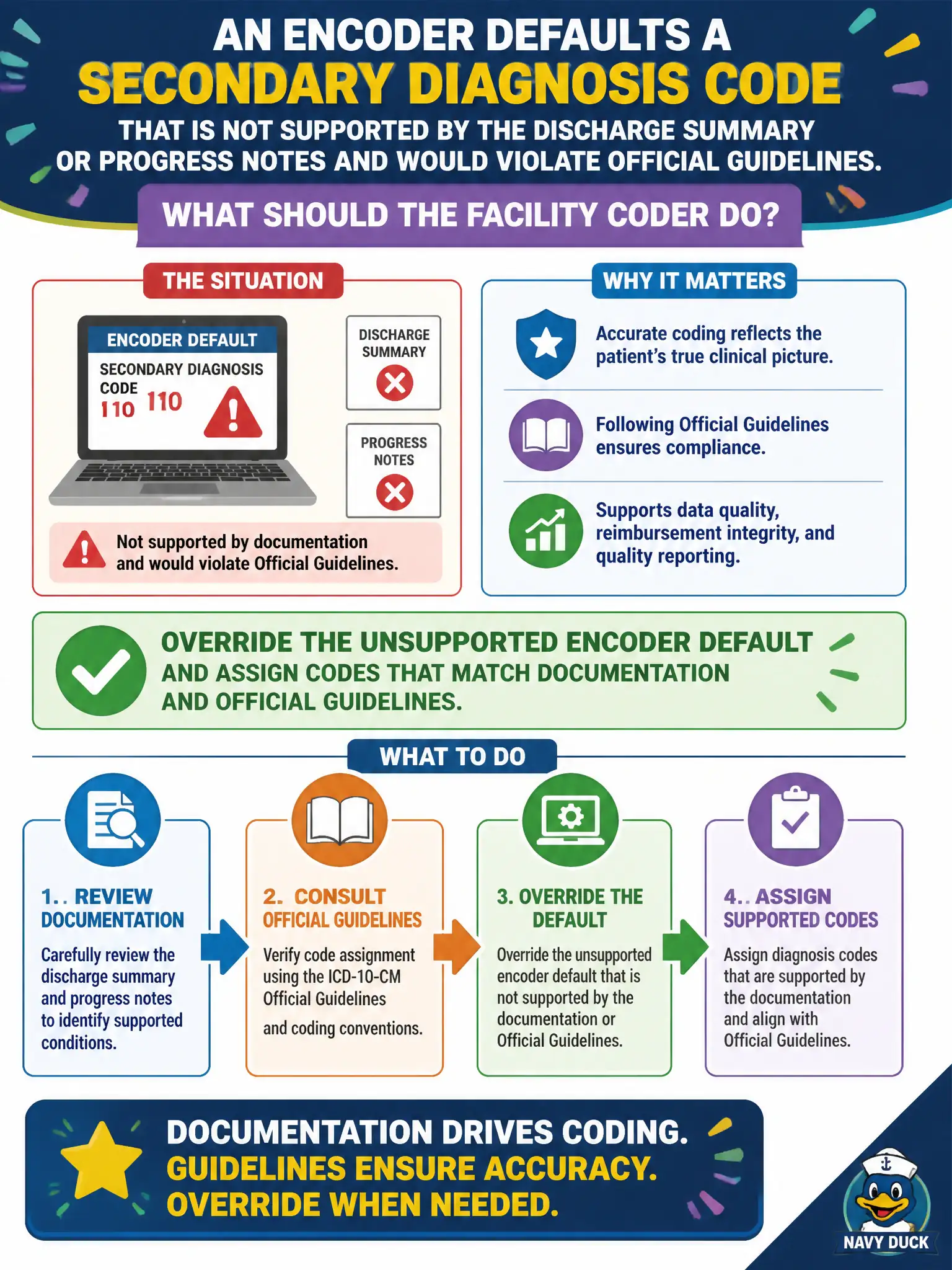
An encoder defaults a secondary diagnosis code that is not supported by the discharge summary or progress notes and would violate Official Guidelines. What should the facility coder do?
Select an answer to reveal the explanation.
Short Explanation
When the software defaults something the chart doesn’t support, you’re the adult in the room. Override it. Guidelines and documentation beat a convenient default every time.
Full Explanation
When an encoder defaults a secondary diagnosis code unsupported by the discharge summary or progress notes and that would violate Official Guidelines, the facility coder at a civic hospital must override the unsupported default and assign codes that match documentation and guidelines. Public trust requires humans to stop convenient but wrong software defaults. Keeping the default to protect CMI while noting software assigned in a query log still posts unsupported severity. Asking billing to hard-code a bypass so encoder defaults always post institutionalizes systematic error. Filing a HITECH breach report because any encoder default equals impermissible PHI disclosure misapplies breach concepts to ordinary coding tooling. Exam caveat: defaults are suggestions; unsupported ones must be overridden. Operational check: compare each default to notes and guidelines, remove unsupported codes, report chronic bad defaults for content repair, and monitor CMI movements tied to encoder defaults in compliance reviews. Treat encoders, groupers, and CAC as assistants inside civic HIM: useful for speed, never a substitute for documentation review, Official Guidelines, or PHI safeguards. Re-read the authenticated record before finalizing whenever tools, payers, or dashboards push a result the documentation does not support.