
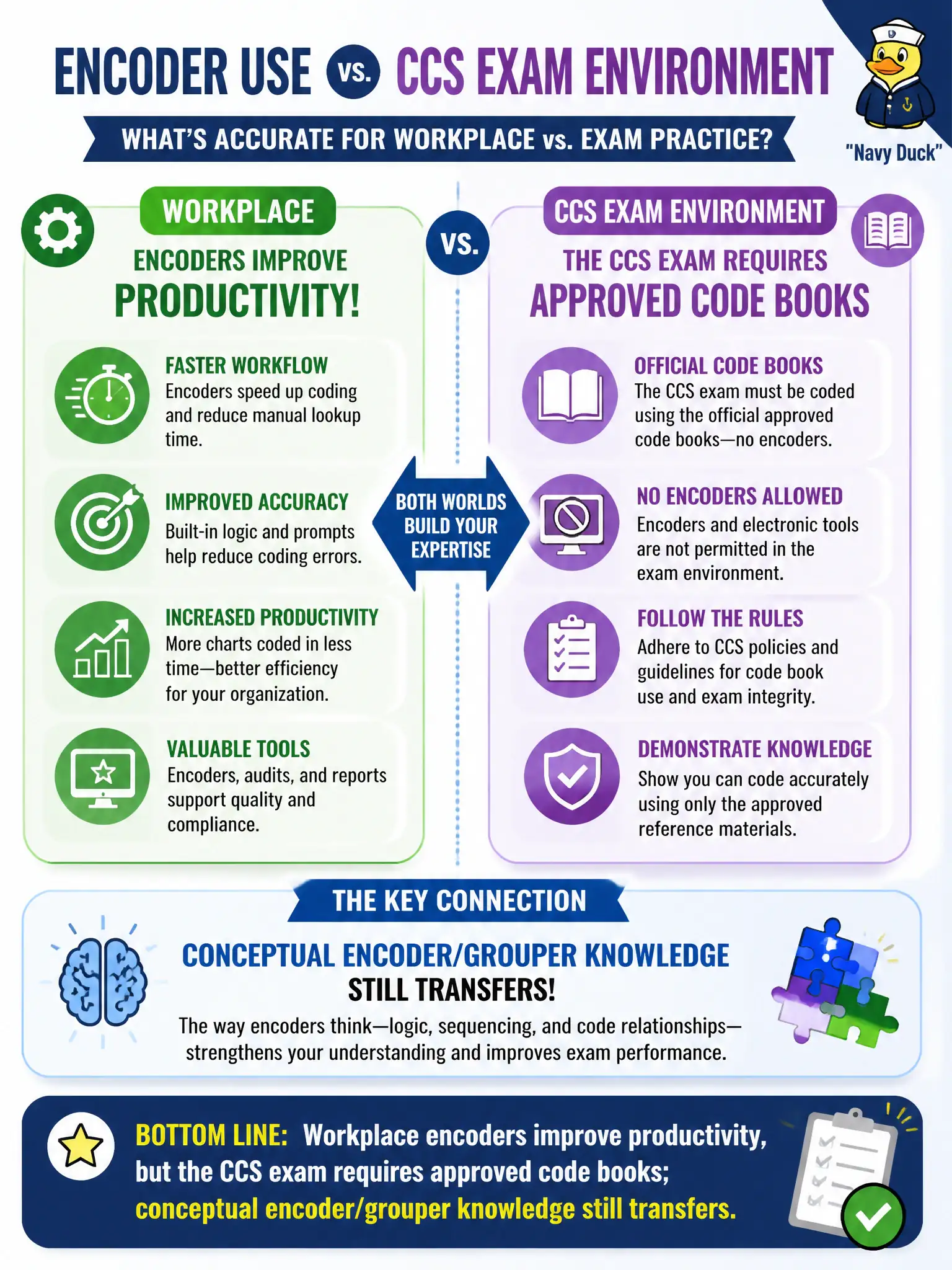
Regarding encoder use versus the CCS certification exam environment, which statement is accurate for workplace versus exam practice?
Select an answer to reveal the explanation.
Short Explanation
On the job you’ve got an encoder; on exam day you’ve got the books AHIMA allows. Learn both worlds—the concepts travel even when the software stays at work.
Full Explanation
Regarding encoder use versus the CCS exam environment, workplace encoders improve productivity at civic hospitals, but the CCS exam requires approved code books; conceptual encoder and grouper knowledge still transfers. Candidates should master both book-based reasoning and tool-aware practice. Claiming candidates may use any commercial encoder on the CCS exam in place of code books misstates exam rules. Saying encoder familiarity is irrelevant because hospitals forbid electronic coding tools is outdated and generally false. Asserting the CCS exam grades only CAC confidence scores and never tests guideline application invents a nonexistent scoring model. Exam caveat: exam logistics use books; job practice uses encoders—concepts of guidelines, sequencing, and grouping still matter in both. Operational check: study with approved books for exam readiness, practice guideline application without over-relying on software hints, and at work still validate encoder output against documentation and Official Guidelines. Treat encoders, groupers, and CAC as assistants inside civic HIM: useful for speed, never a substitute for documentation review, Official Guidelines, or PHI safeguards. Re-read the authenticated record before finalizing whenever tools, payers, or dashboards push a result the documentation does not support.