
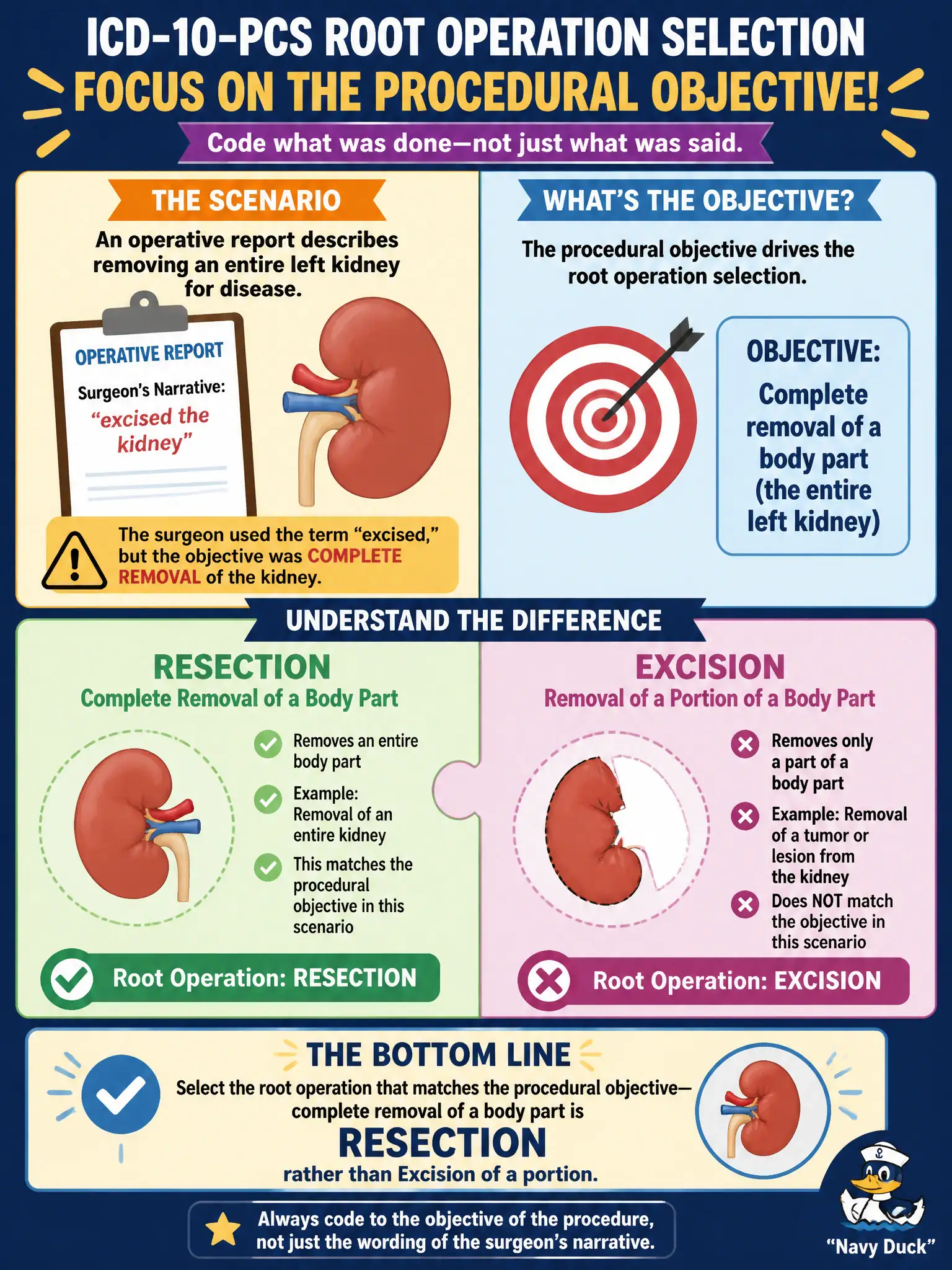
An operative report describes removing an entire left kidney for disease. The surgeon’s narrative casually says “excised the kidney,” but the objective was complete removal of the body part. How should ICD-10-PCS root operation selection be approached?
Select an answer to reveal the explanation.
Short Explanation
PCS cares about what you were trying to accomplish, not the verb the surgeon tossed into the dictation. Taking out the whole kidney is Resection territory; Excision is for cutting out a piece. Read the objective, then pick the root operation.
Full Explanation
ICD-10-PCS root operations are selected by procedural objective, not by casual verb choice in the operative narrative. Complete removal of an entire left kidney (the whole body part) is Resection; Excision is cutting out or off a portion of a body part. Even if the surgeon writes “excised the kidney,” when the objective was complete removal of the kidney, Resection is the correct root operation. Objective-based PCS coding keeps public hospital procedure data comparable and guideline-true.
Coding Excision solely because the note said “excised” fails by concept: PCS definitions override vernacular synonyms. Coding Inspection only because laterality was documented fails—laterality does not reduce a definitive removal to inspection. Omitting a PCS code and reporting only the ICD-10-CM kidney-disease diagnosis fails because inpatient procedures meeting coding criteria must be reported with PCS when performed.
Exam caveat: similarly, Destruction, Extraction, and Detachment have distinct definitions—always map to the PCS definition table, not English synonyms. Operational check: read the operative objective (entire kidney removed); select Resection of the kidney body-part value with correct approach/device/qualifier; ignore casual “excised” wording when the definition matches Resection; verify laterality in the body-part character as documented.