
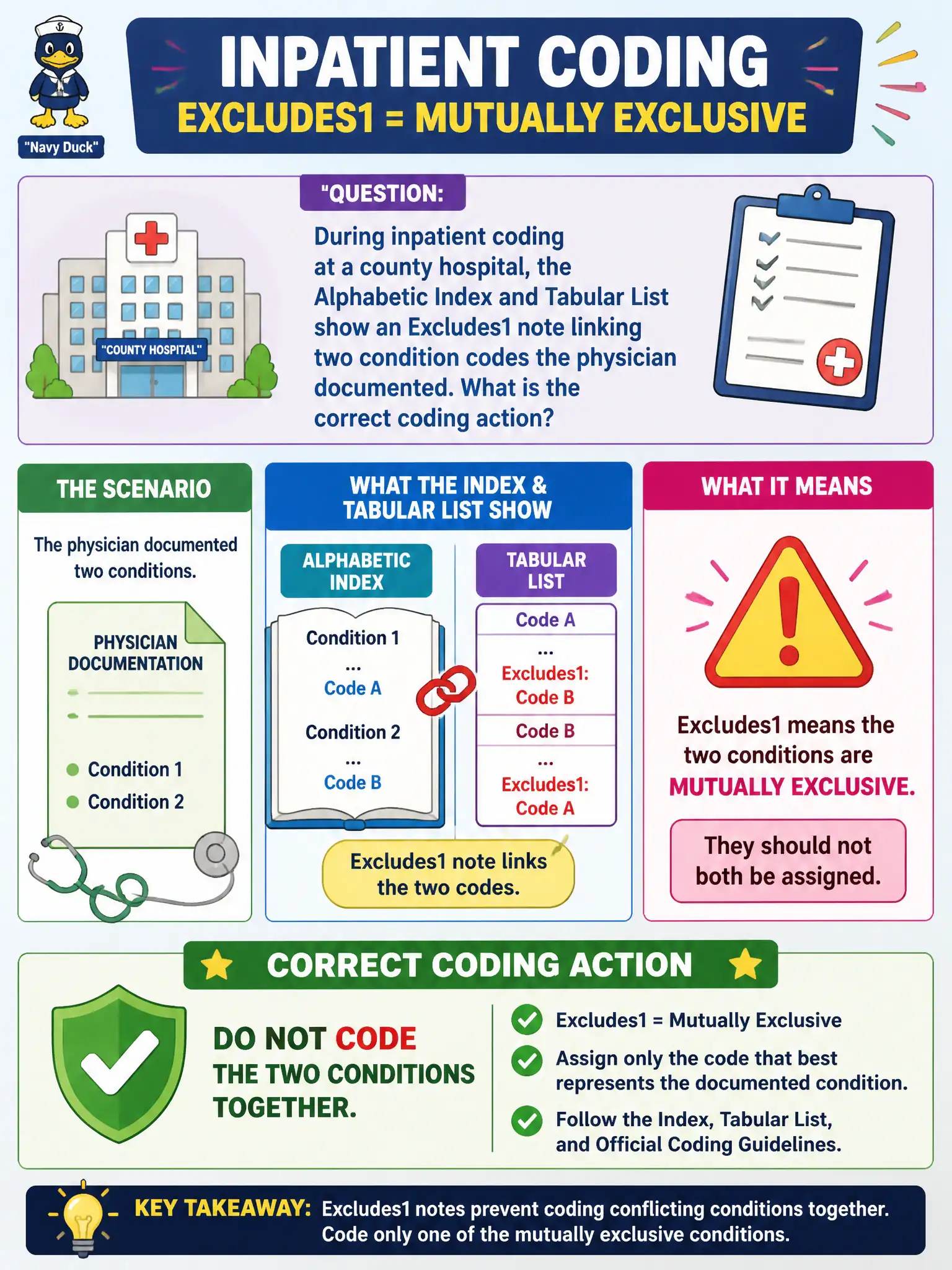
During inpatient coding at a county hospital, the Alphabetic Index and Tabular List show an Excludes1 note linking two condition codes the physician documented. What is the correct coding action?
Select an answer to reveal the explanation.
Short Explanation
Think of Excludes1 like a “pick one lane” sign—those two diagnoses are not supposed to ride together on the same claim. If the note says they are mutually exclusive, you do not assign both. That is different from Excludes2, which is more of a “not built into this code, but both can still be true” reminder.
Full Explanation
An Excludes1 note means the two conditions are mutually exclusive and should not both be assigned for the same encounter when the note links them. At a county hospital, if the Alphabetic Index/Tabular show Excludes1 between two physician-documented condition codes, the coder must not report both together; clarification via query may be needed when documentation truly seems to state mutually exclusive concepts. Excludes1 protects classification integrity in public datasets.
Coding both because Excludes1 “means not included here but may still be reported” fails by concept—that interpretation describes Excludes2, not Excludes1. Ignoring Excludes1 and sequencing by resource use fails because instructional notes override coder preference. Replacing both codes with an external cause code fails because external causes do not satisfy or erase Excludes1 conflicts between diagnosis codes.
Exam caveat: rare exception language exists in guidelines for Excludes1 when unrelated conditions truly coexist; apply that narrow exception only when criteria are met—do not treat it as a routine bypass. Operational check: read Tabular Excludes1 carefully; do not dual-code mutually exclusive pair; query conflicting documentation; choose the code that matches the provider’s clinical meaning after clarification.