
To validate present-on-admission (POA) status for a secondary diagnosis, what chronological comparison should the hospital coder make?
Select an answer to reveal the explanation.
Short Explanation
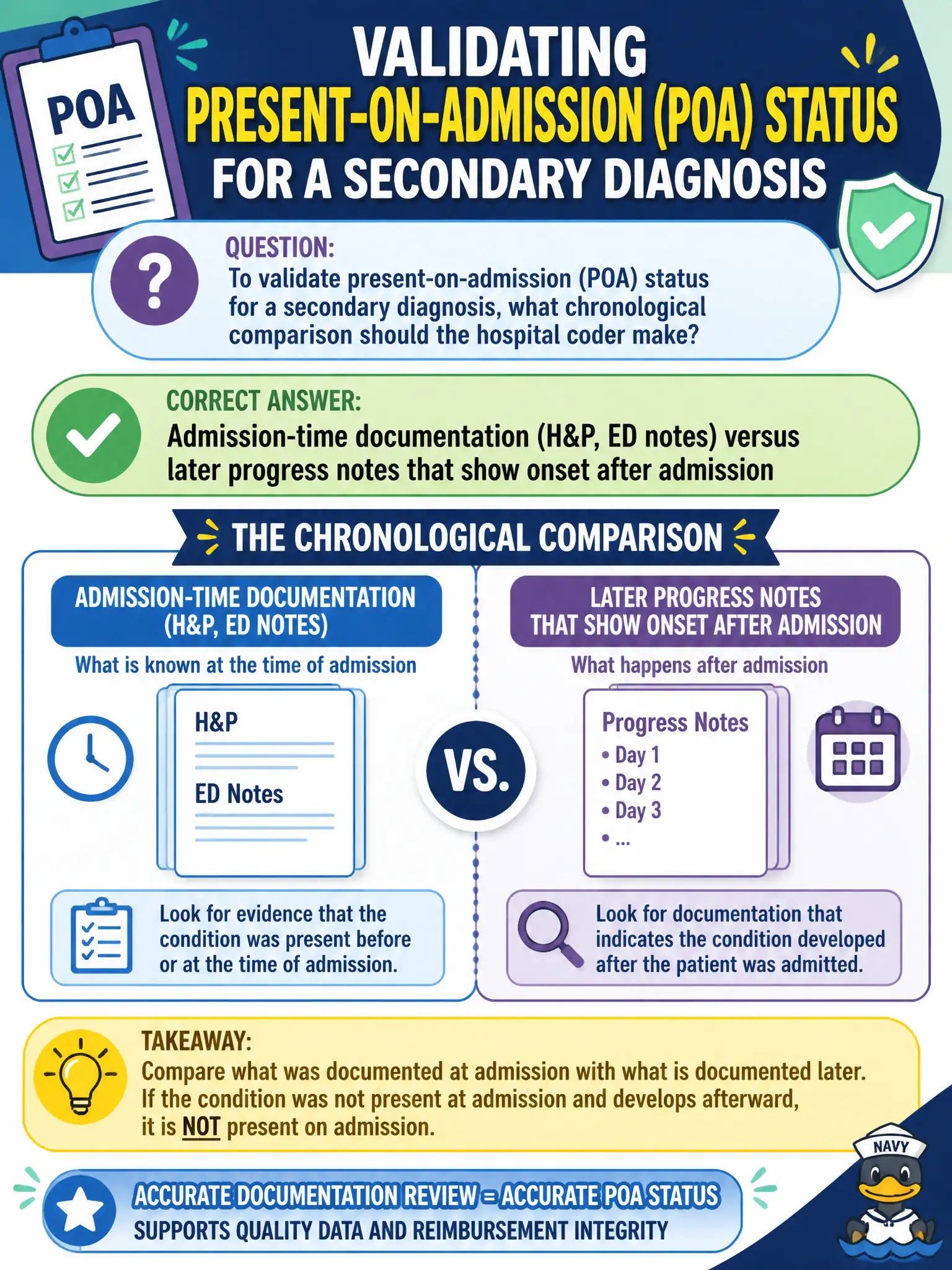
POA is a timeline puzzle: was it cooking at the front door or did it start after admission? Compare the admission H&P/ED story with later notes. That chronology — not the bill date — drives the indicator.
Full Explanation
Present-on-admission (POA) assignment for secondary diagnoses hinges on whether the condition was present at the time of inpatient admission versus arising afterward. The essential chronological comparison is admission-time documentation—such as the history and physical and emergency department notes—versus later progress notes that show onset after admission. Comparing only the final discharge summary date to the bill-drop date says nothing about clinical onset timing and cannot support a POA indicator. Matching a coding summary to remittance advice is a payment reconciliation step, not a method for determining whether disease began before or after admission. Relying solely on prior-year versus current-year problem lists without reading this encounter's admission versus hospital-course notes misses acute conditions that started during the stay. Exam caveat: POA indicators (Y, N, U, W, and 1) and exempt diagnosis lists are defined in Official Guidance—use the correct indicator set for the discharge date and never invent POA values to optimize hospital-acquired condition or quality profiles. Operational check for civic hospital abstracts: timeline the first diagnostic mention against admission documentation and treatment start; assign POA from that chronology, and query when admission presence remains unclear.