
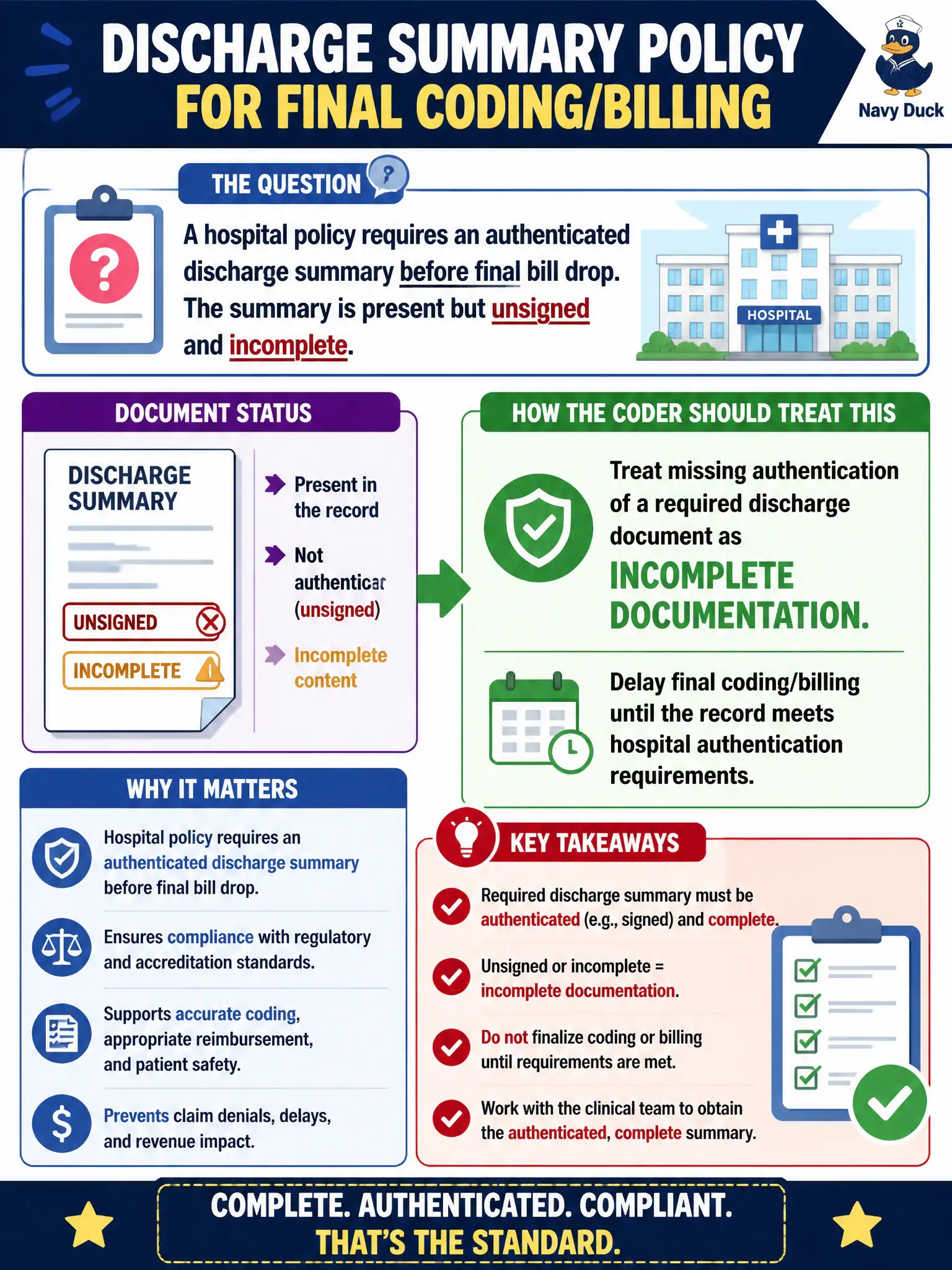
A hospital policy requires an authenticated discharge summary before final bill drop. The summary is present but unsigned and incomplete. How should the coder treat this for final coding?
Select an answer to reveal the explanation.
Short Explanation
An unsigned discharge summary is like a contract without a signature — the hospital is not ready to treat it as final. If policy says authenticate before bill, you hold the drop. Incomplete required docs block clean final coding.
Full Explanation
Final coding and billing for hospital inpatients often depend on authenticated required documents, including a discharge summary when hospital policy and regulatory expectations call for it before bill drop. An unsigned, incomplete discharge summary does not meet authentication standards, so the coder should treat the case as incomplete documentation and delay final coding/billing until authentication requirements are satisfied. Finalizing codes from an unsigned draft because content is 'usually unchanged' after signature bypasses legal-record controls that protect patients and municipal hospitals in audits. Deleting the discharge summary from the legal record to code only from nursing notes destroys required documentation rather than completing it. Using a prior admission H&P as a substitute discharge summary without authentication invents a discharge narrative and violates completeness policy. Exam caveat: authentication timelines and which documents are hard stops before final bill vary by facility bylaws and regulation—know local incomplete-record holds. Operational check: verify signature/attestation status and required discharge-summary elements; if incomplete, route through HIM deficiency workflows and release final codes only after the authenticated document is present.