
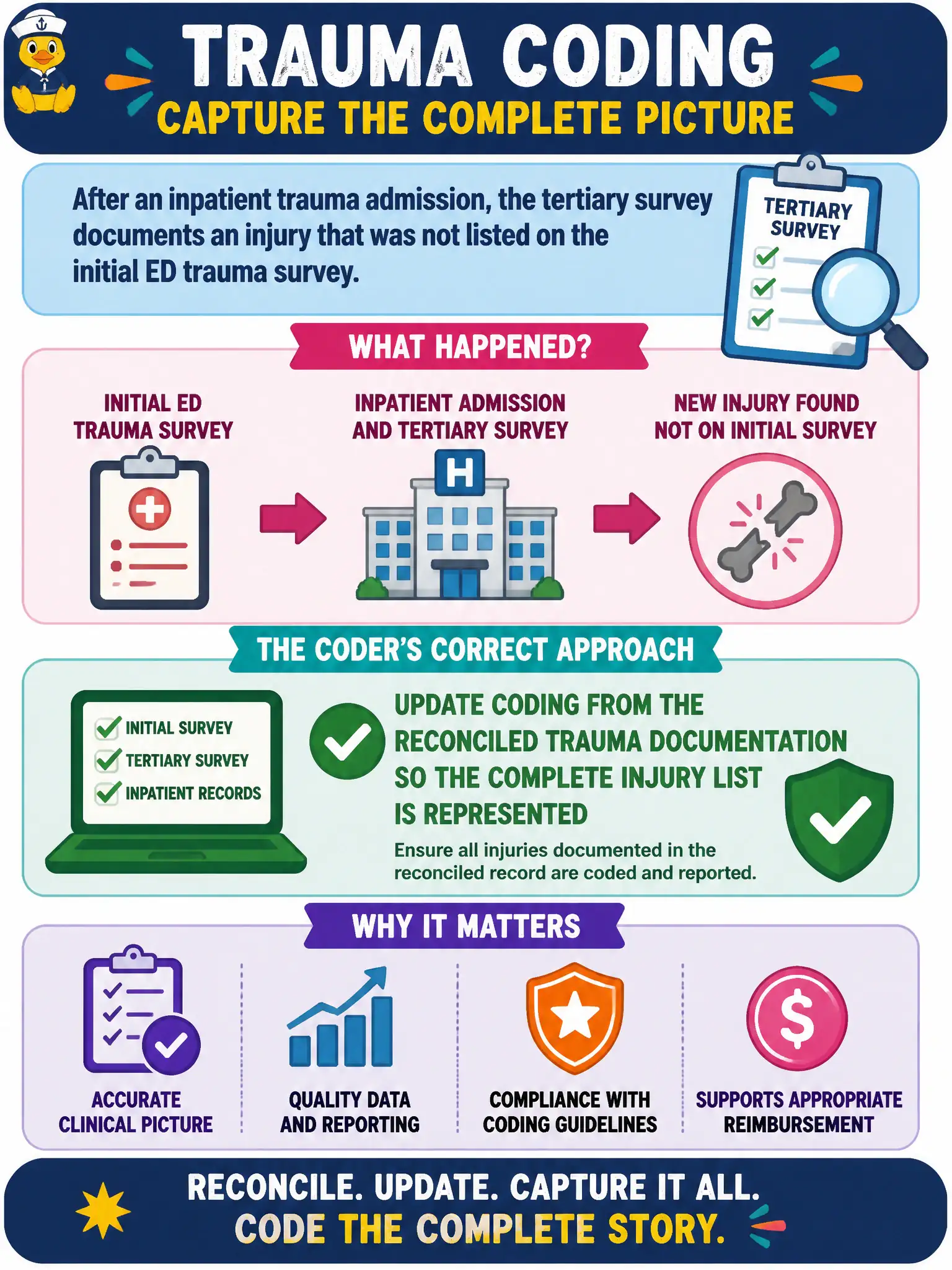
After an inpatient trauma admission, the tertiary survey documents an injury that was not listed on the initial ED trauma survey. What is the coder’s correct approach?
Select an answer to reveal the explanation.
Short Explanation
Trauma lists can grow after the dust settles—the tertiary survey is the cleanup pass. When a later survey finds another injury, fold it into the final coded set once the record is reconciled, not just the first ED checklist.
Full Explanation
After an inpatient trauma admission, when the tertiary survey documents an injury not listed on the initial ED trauma survey, the coder should update coding from the reconciled trauma documentation so the complete injury list is represented. Trauma coding at county trauma centers must evolve with the clinical survey process. Coding only injuries on the first ED survey because later findings are always hospital-acquired fails; later discovery is not automatically a hospital-acquired condition solely due to timing. Ignoring the tertiary survey because secondary surveys never affect facility coding fails complete-injury abstraction. Coding the new injury only if it required surgery fails because nonsurgical injuries may still be reportable and clinically significant. Exam caveat: final trauma coding reflects reconciled complete injury documentation, including tertiary findings. Operational check: incorporate tertiary survey injuries into the municipal trauma abstract with correct POA assignment based on clinical judgment and documentation, query unclear acuity or POA, and coordinate with trauma registrars so facility coding and registry data align for public reporting. In municipal and county facility practice, record the rationale for the chosen coding path and the rejected alternatives in the abstract notes so auditors and future coders understand the clinical and compliance basis. Re-check the decision if new authenticated documentation arrives before final bill drop, and escalate persistent documentation gaps to CDI or compliance rather than normalizing unsupported shortcuts that would distort civic claims, quality metrics, or case-mix reporting.