
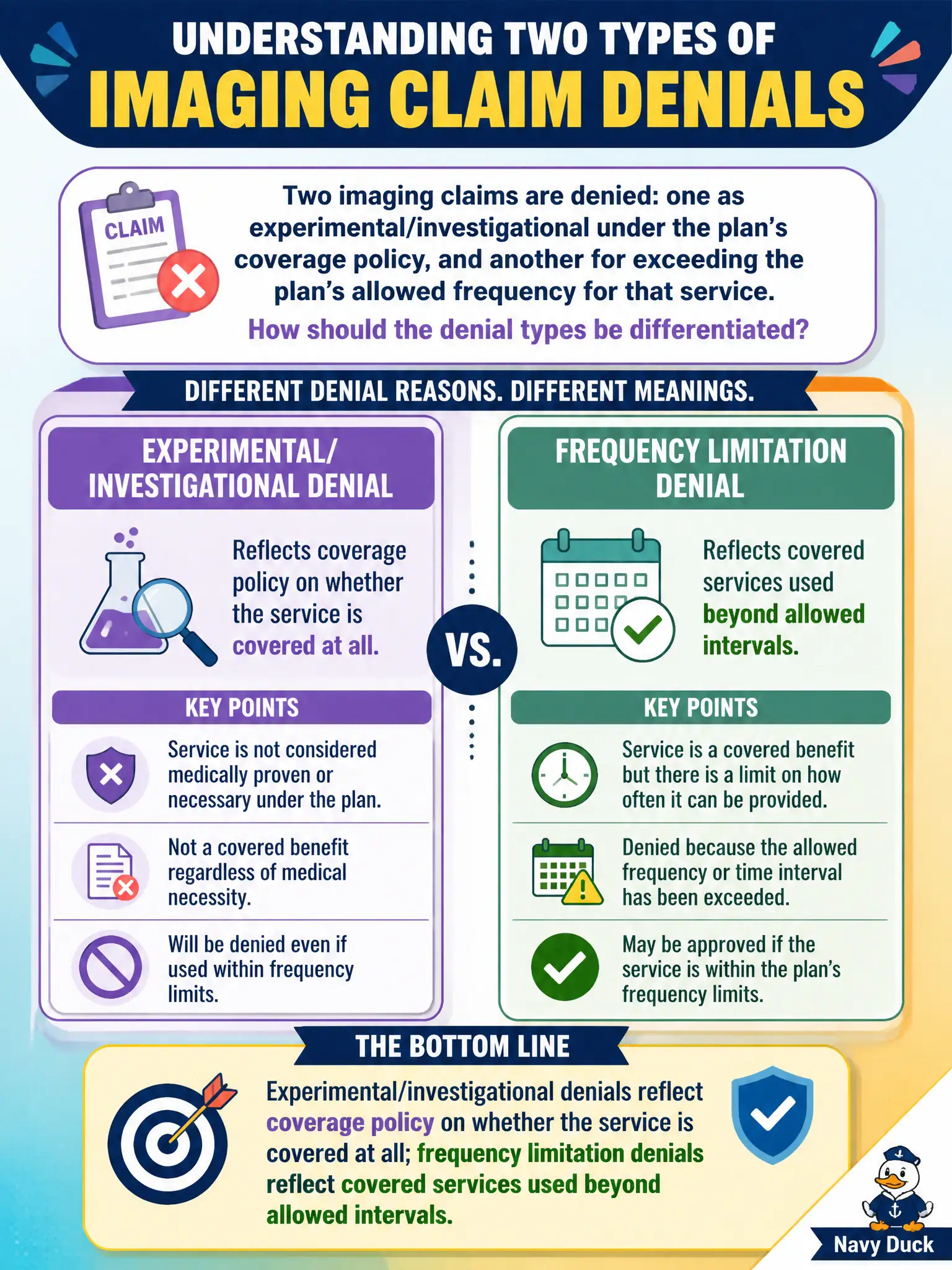
Two imaging claims are denied: one as experimental/investigational under the plan’s coverage policy, and another for exceeding the plan’s allowed frequency for that service. How should the denial types be differentiated?
Select an answer to reveal the explanation.
Short Explanation
“Experimental” means the plan says this service is not on the covered menu. “Frequency” means the menu item is covered, but you ordered it too often. Same imaging suite, different coverage stories—and different appeal evidence.
Full Explanation
Experimental or investigational denials reflect coverage policy on whether the service is covered at all, whereas frequency limitation denials reflect covered services used beyond allowed intervals. Differentiating those coverage stories guides appeal evidence: policy arguments and literature for experimental determinations versus dates-of-service and benefit-interval proof for frequency limits. Civic imaging programs should not treat every imaging denial as the same coverage failure.
Calling frequency and experimental denials identical and both meaning the CPT is invalid fails by concept because frequency implies a covered benefit exhausted by timing, while experimental implies noncoverage of the technology/indication. Fixing experimental denials with modifier 26 and frequency denials with modifier 50 fails because those modifiers address professional component and bilateral surgery concepts, not these coverage denials. Treating both as always eligibility failures unrelated to coverage policy fails because they are coverage-policy categories, not member-not-found eligibility rejects.
Exam caveat: plan documents and LCDs/NCDs define experimental lists and frequency edits; cite the controlling policy in appeals. Operational check: classify imaging denials by remark codes, attach different evidence packets for experimental versus frequency, and use ABNs or plan notices prospectively when frequency or noncoverage risk is known.