
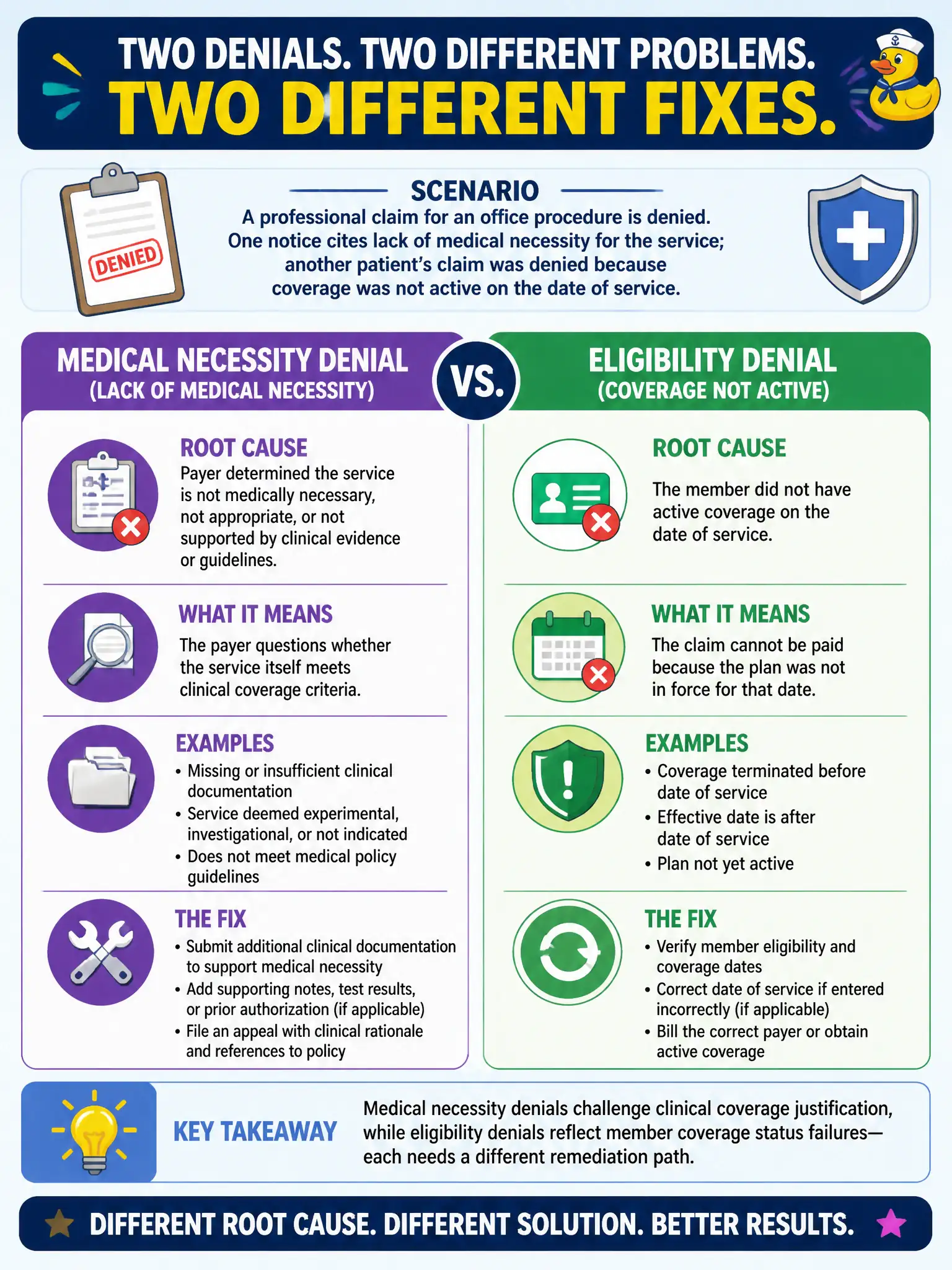
A professional claim for an office procedure is denied. One notice cites lack of medical necessity for the service; another patient’s claim was denied because coverage was not active on the date of service. How do these denial types differ in root cause and fix?
Select an answer to reveal the explanation.
Short Explanation
“Doesn’t meet necessity” is a clinical-coverage fight; “not eligible that day” is an insurance-status fight. Different roots, different fixes. Do not slap modifier 59 on an eligibility problem and call it done.
Full Explanation
A medical necessity denial challenges clinical coverage justification for the service, whereas an eligibility denial reflects member coverage status failure on the date of service. Each needs a different remediation path: clinical/LCD documentation and coding support for necessity versus coverage and enrollment correction for eligibility. Distinguishing those roots keeps civic clinic appeals coherent and avoids one-size-fits-all modifier myths on professional claims.
Fixing both denial types only by changing the CPT modifier to 59 fails by concept because 59 does not cure eligibility inactivity or most medical-necessity policy failures. Treating eligibility and medical necessity denials as identical with one appeal template fails because the evidence packets differ. Solving medical necessity denials by rebilling under a different tax ID fails because tax ID changes do not create medical necessity.
Exam caveat: some remits combine remarks; read all reason codes before choosing the fix path. Operational check: for necessity denials, pull notes and LCD mapping; for eligibility denials, re-verify coverage dates and correct subscriber data, then resubmit or appeal along the matching track.