
Which statement correctly describes how Medicare physician payment is built under RBRVS for a typical CPT service?
Select an answer to reveal the explanation.
Short Explanation
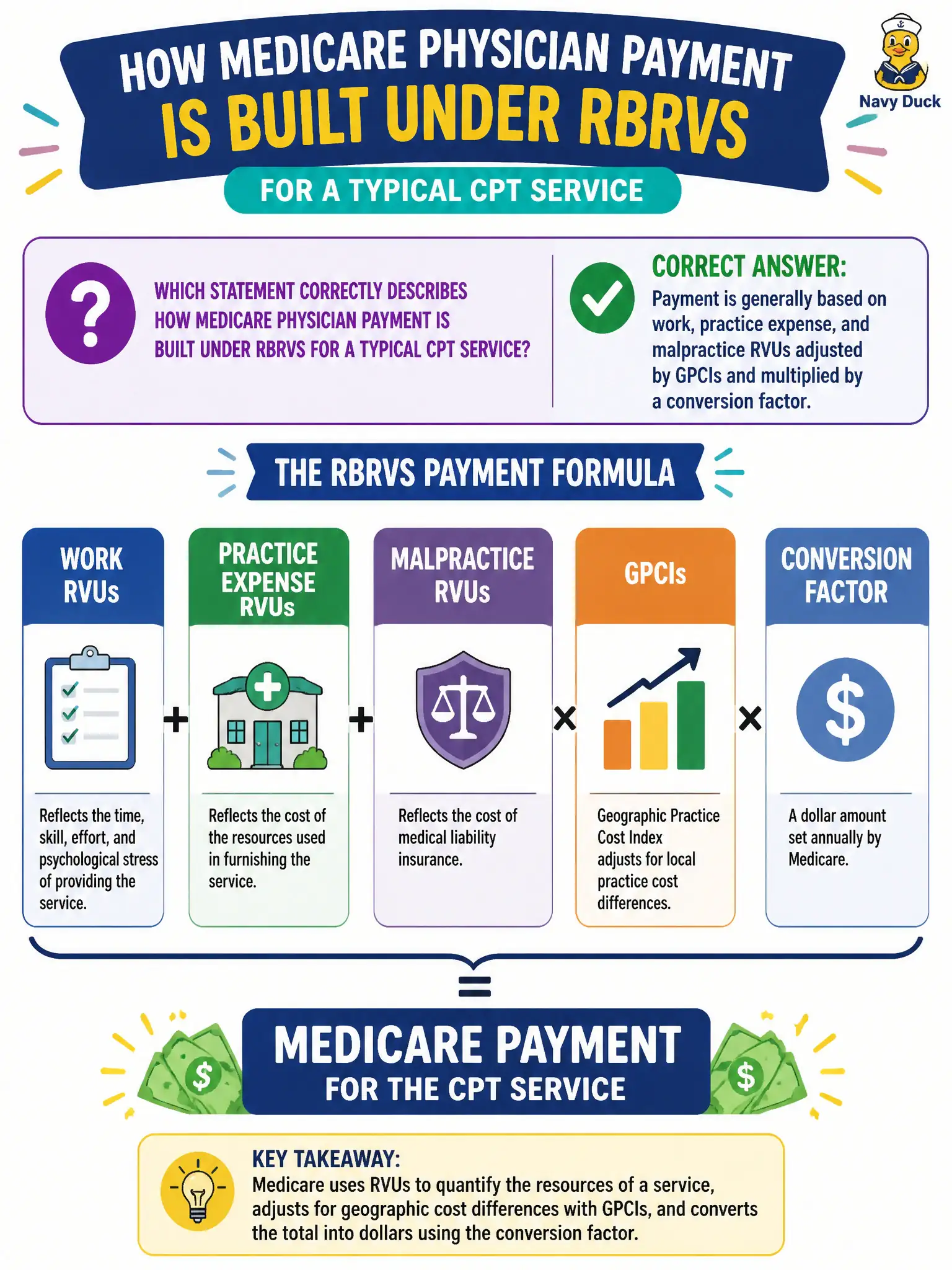
RBRVS is a recipe: three RVU flavors—work, practice expense, and malpractice—seasoned by geography (GPCI) and multiplied by the conversion factor. It is not “whatever you charged” and not diagnosis-weight magic. Know those building blocks and the payment story makes sense.
Full Explanation
Under the Resource-Based Relative Value Scale, Medicare physician payment for a typical CPT service is generally built from work, practice-expense, and malpractice RVUs, adjusted by Geographic Practice Cost Indices, and multiplied by a conversion factor. Understanding that recipe helps civic clinic coding and billing staff explain why fee-schedule amounts move with RVU, GPCI, or conversion-factor updates rather than with billed charges alone.
Equating payment to the billed charge multiplied only by coinsurance fails by concept because Medicare pays from the fee schedule, not from chargemaster whims. Describing payment as a flat national dollar fee schedule that never uses RVUs or geographic adjusters fails because RBRVS explicitly uses RVUs and GPCIs. Claiming payment is determined solely by ICD-10-CM diagnosis weight without procedure RVUs fails because physician fee-schedule pricing is procedure-RVU based, not DRG-style diagnosis weighting.
Exam caveat: not every Medicare payment line is pure RBRVS (drugs, labs, and certain other fee schedules differ); the tested concept is the standard physician CPT RVU build. Operational check: when payment looks unexpected, compare locality GPCIs, RVU files, and the current conversion factor before assuming a coding error.