
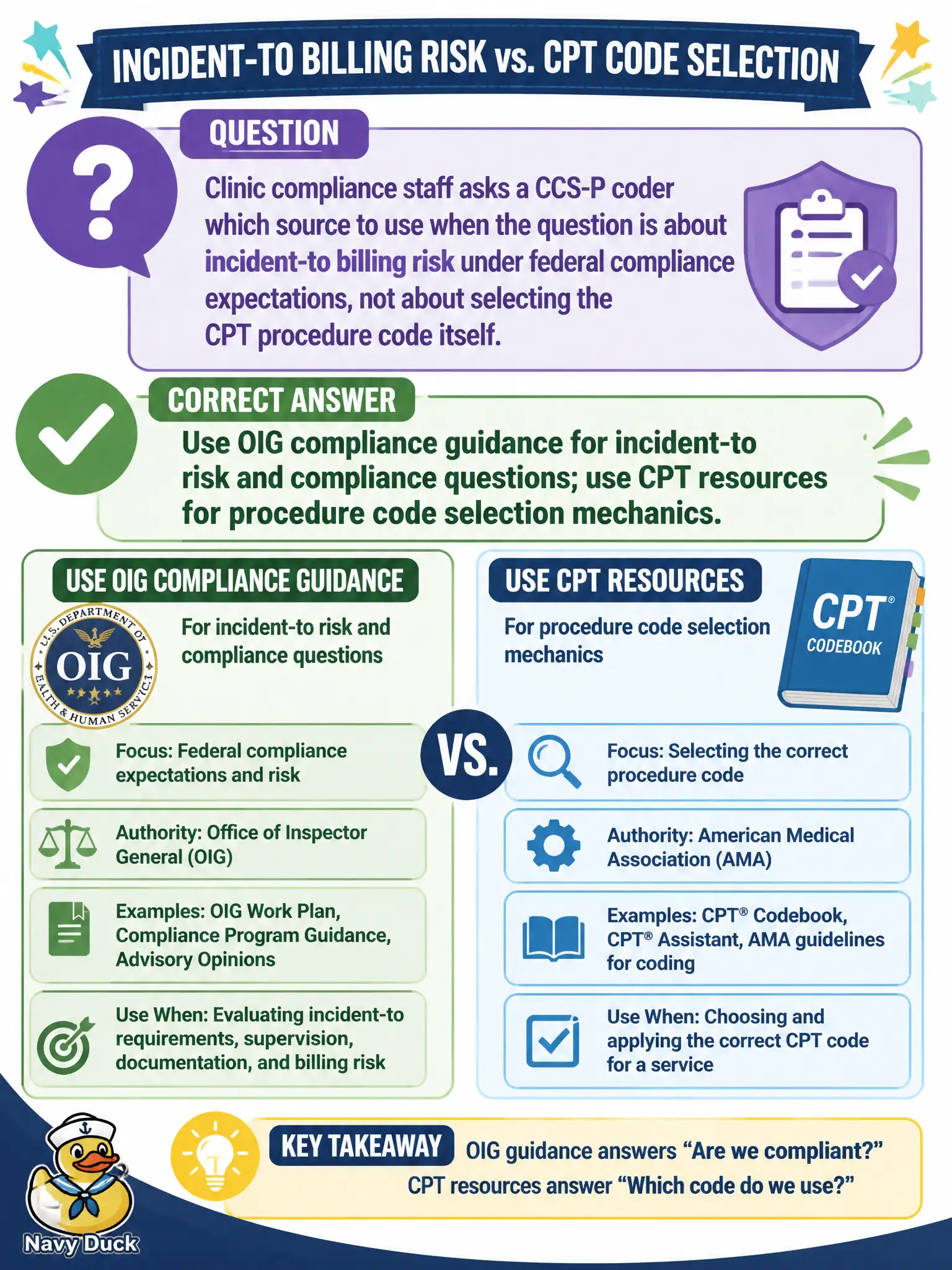
Clinic compliance staff asks a CCS-P coder which source to use when the question is about incident-to billing risk under federal compliance expectations, not about selecting the CPT procedure code itself. Which match is correct?
Select an answer to reveal the explanation.
Short Explanation
Pick the right toolbox for the question. CPT tells you which procedure code fits the work; OIG compliance guidance speaks to incident-to risk and billing integrity. Mixing those sources is like using a cookbook to fix a speeding ticket.
Full Explanation
Authoritative sources must match the decision type. CPT guidelines, descriptors, and parentheticals govern procedure code selection mechanics. OIG compliance guidance and related CMS incident-to rules address compliance risk, supervision, and billing integrity for physician practices—including county and municipal clinics. When compliance staff asks about incident-to billing risk under federal compliance expectations rather than which CPT to pick, the correct match is OIG/compliance guidance for the risk question and CPT resources for procedure-selection mechanics. Using only CPT parenthetical notes to answer fraud-and-abuse risk questions fails because CPT vignettes do not replace OIG/CMS incident-to compliance analysis. Using DRG grouper logic fails by setting and concept: incident-to is a professional-fee billing construct, not an inpatient facility DRG payment construct. Using only ICD-10-PCS tables fails because PCS is inpatient procedure classification and does not govern physician-office incident-to billing. Exam caveat: CCS-P tests source-to-question matching—know when the stem is asking for code mechanics versus compliance integrity. Operational check: classify the question (code selection vs compliance risk), pull OIG/CMS incident-to materials for risk decisions, pull CPT for code choice, cite the governing source on the civic compliance worksheet, and escalate unresolved incident-to scenarios to the compliance officer.