
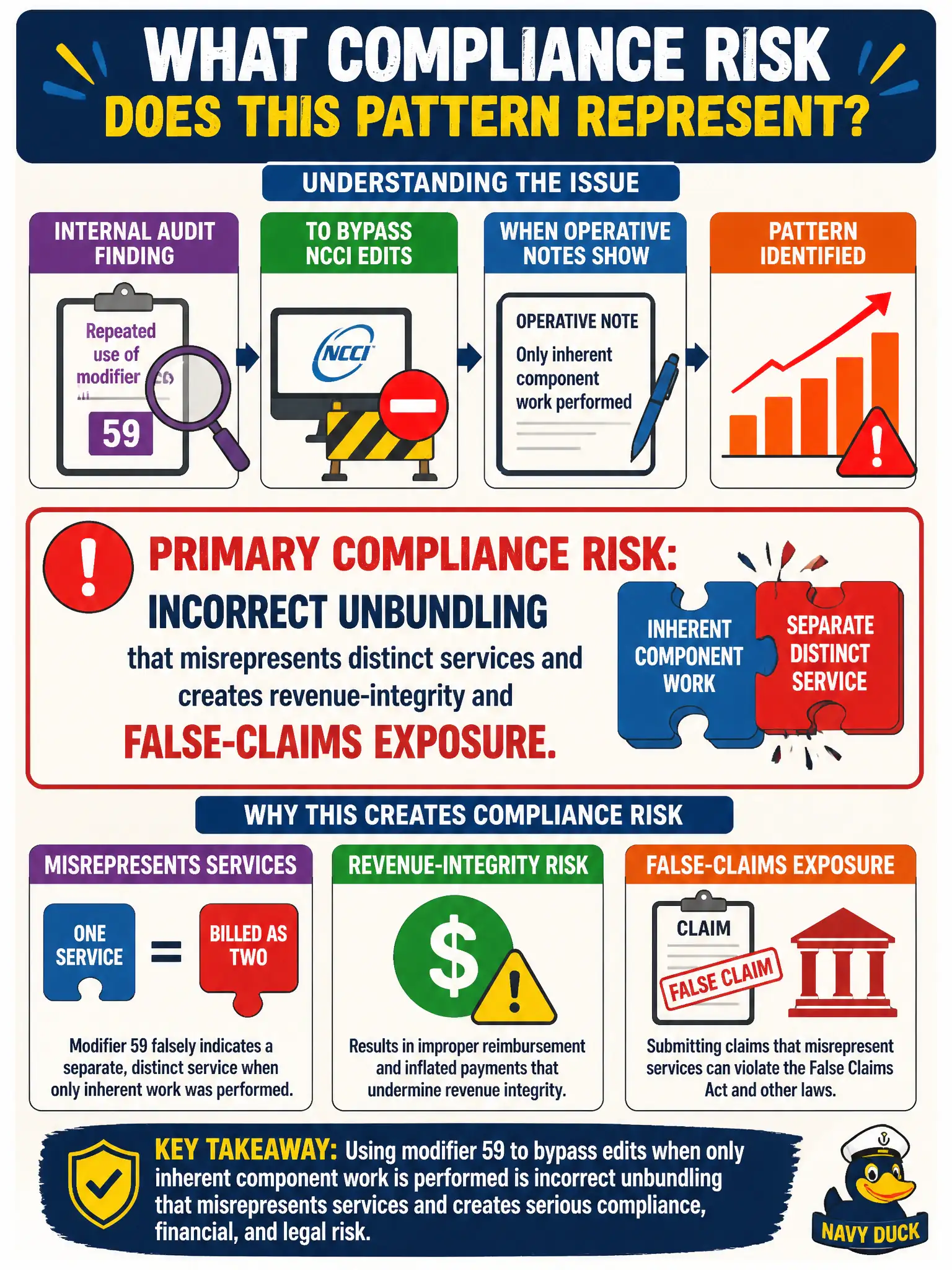
An internal audit finds repeated use of modifier 59 to bypass NCCI edits when operative notes show only inherent component work. What compliance risk does this pattern primarily represent?
Select an answer to reveal the explanation.
Short Explanation
Modifier 59 is not a tip jar. Using it when the work was never separate is unbundling theater—and auditors notice the pattern.
Full Explanation
Repeated use of modifier 59 to bypass NCCI edits when operative notes show only inherent component work is improper unbundling. It misrepresents component services as distinct and creates revenue-integrity and potential false-claims exposure for the physician practice—especially acute for public clinics stewarding taxpayer-funded program dollars. Internal audit should treat the pattern as a high-priority coding compliance finding, not a benign billing habit. Calling the pattern “underbundling that always reduces revenue” fails because this misuse inflates payment by separating bundled work; it is not a revenue-reducing underbundle. Labeling it solely a teaching-physician attestation issue fails because the core defect is distinct-service modifier misuse, even if teaching rules coexist. Calling it a HIPAA privacy breach fails by concept: modifier abuse is coding/payment integrity, not a privacy disclosure event. Exam caveat: indicator “0” edits cannot be bypassed; indicator “1” still requires real distinctness—volume of 59 usage is a risk metric, not proof of correctness. Operational check: sample 59/X{EPSU} claims against op-note distinctness criteria, revoke auto-59 scrubber rules, retrain providers and coders in the civic practice, refund/rebill as required by findings, and track modifier override rates on the compliance dashboard.