
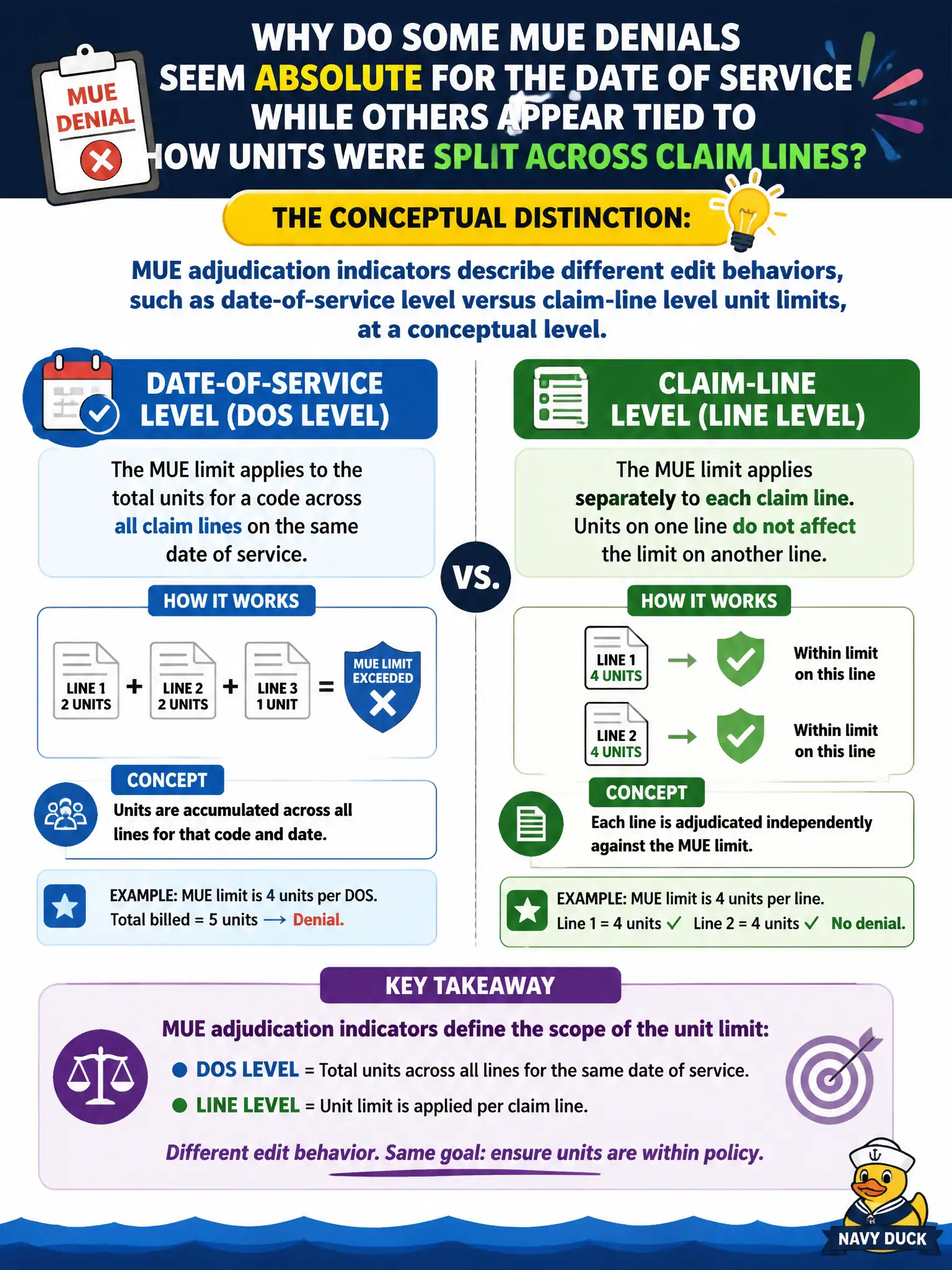
A billing analyst asks why some MUE denials seem absolute for the date of service while others appear tied to how units were split across claim lines. What conceptual distinction should the CCS-P coder explain?
Select an answer to reveal the explanation.
Short Explanation
Some unit caps watch the whole day; others watch one claim line. That MAI difference is why splitting lines sometimes looks clever—and sometimes still fails.
Full Explanation
Each MUE carries an adjudication indicator (MAI) that describes how CMS applies the unit edit—commonly distinguishing date-of-service level limits from claim-line level limits, among other published behaviors. A CCS-P coder in a public specialty practice should explain that some denials look “absolute” for the DOS while others relate to how units were split across lines because the MAI defines that edit behavior. Understanding MAI conceptually helps billers remediate correctly instead of blindly re-billing the same unit pattern. Treating all MUEs as advisory only fails because MUEs are payment edits that deny or return units exceeding the limit under their MAI rules. Claiming MUEs apply exclusively to inpatient UB-04 claims fails by setting: MUEs are relevant to professional fee claims. Asserting clinics may rewrite MAI values in the encoder fails because MAI is CMS-published edit metadata, not a local preference. Exam caveat: do not memorize a single MAI meaning for every code—look up the current MUE value and MAI for the HCPCS/CPT and DOS rather than assuming line-splitting always helps or never helps. Operational check: look up MUE value + MAI for the code/DOS, compare billed units and line construction to that behavior, correct units or documentation pathway before resubmission, and record the MAI rationale in the civic billing denial tip sheet.