
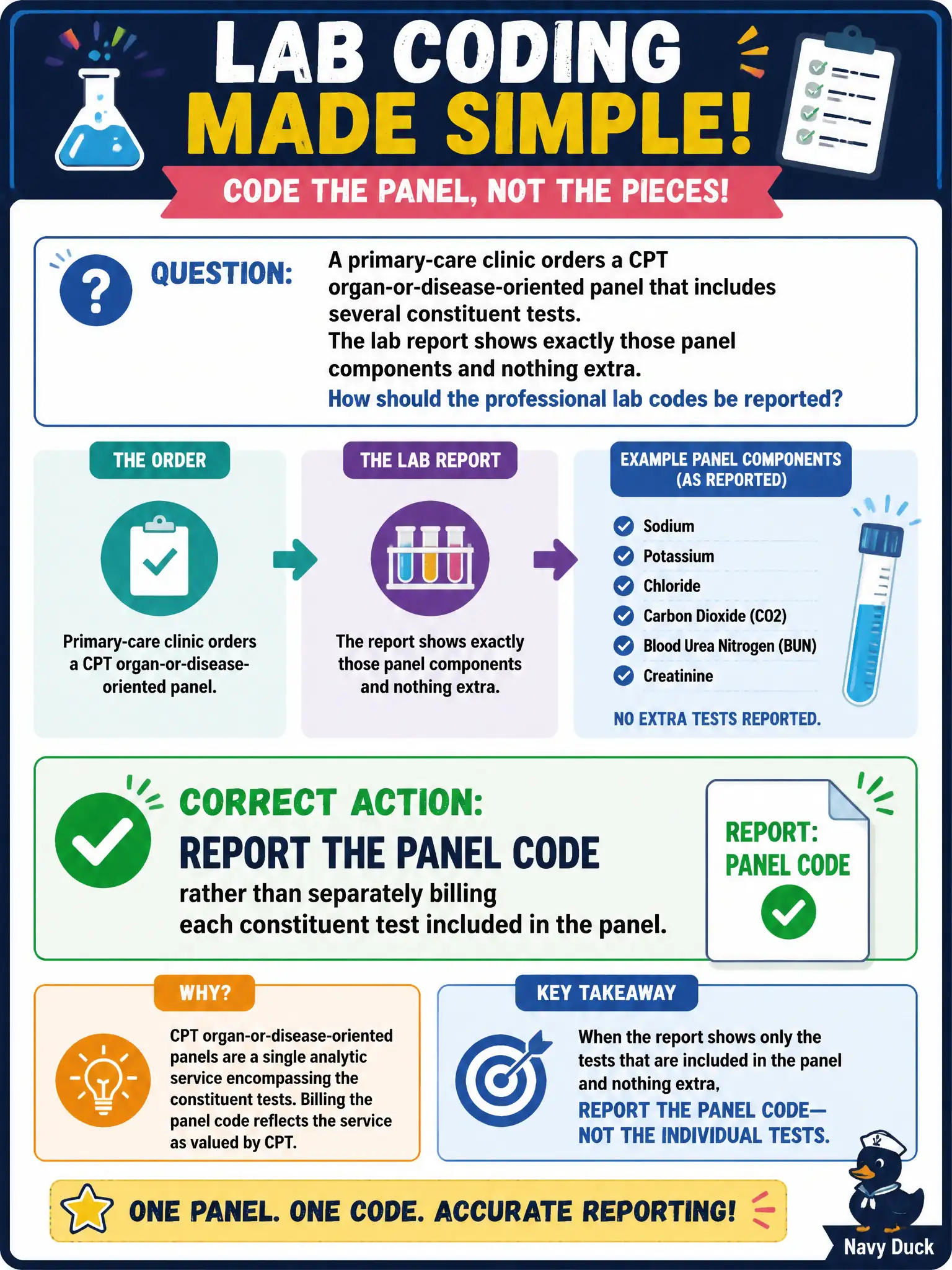
A primary-care clinic orders a CPT organ-or-disease-oriented panel that includes several constituent tests. The lab report shows exactly those panel components and nothing extra. How should the professional lab codes be reported?
Select an answer to reveal the explanation.
Short Explanation
A panel is the combo meal. If you ordered the combo and got only what is in it, you do not also ring up every item a la carte. That is classic unbundling.
Full Explanation
When CPT defines an organ- or disease-oriented panel and the laboratory performs exactly those constituent tests, professional lab coding reports the panel code rather than itemizing each included component. For a primary-care civic clinic claim, that panel-first rule prevents unbundling of tests already valued together and aligns with CPT panel conventions and NCCI unbundling controls. Extra medically necessary tests outside the panel definition may be reported separately when not otherwise bundled; identical panel contents alone are not. Billing each component with modifier 59 to maximize reimbursement fails because distinct-service modifiers do not legitimize unbundling panel constituents that were performed as the panel set. Omitting laboratory codes because panels are “facility-only” fails by setting: panel CPT concepts apply on professional/lab claims when the practice is reporting the lab services. Reporting both the panel and every component on the same claim fails as double billing of the same analytic work. Exam caveat: confirm whether the practice is billing the lab service professionally versus referring out; ownership/billing arrangement changes who reports the panel, but not the anti-unbundling principle when the panel was performed. Operational check: map the lab report lines to the CPT panel definition, bill the panel if contents match, add only true extras with medical necessity support, run NCCI/panel edits in the encoder, and retain the panel crosswalk in the county clinic’s lab coding desk reference.