
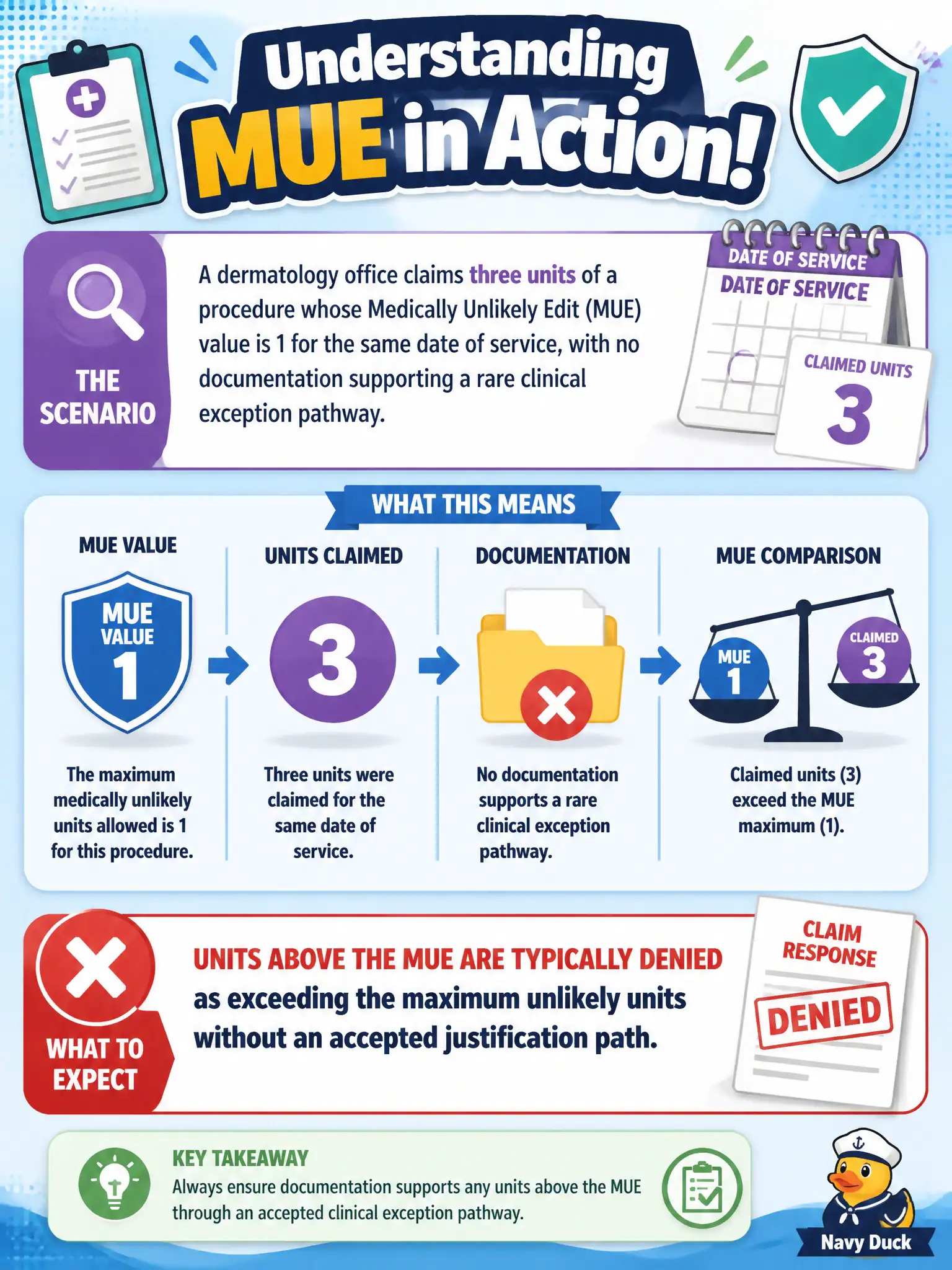
A dermatology office claims three units of a procedure whose Medically Unlikely Edit (MUE) value is 1 for the same date of service, with no documentation supporting a rare clinical exception pathway. What should the CCS-P coder expect?
Select an answer to reveal the explanation.
Short Explanation
An MUE is like a speed limit for units—CMS says going past that number is almost never believable. Stacking three when the limit is one usually means a denial, not a bigger check.
Full Explanation
Medically Unlikely Edits (MUEs) establish the maximum units of a HCPCS/CPT code that a provider would ordinarily report for a single beneficiary under the edit’s adjudication rules (commonly for a date of service or per claim-line behavior depending on the MUE adjudication indicator). On a dermatology professional claim for a public clinic program, submitting three units when the MUE value is 1, without a rare accepted clinical exception pathway, should be expected to deny the excess units as exceeding the unlikely maximum. The CCS-P professional anticipates that outcome and corrects units to the documented, medically necessary amount that does not violate the MUE rather than gambling on payment. Assuming all three units will auto-pay because MUEs apply only to facility claims fails by setting: MUEs apply to professional claims as well and are not limited to hospital UB-04 workflows. Ignoring MUEs because the physician fee schedule “allows” multiple units fails because fee-schedule existence does not override CMS unit edits. Replacing excess units with modifier 76 to force payment fails because 76 addresses repeat procedures by the same physician under defined circumstances and does not automatically neutralize an MUE. Exam caveat: MUE values and adjudication indicators change over time; civic practices must use the MUE file effective for the date of service, and some MAIs behave differently for line-level versus date-of-service adjudication. Operational check: before release, compare billed units to the current MUE value and MAI, confirm documentation does not support an exceptional pathway, reduce units or split dates only when clinically true, and log MUE overrides (if any) through the county clinic’s compliance-approved process—not ad hoc modifier padding.