
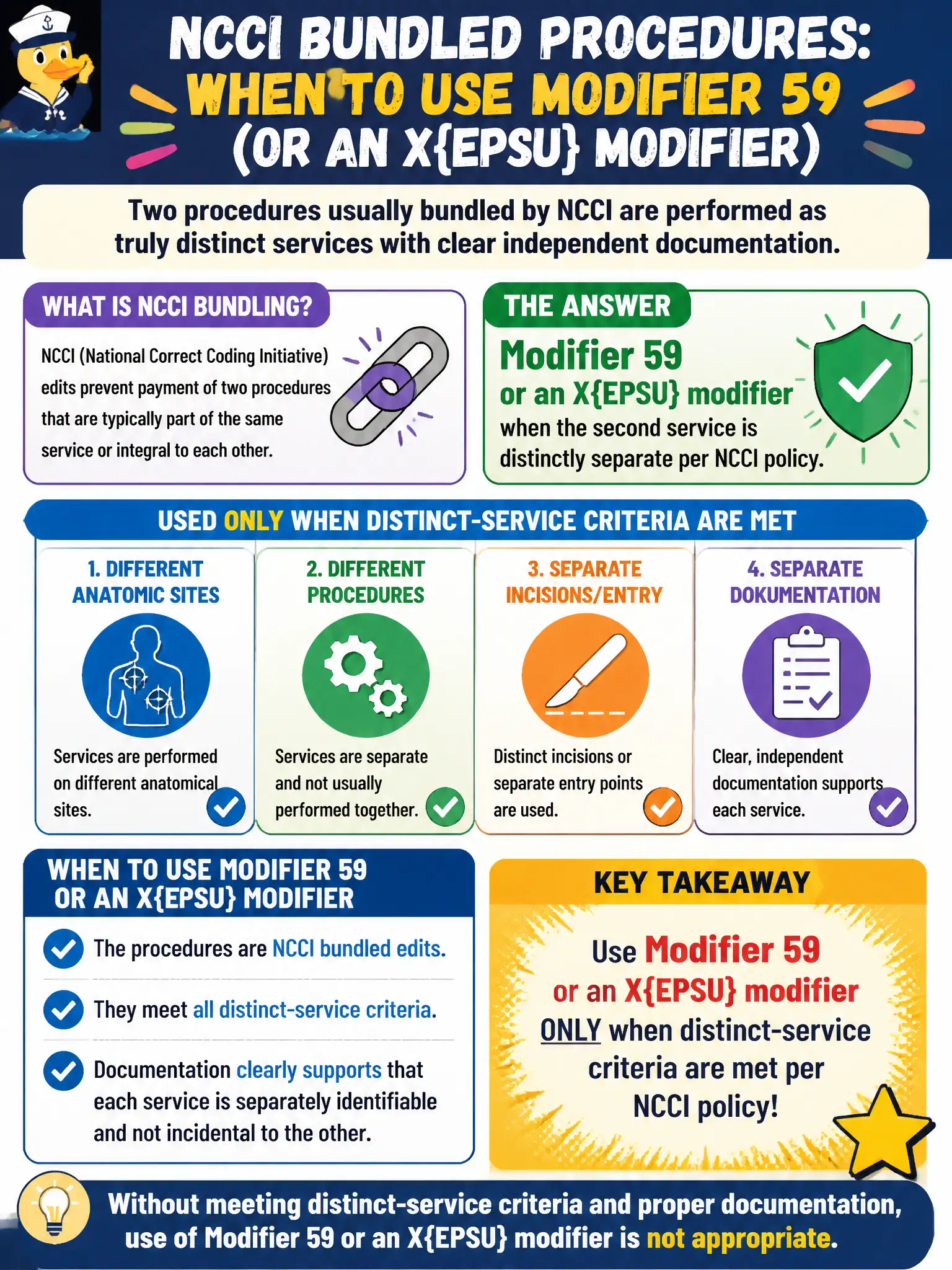
Two procedures usually bundled by NCCI are performed as truly distinct services with clear independent documentation. Which modifier family is used only when distinct-service criteria are met?
Select an answer to reveal the explanation.
Short Explanation
Modifier 59 (or the XE/XP/XS/XU cousins) is a scalpel, not a butter knife—only for truly distinct services that NCCI would otherwise glue together. Documentation has to prove independence.
Full Explanation
When two procedures usually bundled by NCCI are performed as truly distinct services with clear independent documentation, modifier 59 or an X{EPSU} modifier may be used only when distinct-service criteria are met per NCCI policy. That scalpel should be rare and well supported. Responsible use in public specialty clinics prevents both underpayment for truly separate work and abusive unbundling of integral components.
Modifier 24 on both procedures to mark them unrelated to a global period addresses postoperative E/M unrelatedness, not NCCI procedure-to-procedure unbundling. Modifier 57 on the secondary procedure to indicate decision for surgery belongs on decision-for-surgery E/M services, not as a generic unbundler. Modifier 26 on both codes to convert them to professional-only services addresses professional components of diagnostic services, not NCCI distinct-procedure overrides.
Exam caveat: prefer the more specific XE/XP/XS/XU modifier when the payer requires it instead of defaulting to 59. Operational check: prove distinct sites, sessions, or encounters in the note; confirm an NCCI PTP edit exists; append 59 or the appropriate X modifier only to the column two code as directed; and never use these modifiers to bypass inclusive surgical package work.