
A new patient at a county clinic has a medically appropriate history and exam with moderate medical decision making. Under current office/outpatient E/M guidelines, how is the level primarily selected?
Select an answer to reveal the explanation.
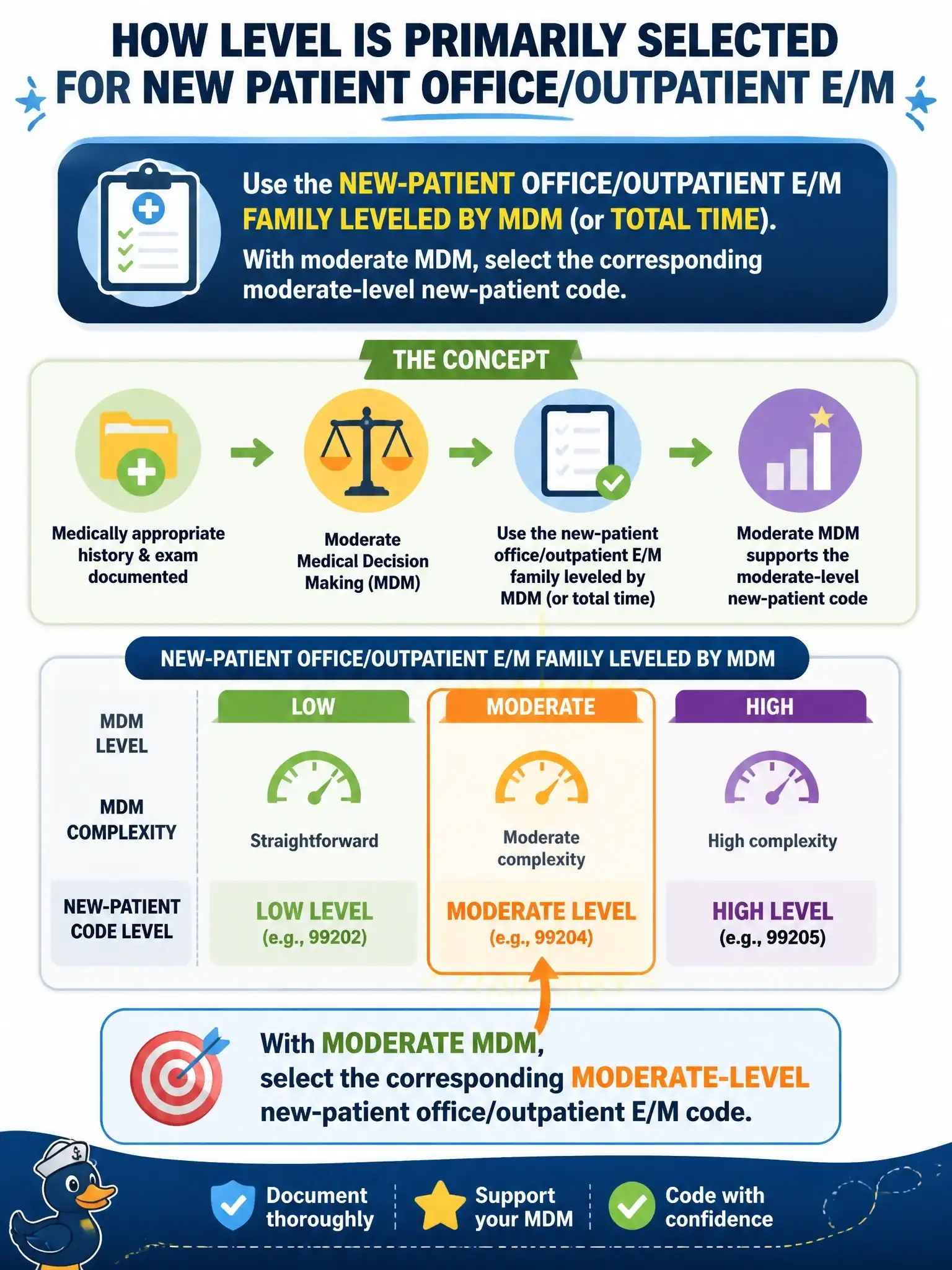
Short Explanation
New clinic patient plus moderate medical decision making means you use the new-patient office/outpatient E/M family, leveled by MDM or total time. Moderate MDM supports the matching moderate-level new-patient code. You don’t use inpatient codes or old bullet-count archaeology for a county clinic visit.
Full Explanation
Under current office and outpatient E/M guidelines, a new patient at a county clinic with medically appropriate history and exam and moderate medical decision making is leveled using the new-patient office/outpatient E/M family by MDM or total time. Moderate MDM supports the corresponding moderate-level new-patient code. Modern leveling in civic clinics emphasizes medical complexity over obsolete bullet counting and improves consistency across public panels. Counting history and exam bullets as the sole leveling method under pre-2021 rules only ignores the current MDM-or-time framework for office visits. Assigning inpatient initial hospital care codes for every new clinic patient misstates site of service. Always selecting the highest new-patient code whenever any lab is ordered bypasses MDM and time thresholds with an unjustified automatic upcode. Exam caveat: medically appropriate history and exam are still expected, but they no longer solely drive office level selection the way the old bullet system did. Operational check: score problems, data, and risk (or document total time), confirm new-patient status, and select the matching new-patient office E/M level with supporting MDM or time narrative.