
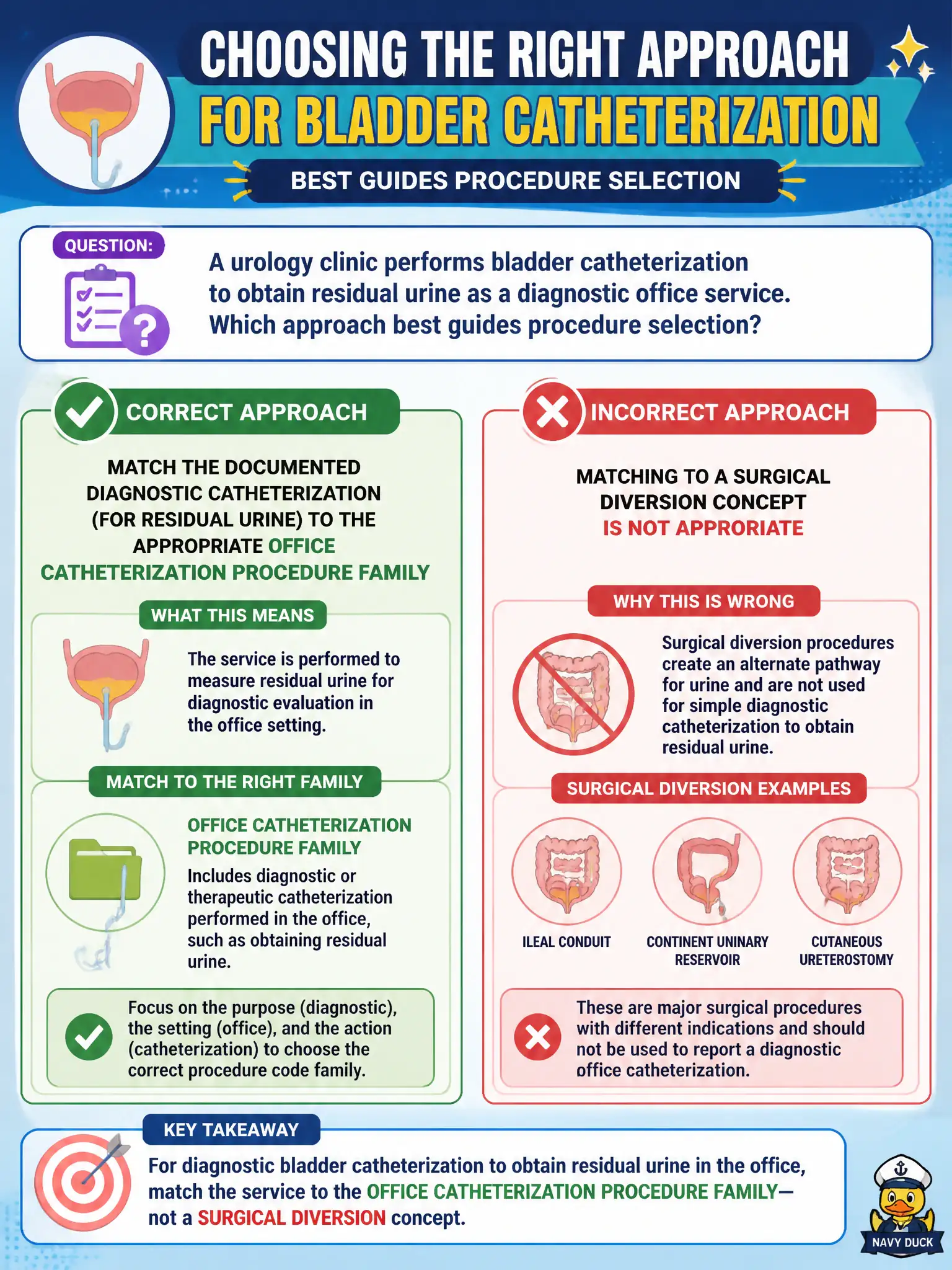
A urology clinic performs bladder catheterization to obtain residual urine as a diagnostic office service. Which approach best guides procedure selection?
Select an answer to reveal the explanation.
Short Explanation
Checking leftover urine with a temporary catheter is a diagnostic pit-stop, not rebuilding the plumbing. Pick the office catheterization family that fits residual-urine work—don’t jump to diversion surgery or hide it inside a vague visit.
Full Explanation
Diagnostic bladder catheterization performed in a urology clinic to obtain residual urine should be matched to the appropriate office catheterization procedure family, not to surgical diversion concepts. Temporary diagnostic catheterization is a focused office service; coding it accurately keeps community urology claims aligned with the limited work performed and avoids overstating invasiveness.
Always including catheterization in every urology E/M and never identifying a catheterization procedure family underreports separately reportable diagnostic catheterization when documentation supports it. Reporting inpatient urinary diversion surgery codes for temporary office catheterization grossly overstates the service and misuses facility surgical constructs on a professional clinic claim. Selecting only a urinalysis code and ignoring catheterization when residual urine is measured identifies the lab result while omitting the catheter procedure that obtained the specimen or measurement.
Exam caveat: some residual checks use bladder scan without catheterization—code only what was performed. Operational check: verify catheterization purpose (residual urine), temporary office technique, and select the office catheterization family; do not substitute diversion or inpatient procedure coding.