
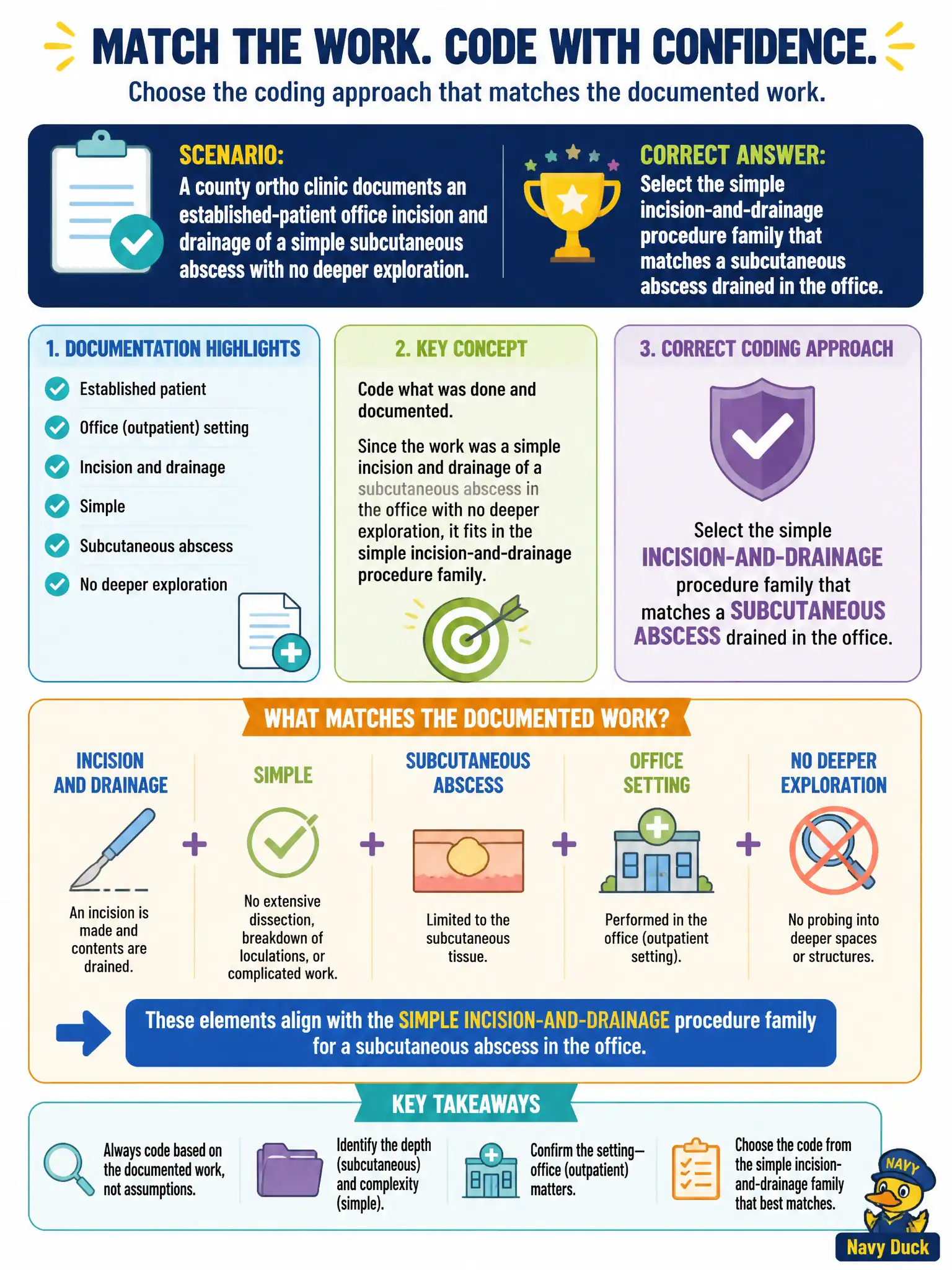
A county ortho clinic documents an established-patient office incision and drainage of a simple subcutaneous abscess with no deeper exploration. Which coding approach best matches the documented work?
Select an answer to reveal the explanation.
Short Explanation
Picture popping a shallow blister versus digging into deep underground pipes. A simple subcutaneous I&D is the shallow job. Match the note’s depth and work to the simple I&D procedure family—don’t upgrade it just because a scalpel showed up.
Full Explanation
For a county ortho clinic incision and drainage of a simple subcutaneous abscess without deeper exploration, professional coding must match documented depth and work. Select the simple incision-and-drainage procedure family that describes office drainage of a subcutaneous abscess. Accurate matching keeps community surgical claims aligned with the service furnished and supports transparent stewardship of public and commercial dollars.
Reporting a complex abscess excision family because any incision automatically qualifies as complex surgery overstates work the note explicitly limited to subcutaneous drainage. Billing only an E/M and never reporting a procedure when I&D is performed erases separately identifiable procedural work that CCS-P expects on the professional claim. Assigning a facility DRG for abscess drainage confuses inpatient facility packaging with physician-office professional-fee coding.
Exam caveat: complexity hinges on documented tissue depth and exploration, not on the mere presence of an incision. Operational check: confirm the note states subcutaneous level without deeper exploration, select the simple I&D family, and ensure place of service and claim type remain professional office—not facility inpatient constructs.