
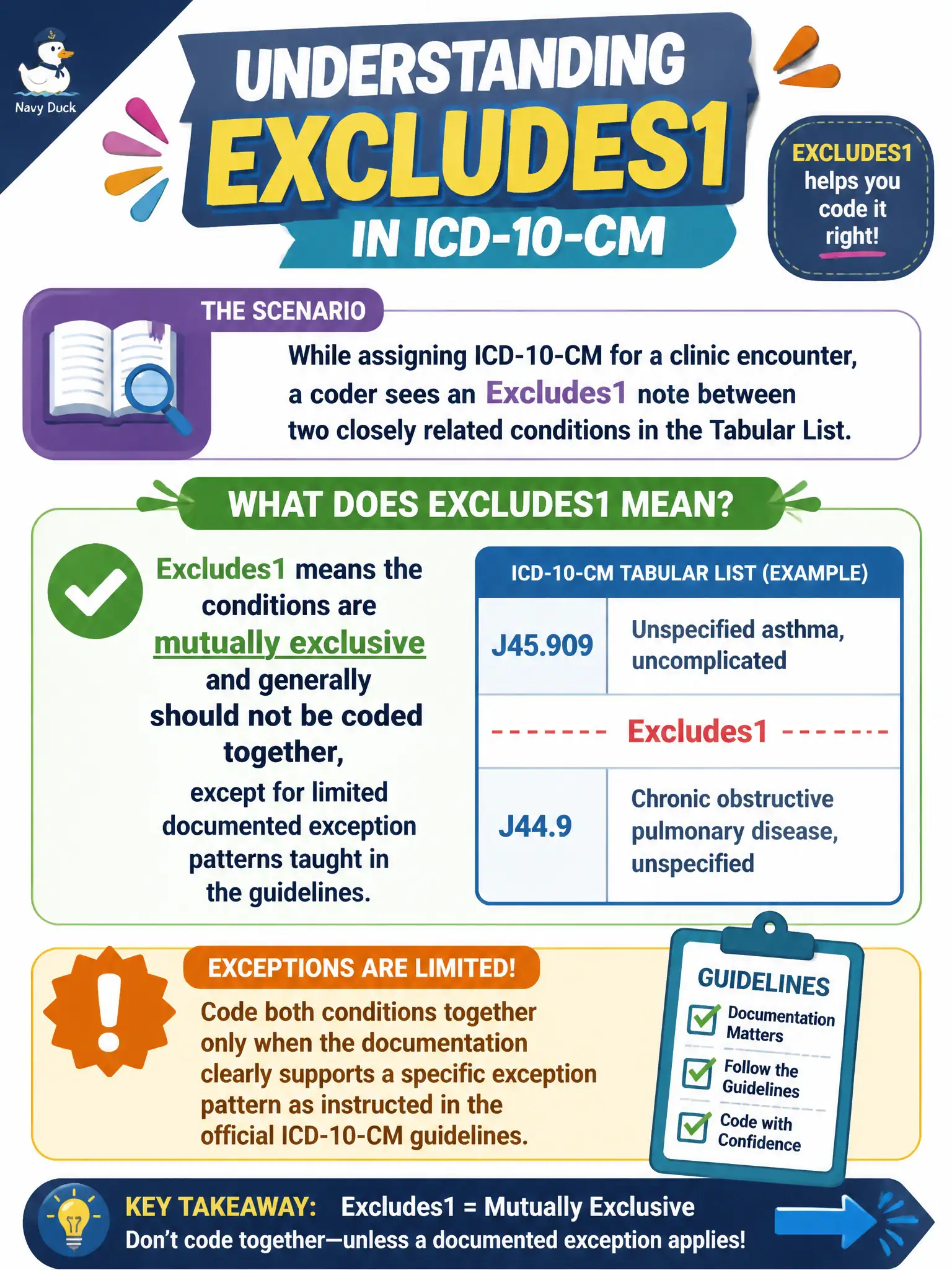
While assigning ICD-10-CM for a clinic encounter, a coder sees an Excludes1 note between two closely related conditions in the Tabular List. What does Excludes1 generally mean for code assignment?
Select an answer to reveal the explanation.
Short Explanation
Excludes1 is the “these two don’t share a seat” rule. Unlike Excludes2, you generally don’t report both—unless you’re in one of those narrow guideline exception lanes the books actually teach.
Full Explanation
Excludes1 notes identify conditions that should not be coded together because they are mutually exclusive or otherwise incompatible for dual reporting, with only limited guideline-recognized exceptions. When a coder sees an Excludes1 note between two closely related conditions in the Tabular List for a clinic encounter, the conditions are mutually exclusive and generally should not be coded together except for those limited documented exception patterns. Believing both codes may always be reported together because Excludes1 means not included here confuses Excludes1 with Excludes2. Treating Excludes1 as advisory only for professional-fee claims fails; instructional notes apply in physician-based coding. Replacing both diagnoses with an external cause code fails; Excludes1 does not convert diagnoses into external causes. Exam caveat: learn the rare guideline exceptions rather than inventing local exceptions. Operational check: when both conditions appear tempting, read the Excludes1 note, choose the code that matches documentation, and do not dual-code prohibited pairs. In civic and community clinic workflows, document the chosen pathway in the coding rationale so auditors can see how the record supported specificity, sequencing, and instructional-note compliance on the professional claim.