
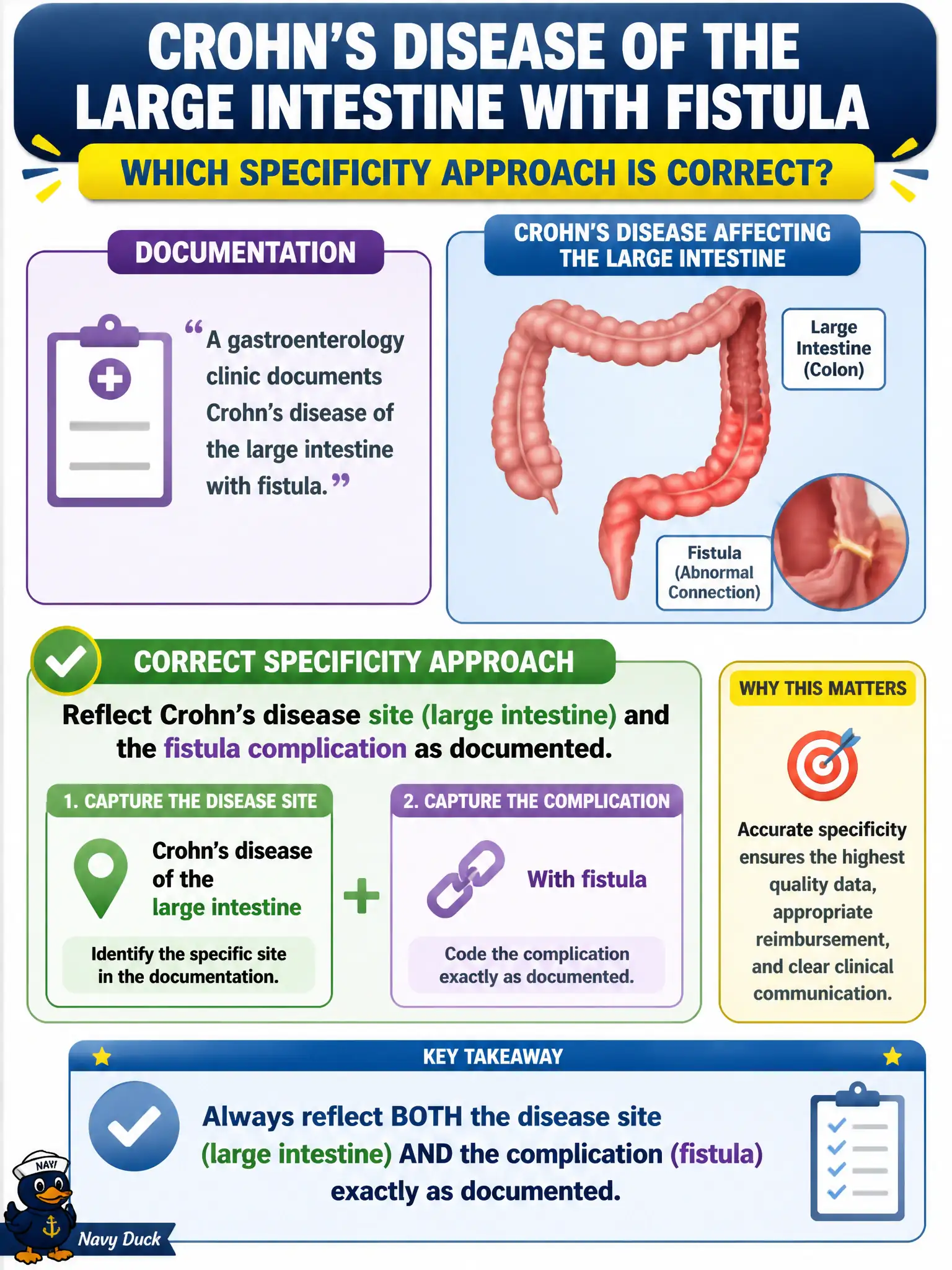
A gastroenterology clinic documents Crohn’s disease of the large intestine with fistula. Which specificity approach is correct?
Select an answer to reveal the explanation.
Short Explanation
Crohn’s coding likes a map pin (where) and the complication badge (fistula). If GI documents large-intestine Crohn’s with fistula, capture both—don’t flatten it to unspecified IBD or swap in ulcerative colitis.
Full Explanation
ICD-10-CM Crohn's categories specify anatomic site and complications such as fistula when documented. When a gastroenterology clinic documents Crohn's disease of the large intestine with fistula, reflect site as large intestine and the fistula complication. Coding unspecified Crohn's and ignoring site and fistula fails available specificity. Coding only the fistula and omitting Crohn's as the underlying condition fails to report the disease driving care. Using ulcerative colitis codes interchangeably with Crohn's when any IBD is present fails; the diseases are distinct families. Exam caveat: additional manifestation codes may apply when instructions require them; verify Tabular notes rather than stopping at site alone. Operational check: confirm large-intestine site and fistula complication, assign Crohn's coding that captures both, and reject unspecified IBD or ulcerative colitis substitutions. In civic and community clinic workflows, document the chosen pathway in the coding rationale so auditors can see how the record supported specificity, sequencing, and instructional-note compliance on the professional claim. Retain civic clinic, community health, and physician-office framing in the coding rationale so the professional claim reflects ambulatory CCS-P practice rather than facility-only habits.