
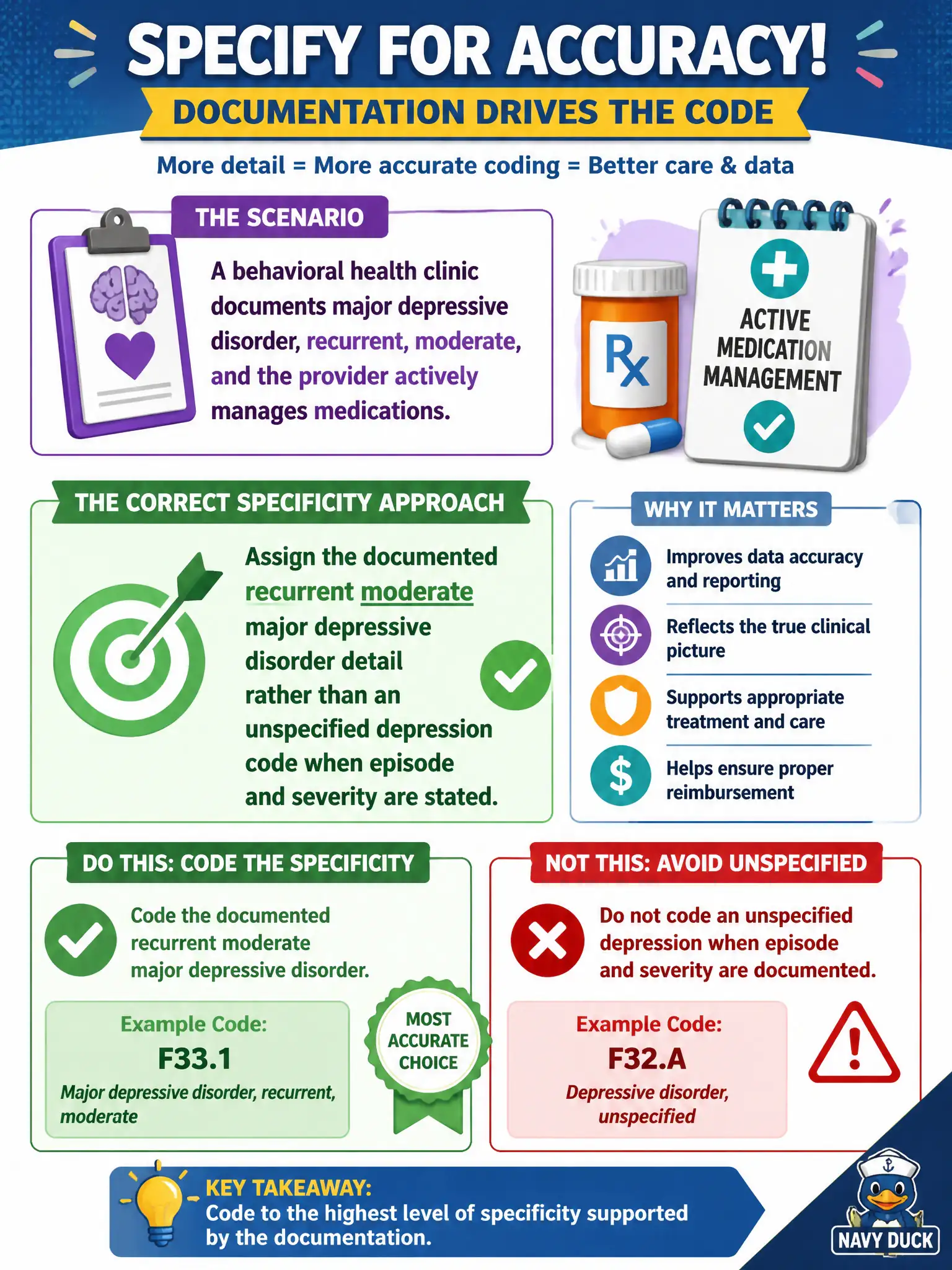
A behavioral health clinic documents major depressive disorder, recurrent, moderate, and the provider actively manages medications. What is the correct specificity approach?
Select an answer to reveal the explanation.
Short Explanation
If the note already tells you recurrent and moderate, don't throw that detail in the trash for a vague 'depression NOS' code. Specificity is free information—use the episode and severity the provider wrote.
Full Explanation
ICD-10-CM requires coding to the highest specificity supported by the documentation. When a behavioral health clinic documents major depressive disorder, recurrent, moderate, with active medication management, assign the recurrent moderate major depressive disorder detail rather than an unspecified depression code. Always using unspecified depressive disorder because behavioral health supposedly prohibits severity fails: severity and episode type are valid axes in the classification when documented and are reportable on professional claims. Coding single-episode mild depression only because medications are managed fails; medication management does not reset documented episode type or severity. Reporting adjustment disorder instead of depression whenever medications are prescribed fails without documentation of adjustment disorder—drug therapy does not redefine the diagnosis family. Exam caveat: if the note is truly vague, unspecified may be appropriate, but specificity already stated in the assessment must not be discarded for coder convenience. Operational check: extract episode (single versus recurrent) and severity (mild, moderate, severe, with or without psychotic features as documented), match that statement in code selection, and avoid substituting a different mood or adjustment category without support.