
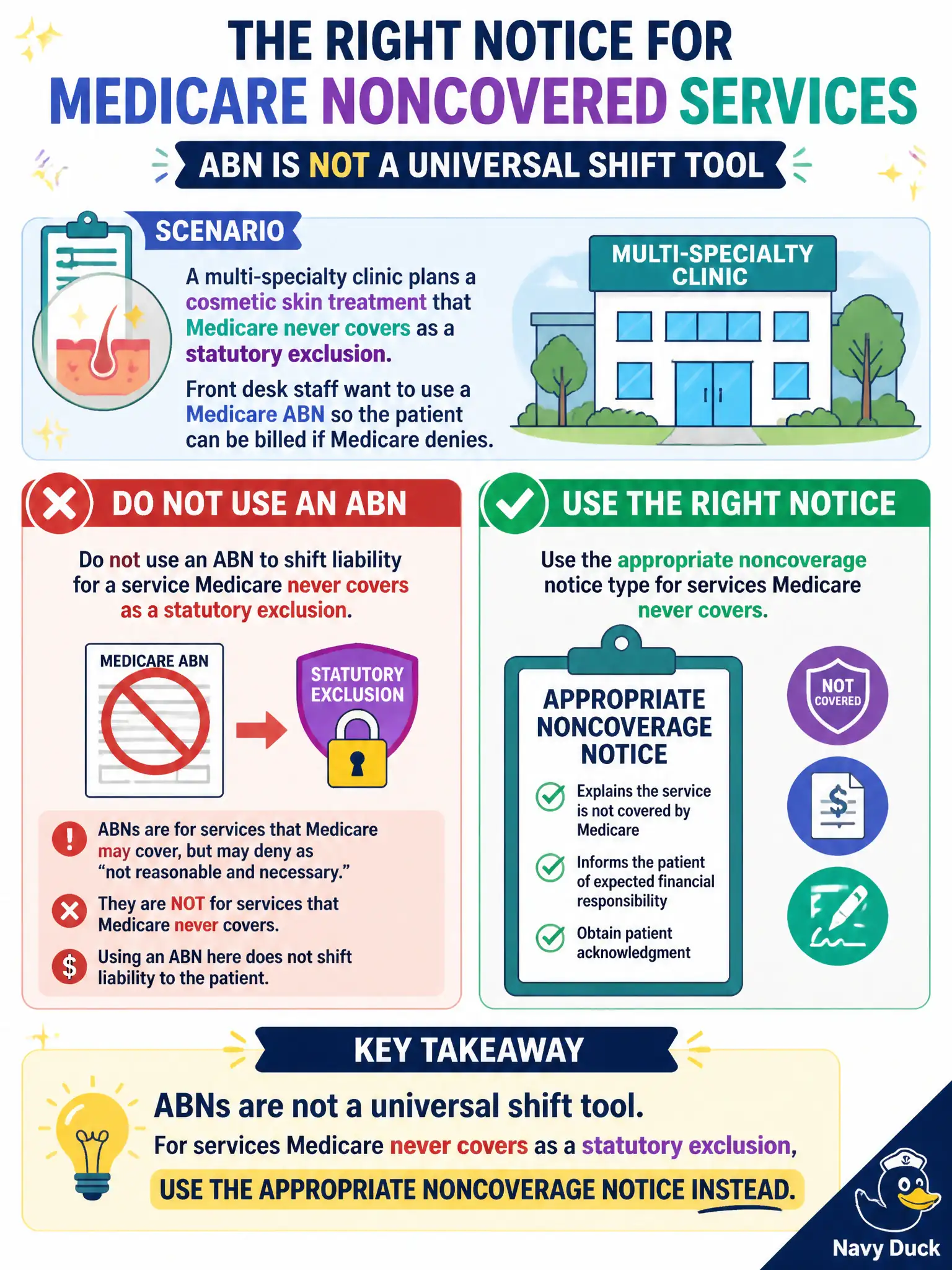
A multi-specialty clinic plans a cosmetic skin treatment that Medicare never covers as a statutory exclusion. Front desk staff want to use a Medicare ABN so the patient can be billed if Medicare denies. What is the correct notice approach?
Select an answer to reveal the explanation.
Short Explanation
An ABN is not a blank check to dump every noncovered bill on the patient. If Medicare never covers something by statute—like many cosmetic services—you need the right noncoverage notice, not an ABN dressed up as a cost-shift tool. Match the notice to the reason Medicare will not pay.
Full Explanation
Services Medicare never covers as statutory exclusions—such as many cosmetic skin treatments—are not shifted to patient liability through a standard ABN as if they were ordinary medical-necessity denials. The correct notice approach in a multi-specialty civic clinic is to use the appropriate noncoverage notice type for statutory exclusions rather than treating the ABN as a universal cost-shift tool. Matching notice type to noncoverage reason protects beneficiaries from misleading paperwork and keeps professional-fee collections compliant.
Issuing a standard ABN for every noncovered service including statutory exclusions fails by concept because ABN use is reason-specific, not universal. Skipping any notice because statutory exclusions never require patient communication fails because patients still need clear advance communication using the correct notice vehicle. Using an ABN only after Medicare denies and then billing the patient fails both timing and notice-type rules for services that were never covered.
Exam caveat: CMS distinguishes voluntary ABNs, mandatory ABNs, and other noncoverage notices; cosmetic statutory exclusions generally call for the non-ABN notice pathway rather than a forced ABN. Operational check: maintain a quick-reference for exclusion versus medical-necessity scenarios, stock the correct forms, and train front desk not to default every noncover risk to an ABN.