
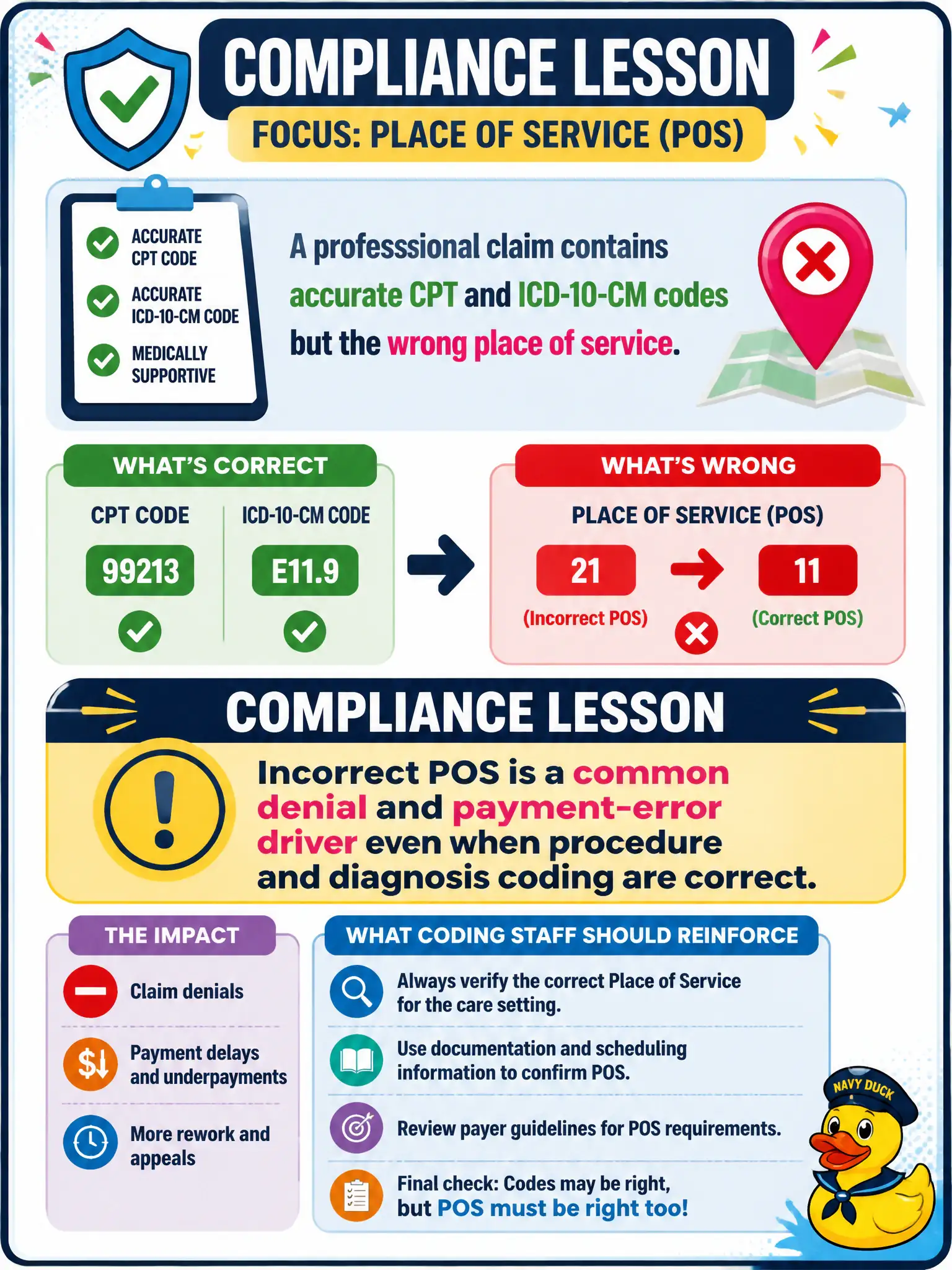
A professional claim contains accurate CPT and ICD-10-CM codes but the wrong place of service. What compliance lesson should coding staff reinforce?
Select an answer to reveal the explanation.
Short Explanation
Right codes, wrong doorway—and the claim still bounces. POS is part of the clean-claim package, not a decorative field. Treat setting accuracy like diagnosis accuracy.
Full Explanation
Accurate CPT and ICD-10-CM coding do not rescue a professional claim that carries the wrong place of service. Incorrect POS is a common denial and payment-error driver because payers use setting to adjudicate site-of-service differentials, coverage edits, and claim validity on CMS-1500 submissions. Coding staff in county and community physician practices should reinforce that POS is part of the clean-claim package equal in importance to procedure and diagnosis accuracy for public-program stewardship.
Assuming payers ignore POS whenever modifiers are present fails by concept because modifiers do not nullify setting requirements. Claiming POS errors matter only on UB-04 facility claims fails because professional claims also require correct POS. Hard-coding office POS on every claim for speed fails because it systematically misreports hospital clinics, ASCs, NFs, and other sites and invites recoupments.
Exam caveat: some edits are soft (payment differentials) and others hard (rejects); either way, wrong POS is a compliance and revenue-integrity issue, not a cosmetic field. Operational check: include POS in claim scrubbing rules, reconcile appointment location to POS before drop to payer, and trend denials coded as invalid or inconsistent place of service.