
A public-health clinic network has multiple equal-cost transport LSPs between PEs carrying VPN traffic. How does ECMP typically behave for that MPLS VPN load sharing?
Select an answer to reveal the explanation.
Short Explanation
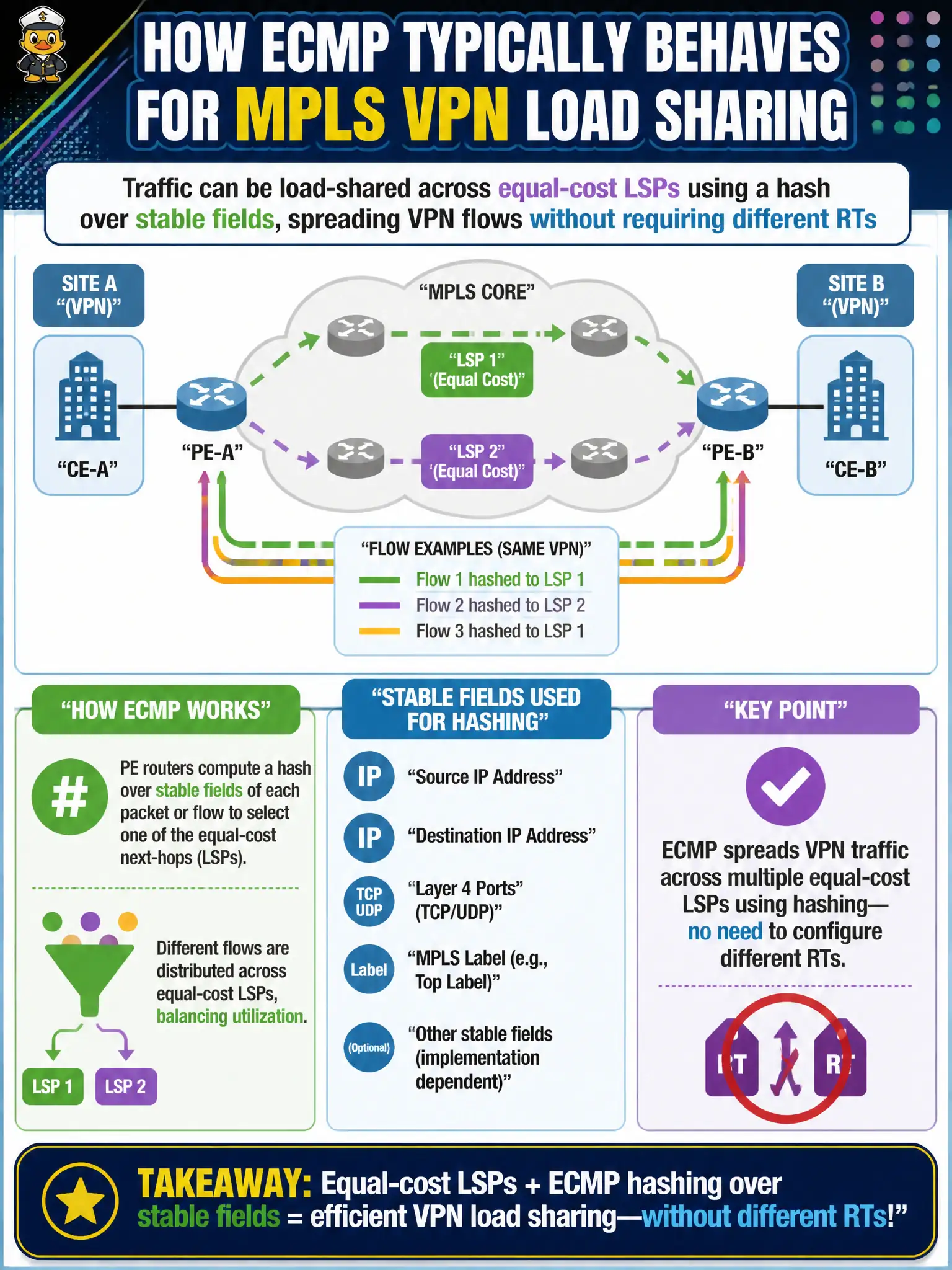
Equal-cost LSPs are multiple lanes on the same highway between PEs. Hash the flow onto a lane and VPN traffic spreads out — no need to invent extra RTs just for load sharing. Pinning everything to one LSP wastes the parallel paths the underlay already built.
Full Explanation
When the underlay offers multiple equal-cost labeled paths between PEs, platforms can ECMP VPN traffic across those LSPs using a hash over stable packet fields. For a public-health clinic network, that spreads VPN flows across parallel transport LSPs without requiring different route targets simply to achieve load sharing. ECMP uses the paths the IGP/LDP (or SR) already built.
Requiring all VPN packets for every prefix to pin to a single LSP so PHP remains deterministic wastes equal-cost capacity. Claiming the PE ignores equal-cost paths and always prefers the highest LDP label value invents a preference rule that is not how ECMP works. Saying ECMP is available only inside VRFs and never on labeled transport paths misplaces multipath behavior.
Exam caveat: RT design shapes VPN membership; ECMP over LSPs is an underlay multipath forwarding behavior—do not conflate them.
Operational check: confirm equal-cost LSPs between clinic PEs, verify hash-based sharing in CEF/hardware, generate diverse flows, and ensure no single LSP carries unintended pin-down unless policy demands it. For civic operations, record the chosen control and the rejected alternatives in the change record so future on-call engineers understand which failure modes were avoided for citizen-facing services.