
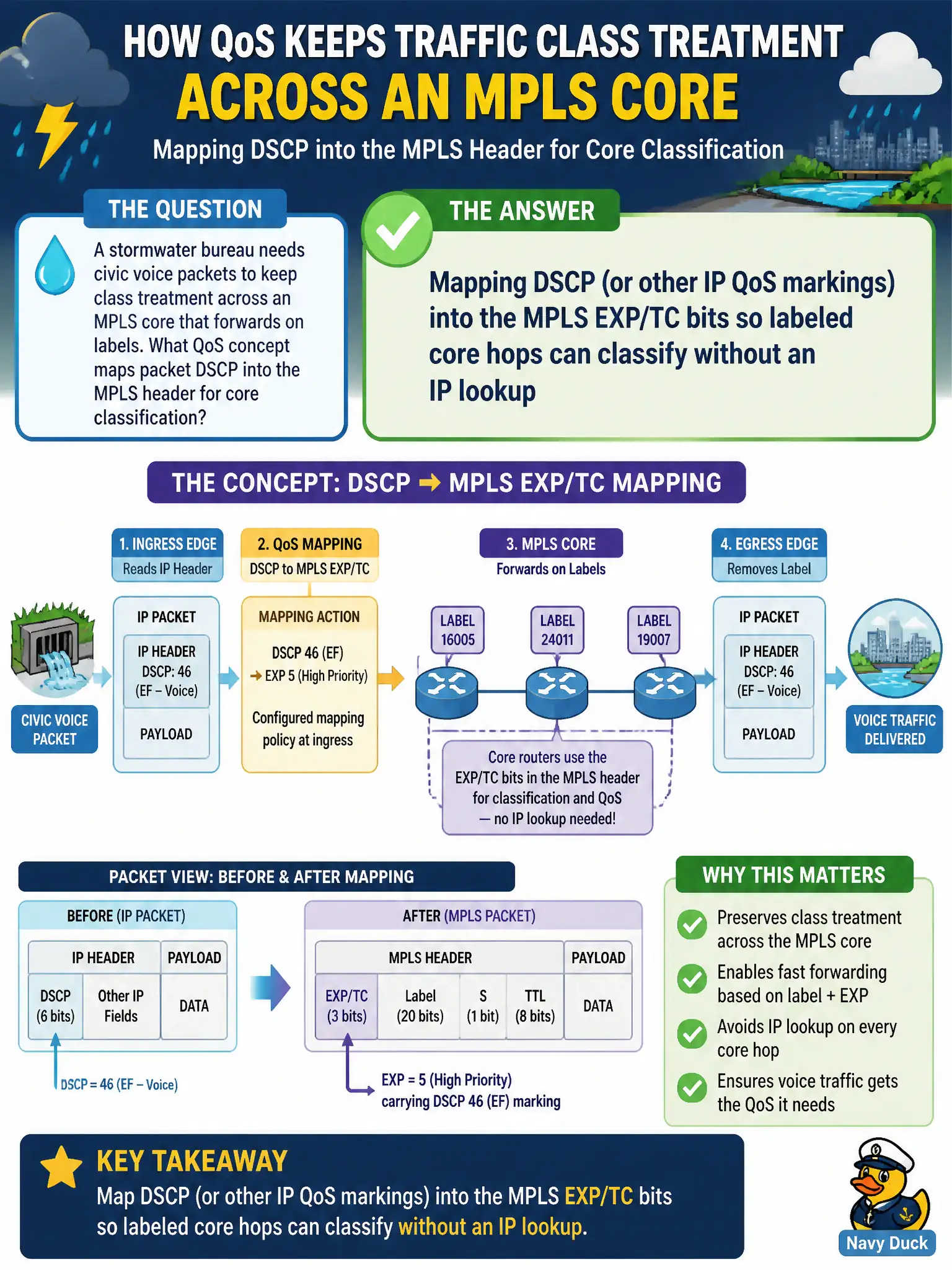
A stormwater bureau needs civic voice packets to keep class treatment across an MPLS core that forwards on labels. What QoS concept maps packet DSCP into the MPLS header for core classification?
Select an answer to reveal the explanation.
Short Explanation
Once the packet is labeled, the core often never peeks at IP DSCP again — so you pipe that marking into the EXP/TC bits at imposition. Think of EXP as the colored sticker on the shipping label that voice wears across the stormwater MPLS cloud.
Full Explanation
MPLS QoS commonly maps IP DSCP (or equivalent markings) into the 3-bit EXP/Traffic Class field at label imposition so P routers can classify and queue labeled packets without an IP deep inspection. That mapping lets a stormwater bureau preserve civic voice class treatment across a core that forwards on labels rather than looking up DSCP at every hop.
Copying the entire IPv6 flow label into the VPN label so P routers read application ports is not how MPLS QoS marking works. Stripping DSCP at the ingress PE because EXP is assigned randomly per LSP for load balancing destroys intentional class treatment. Using route distinguishers to encode voice versus data so RT policy provides QoS confuses VPN membership with PHB marking.
Exam caveat: DSCP-to-EXP/TC at imposition is the conceptual bridge between IP QoS and labeled cores—keep PHBs consistent through the LSP.
Operational check: define DSCP-to-EXP policy on stormwater PEs, verify EXP on labeled voice packets, confirm queueing on P hops, and retest after any remarking changes at edges. For civic operations, record the chosen control and the rejected alternatives in the change record so future on-call engineers understand which failure modes were avoided for citizen-facing services.