
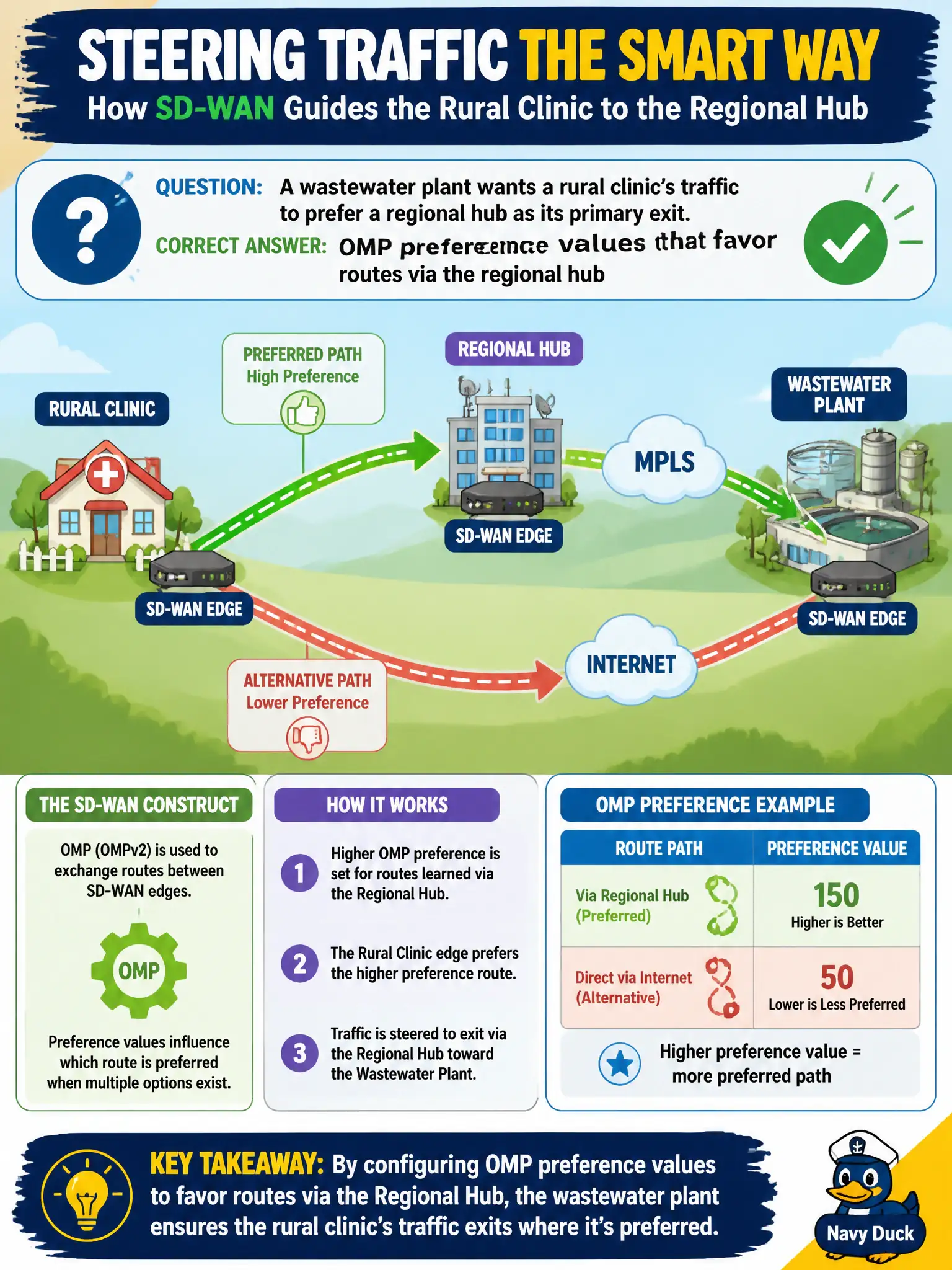
A wastewater plant wants a rural clinic’s traffic to prefer a regional hub as its primary exit. Which SD-WAN construct commonly steers that preference?
Select an answer to reveal the explanation.
Short Explanation
If the clinic should leave through the regional hub, tell OMP which path you like better. Preference is the overlay’s way of saying “use this exit first.” STP and vBond VRRP aren’t the steering knobs for that job.
Full Explanation
OMP route preference is a primary overlay mechanism for influencing which advertised path an Edge prefers, including steering a rural clinic’s traffic to exit via a regional hub preferred by a wastewater plant design. Raising preference on hub-advertised routes makes that exit win in the OMP decision process without misusing LAN switching or orchestrator gadgets as WAN steering knobs. The result is intentional primary-hub behavior with defined failover.
Spanning Tree priority on the service-VPN LAN switch affects L2 topology inside the site, not OMP hub exit selection across the WAN. VRRP on vBond does not elect a data-plane hub for application traffic—vBond is an orchestrator for fabric bring-up. Lowering BFD multipliers only on a non-preferred color changes failure-detection timing; it is not the intentional primary-hub preference control by itself.
Exam caveat: preference and related TLOC preference style controls steer overlay path choice; BFD is for liveliness, and STP is for LAN switching domains.
Operational check: set OMP preference to favor the regional hub, confirm the clinic Edge installs that path as best, fail the preferred exit in a maintenance window, verify orderly failover and restoration, and document the preference values in the design record.