
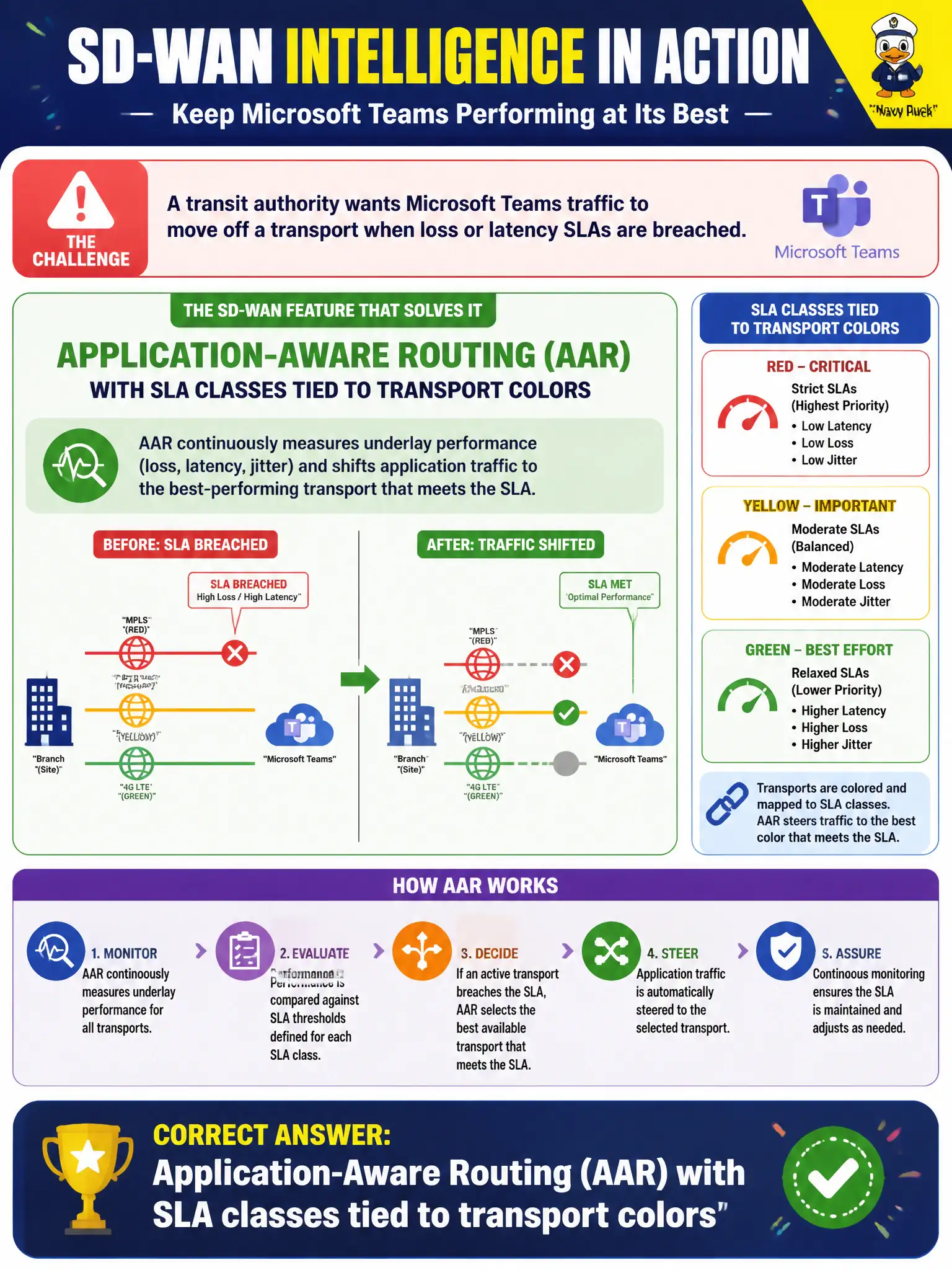
A transit authority wants Microsoft Teams traffic to move off a transport when loss or latency SLAs are breached. Which SD-WAN feature measures underlay performance and can shift application traffic accordingly?
Select an answer to reveal the explanation.
Short Explanation
AAR is the ride-share app for packets: it watches loss and latency on each colored road and moves Teams when a path turns ugly. Waiting for a hard circuit down—or turning BFD off—means riders suffer through the brownout. VTP pruning and NAT on vBond are not application SLA tools.
Full Explanation
A transit authority wanting Microsoft Teams to leave a transport when loss or latency SLAs breach should use Application-Aware Routing with SLA classes tied to transport colors. AAR measures underlay performance and can shift matching application traffic to complying colors—ideal for civic UC/collaboration quality.
VTP pruning across the underlay provider core is a campus VLAN pruning feature, not SD-WAN SLA steering.
Static NAT overload on the vBond interface only affects onboarding address translation, not Teams path selection.
Disabling BFD so brownouts are ignored until hard-fail removes liveliness signals AAR and TLOC health rely on.
Exam caveat: AAR needs correct app classification plus realistic SLA thresholds—too tight causes flapping; too loose never switches.
Operational check: define Teams in an AAR policy with loss/latency SLAs, simulate brownout on one color, and confirm switchover. Document SLA classes in the transit UC SD-WAN guide. In municipal operations, record the rationale in the change ticket so future on-call staff know which control was chosen and which failure modes the rejected options would create for city services. Re-validate after the next maintenance window that the same control still holds under the platform code and policy revisions used by the civic network team.