
A township board wants SCADA traffic to prefer MPLS while guest traffic prefers Internet across the SD-WAN overlay. Which policy type primarily influences that overlay pathing from the controllers?
Select an answer to reveal the explanation.
Short Explanation
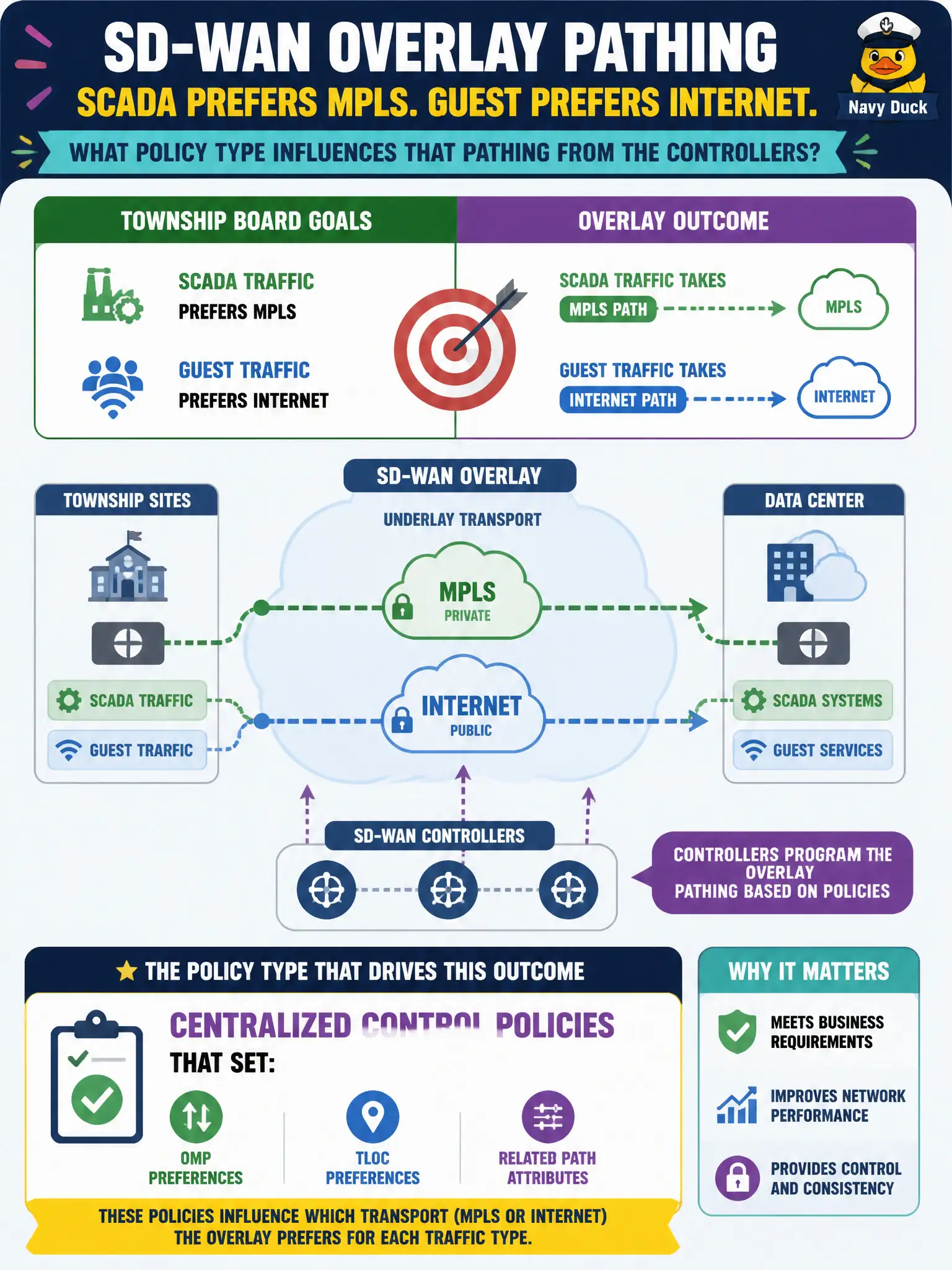
Centralized control policy is the city planner drawing preferred roads on the overlay map—SCADA on MPLS, guests on Internet—pushed from the controllers. Storm-control on a museum port and ISP IS-IS tweaks are different layers of the problem. DHCP pools do not steer overlay colors.
Full Explanation
A township board wanting SCADA to prefer MPLS while guest prefers Internet across SD-WAN should use centralized control policies that set OMP preferences, TLOC preferences, or related path attributes. Those controller-distributed policies are the primary lever for overlay pathing intent from vSmart.
Only a switchport storm-control setting on museum access ports is an L2 access rate limiter unrelated to SD-WAN overlay preference.
Underlay IS-IS metric changes inside the ISP cloud that Edges cannot see are outside the SD-WAN policy plane the operators control.
Localized DHCP option pools on each Edge with no control policy assign addresses; they do not steer SCADA versus guest overlay paths.
Exam caveat: control policy (OMP/TLOC attributes) differs from data policy (packet steering/app firewalling)—pick the right policy type for the intent.
Operational check: deploy centralized control policy preferring mpls for SCADA VPN/app and biz-internet for guest, then traceroute/verify TLOC choice. Store policy intent in the township SD-WAN policy catalog. In municipal operations, record the rationale in the change ticket so future on-call staff know which control was chosen and which failure modes the rejected options would create for city services. Re-validate after the next maintenance window that the same control still holds under the platform code and policy revisions used by the civic network team.