
An election office SD-Access fabric must hand off traffic to a traditional WAN edge that is not fabric-aware. Which border design provides IP connectivity without requiring the WAN edge to understand fabric overlays?
Select an answer to reveal the explanation.
Short Explanation
Non-fabric gear is like a county road that never learned the fabric’s private street names. IP transit at the border translates fabric destinations into ordinary IP routes the WAN edge already understands. You do not bolt LISP or VXLAN onto that traditional box just to get packets out.
Full Explanation
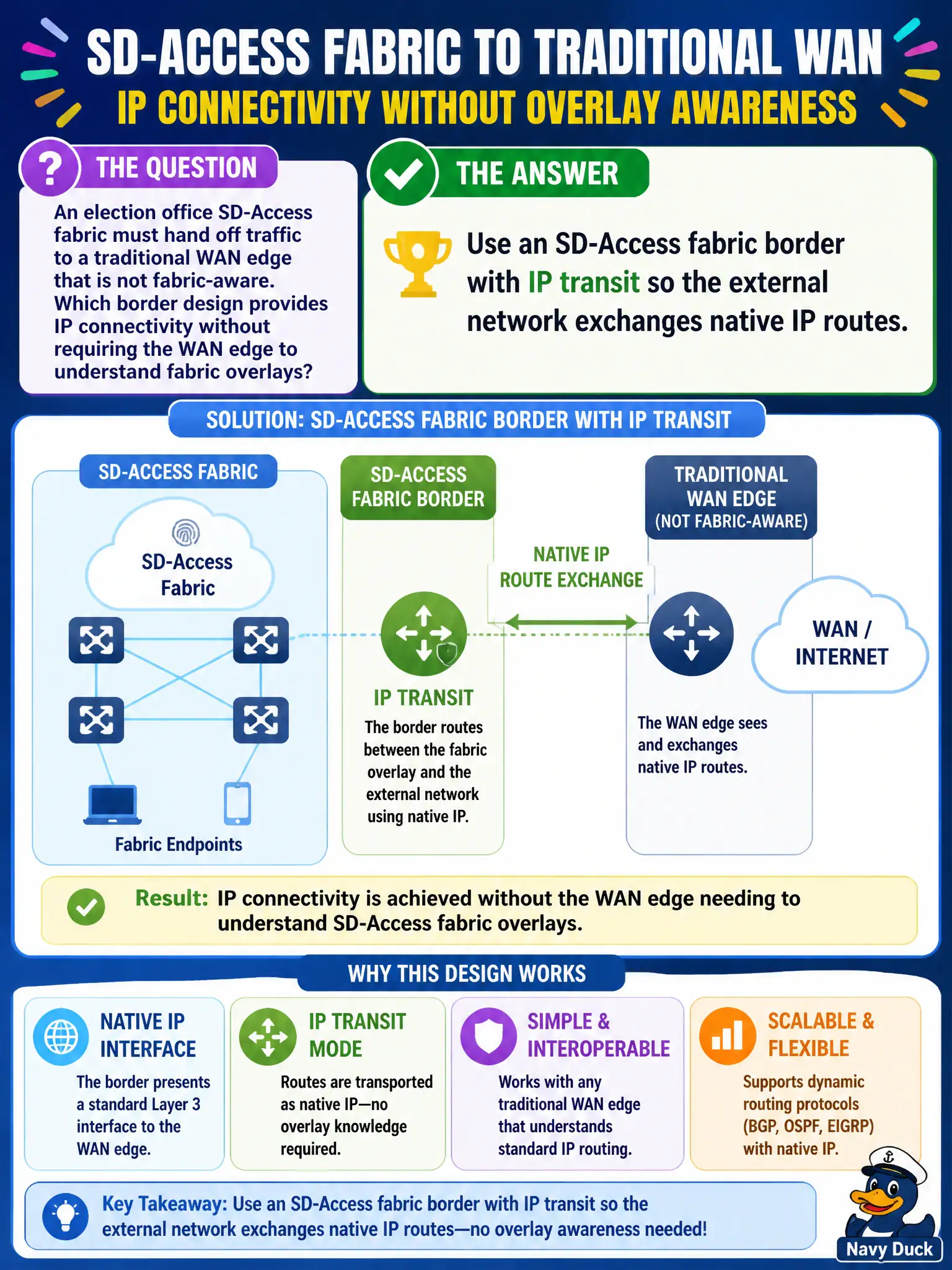
An election-office SD-Access fabric handing traffic to a traditional WAN edge that is not fabric-aware should use a fabric border with IP transit so the external network exchanges native IP routes. The WAN edge need not understand LISP/VXLAN; the border de-encapsulates and routes classic IP toward the WAN.
Extending LISP map-cache and VXLAN VTEP state onto the non-fabric WAN edge forces fabric awareness the stem says the WAN edge lacks.
Forcing every WAN packet through an SGT-only path with no IP routing is not a viable WAN handoff model.
Replacing the WAN edge with a wireless WLC so CP nodes peer over CAPWAP misuses wireless control plane for WAN routing.
Exam caveat: IP transit still needs careful VRF/VN to WAN VRF mapping and routing protocol choice at the border.
Operational check: configure border IP transit toward the WAN edge, verify route exchange, and test polling-site applications across the WAN. Document the handoff in the election network WAN interconnect diagram. In municipal operations, record the rationale in the change ticket so future on-call staff know which control was chosen and which failure modes the rejected options would create for city services. Re-validate after the next maintenance window that the same control still holds under the platform code and policy revisions used by the civic network team.