
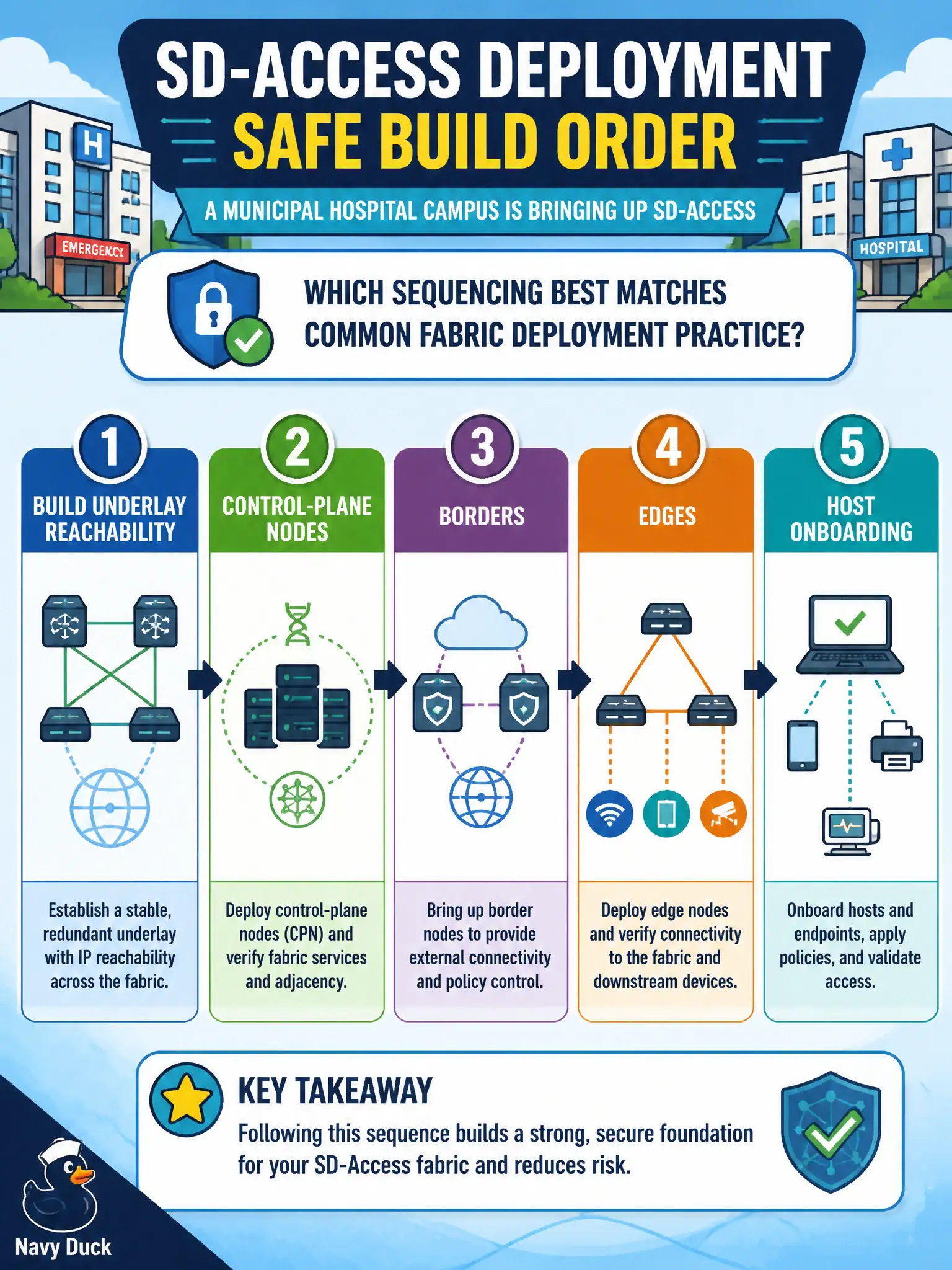
A municipal hospital campus is bringing up SD-Access and wants a safe build order. Which sequencing best matches common fabric deployment practice?
Select an answer to reveal the explanation.
Short Explanation
You do not hang patient monitors before the walls and wiring exist. Stand up the underlay roads, then the LISP phone books (control plane), then doors to the outside (borders), then access edges, and only then walk hosts onboard. That order keeps the hospital fabric from collapsing mid-build.
Full Explanation
A municipal hospital bringing up SD-Access safely should follow a common sequence: build underlay reachability, then control-plane nodes, then borders, then edges, then host onboarding. That order ensures mapping services and external handoffs exist before production endpoints arrive on clinical networks.
Onboarding production hosts first, then creating borders, then inventing an underlay from leftover VLANs reverses dependencies and risks outages.
Configuring only wireless fabric features before any underlay routing exists skips the IP underlay prerequisite.
Deploying external Internet borders before any control-plane or edge capability is present leaves borders without a coherent fabric to serve.
Exam caveat: small sites may collocate roles, but logical sequencing (underlay → CP → border → edge → hosts) still applies.
Operational check: gate each hospital build phase on show/Assurance checks for the prior layer before enabling the next. Keep the sequenced checklist in the clinical network cutover binder. In municipal operations, record the rationale in the change ticket so future on-call staff know which control was chosen and which failure modes the rejected options would create for city services. Re-validate after the next maintenance window that the same control still holds under the platform code and policy revisions used by the civic network team.