
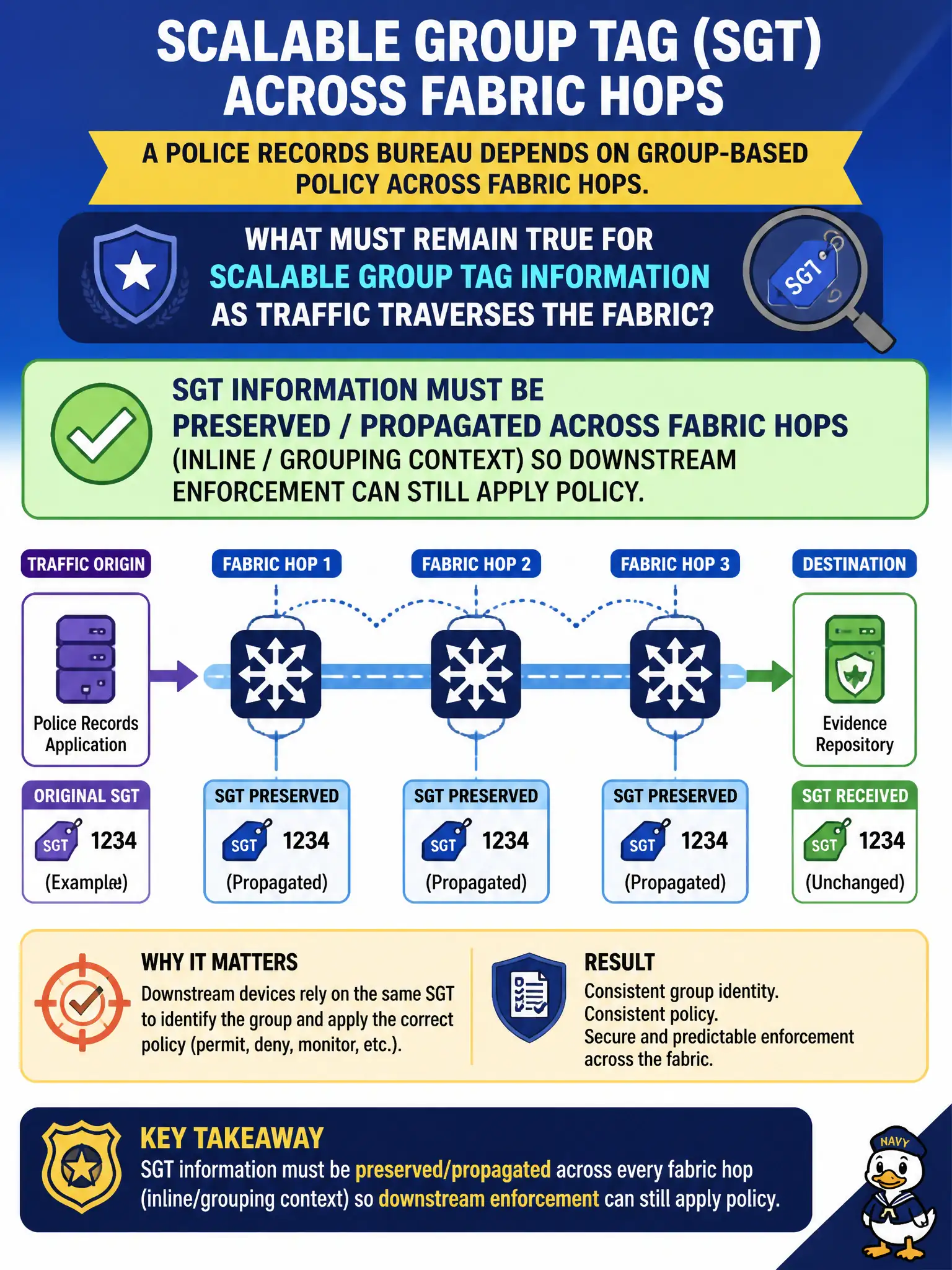
A police records bureau depends on group-based policy across fabric hops. What must remain true for Scalable Group Tag information as traffic traverses the fabric?
Select an answer to reveal the explanation.
Short Explanation
A badge only helps if every door along the hallway can still read it. In fabric, SGT context has to ride along through the hops so the far side can enforce group policy. If you strip the tag at the first edge, downstream enforcement is flying blind.
Full Explanation
A police records bureau depending on group-based policy across fabric hops must keep Scalable Group Tag information preserved/propagated across those hops (inline or equivalent grouping context) so downstream enforcement can still apply policy. If SGTs vanish mid-path, east-west controls fail even when VNs are correct.
SGTs stripped at the first edge and replaced with DSCP alone lose group identity; DSCP is QoS marking, not a TrustSec group substitute for GBAC.
SGTs applying only on wireless and never carried for wired fabric endpoints invents a media-type limitation that breaks wired enforcement.
SGTs stored only in underlay OSPF opaque LSAs and never in the overlay path misplace SGT transport into the underlay IGP.
Exam caveat: know whether your path uses inline tagging, SXP, or platform-specific propagation—and verify mixed wired/wireless paths.
Operational check: generate a flow with a known source SGT across multiple fabric hops and confirm downstream enforcement still sees the tag/group. Document propagation method in the police TrustSec fabric guide. In municipal operations, record the rationale in the change ticket so future on-call staff know which control was chosen and which failure modes the rejected options would create for city services. Re-validate after the next maintenance window that the same control still holds under the platform code and policy revisions used by the civic network team.