
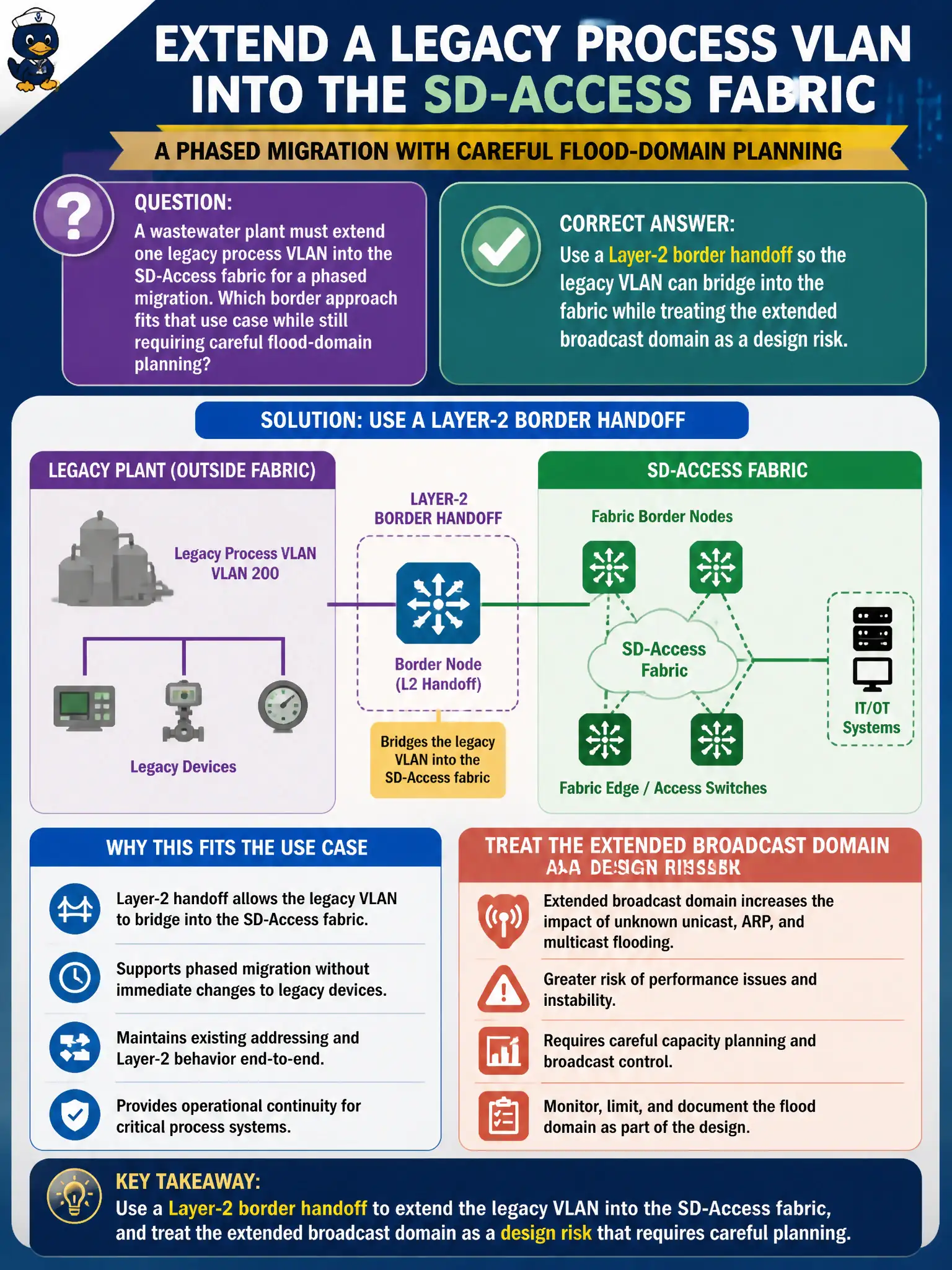
A wastewater plant must extend one legacy process VLAN into the SD-Access fabric for a phased migration. Which border approach fits that use case while still requiring careful flood-domain planning?
Select an answer to reveal the explanation.
Short Explanation
Think of the plant VLAN like an old wing you temporarily connect to a new building—you need a real Layer-2 doorway, not just a routed hallway. An L2 border handoff bridges that legacy VLAN into the fabric so endpoints can keep talking during migration. The catch is you also dragged the flood domain along, so keep that broadcast blast radius on a short leash.
Full Explanation
A wastewater plant extending one legacy process VLAN into SD-Access for phased migration should use a Layer-2 border handoff so the VLAN can bridge into the fabric while the extended segment is treated carefully for broadcast domain scope. That preserves OT addressing during migration without forcing an overnight L3 redesign of every controller.
Advertising only the process subnet into every fabric VN with no Layer-2 adjacency at the border is an L3/macro approach that does not extend the legacy VLAN broadcast domain as requested.
Converting every plant switch into a control-plane node so LISP replaces Spanning Tree for that VLAN misassigns roles and oversimplifies STP/L2 extension behavior.
Disabling VXLAN on the edges and spanning the plant VLAN across the underlay IGP as transit collapses overlay back into underlay VLAN sprawl—the opposite of fabric migration discipline.
Exam caveat: L2 handoff enlarges the broadcast domain—apply aggressively only for migration windows and plan L3 segmentation exit criteria.
Operational check: enable L2 border handoff for the process VLAN, confirm MAC/endpoint learning across the extension, and monitor broadcast rates. Record the migration VLAN ID and sunset date in the plant OT network plan.