
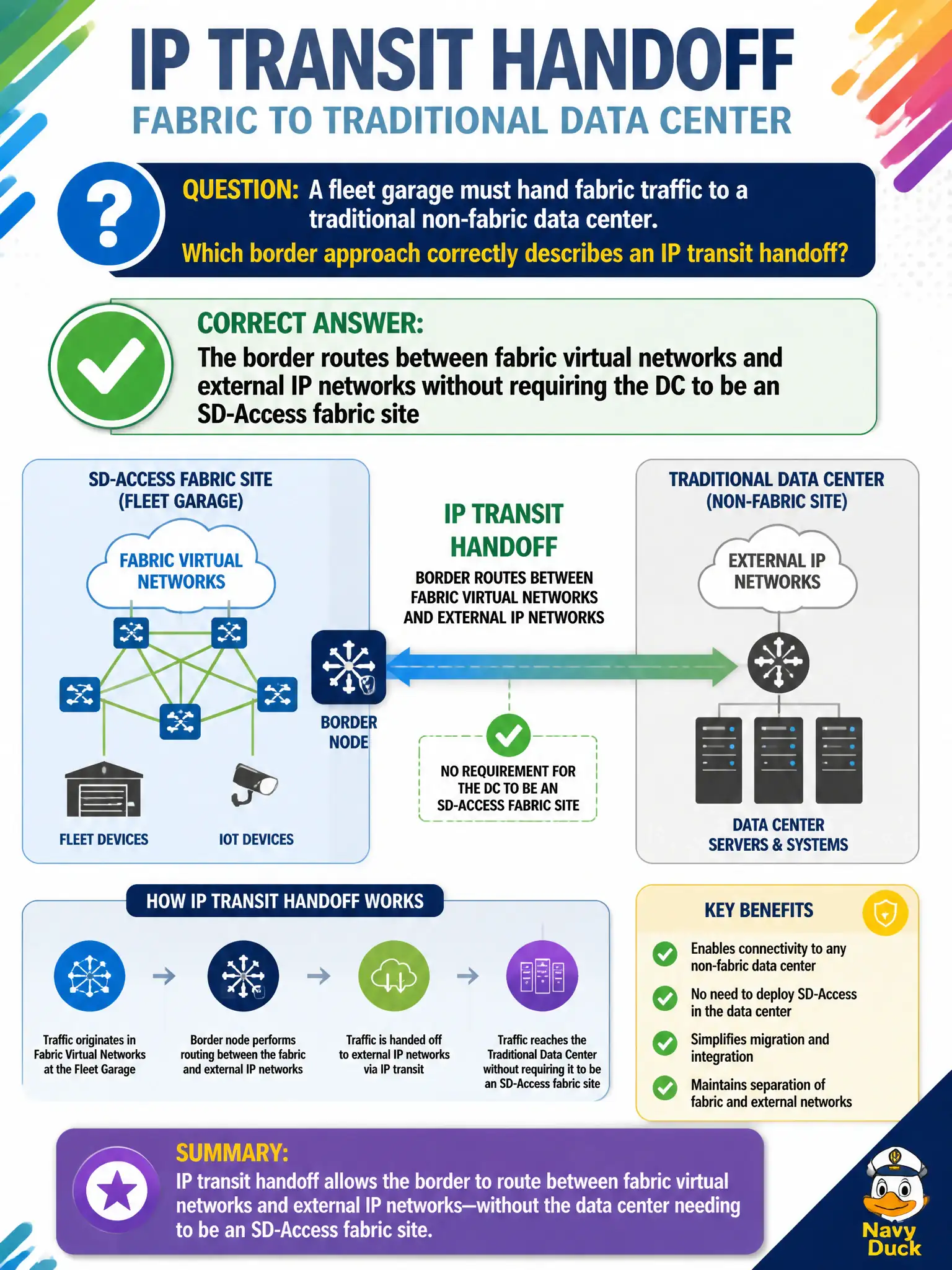
A fleet garage must hand fabric traffic to a traditional non-fabric data center. Which border approach correctly describes an IP transit handoff?
Select an answer to reveal the explanation.
Short Explanation
IP transit is the loading dock where fabric trucks transfer cargo onto ordinary IP roads into a classic DC. The DC doesn’t have to speak full SD-Access—just IP routing at the border. Don’t confuse that with stretching L2 or building fabric transit between two fabric sites.
Full Explanation
When a fleet garage must hand fabric traffic to a traditional non-fabric data center, the border uses IP transit: it routes between fabric virtual networks and external IP networks without requiring the DC to become an SD-Access fabric site. That Layer-3 handoff is the standard way civic fabrics reach legacy DC subnets.
Requiring the data center to run LISP map-servers for every garage endpoint for IP transit invents an overlay control-plane obligation the external DC does not need for pure IP handoff.
Equating IP transit with L2 handoff that extends the same broadcast domain unbroken confuses L3 IP transit with Layer-2 border extension.
Claiming only fabric transit can reach non-fabric networks, with IP transit reserved for wireless guests, misstates handoff options and use cases.
Exam caveat: choose IP vs L2 vs fabric transit based on whether you need routed boundaries, extended VLANs, or fabric-to-fabric interconnection—each solves a different problem.
Operational check: configure border IP transit toward the DC, verify VN-to-external route exchange, and test application flows from a garage endpoint to a DC server. Document handoff type and VRFs in the fleet/DC interconnection diagram.