
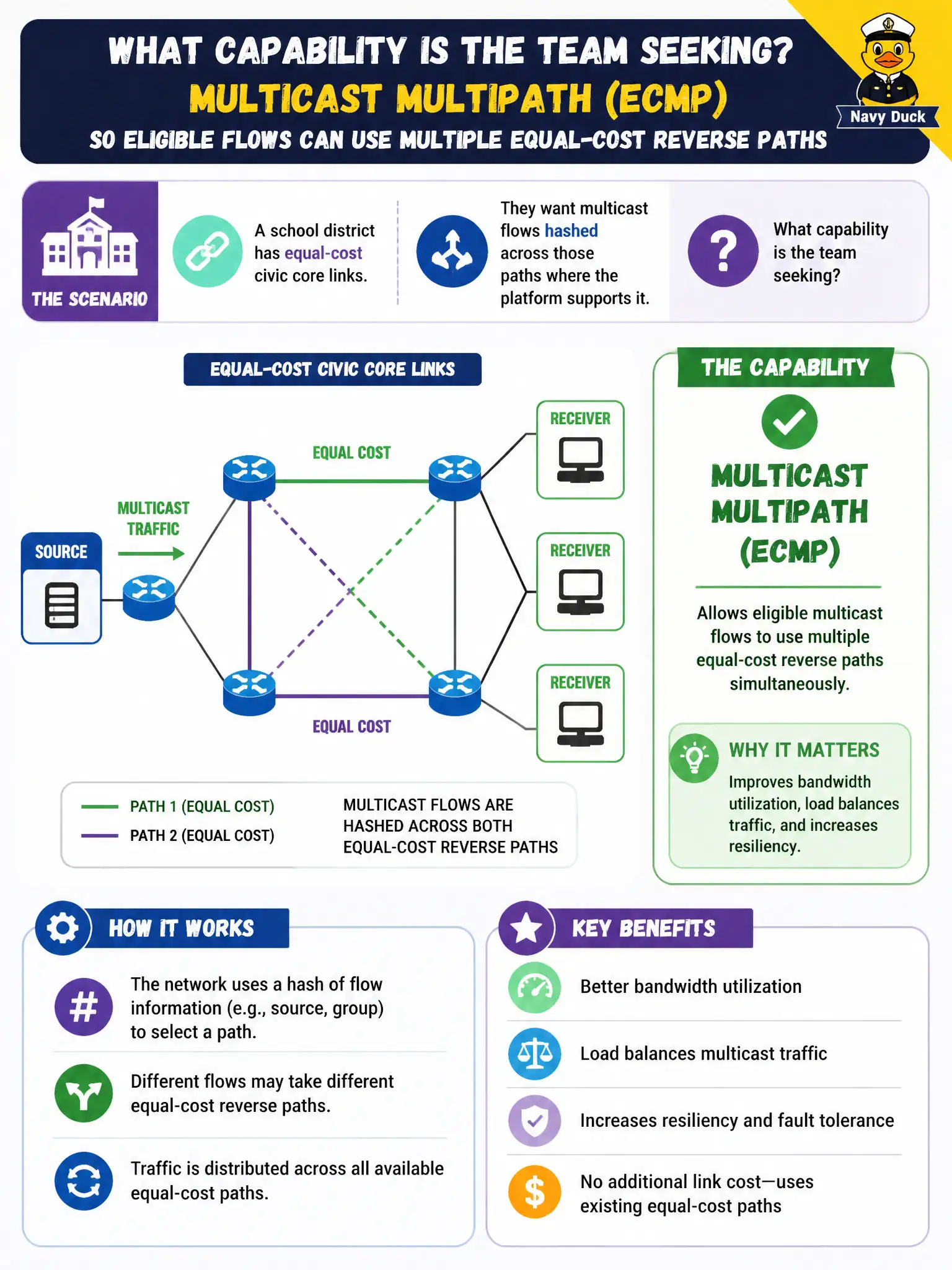
A school district has equal-cost civic core links and wants multicast flows hashed across those paths where the platform supports it. What capability is the team seeking?
Select an answer to reveal the explanation.
Short Explanation
Unicast already loves equal-cost links; multicast can too when the OS supports multipath RPF hashing. Instead of every stream stampeding down one fiber, flows can spread across the bundle. Check platform support—then turn on multicast multipath thoughtfully.
Full Explanation
A school district with equal-cost civic core links that wants multicast flows hashed across those paths is seeking multicast multipath (multicast ECMP). When the platform supports it, the router can consider multiple equal-cost reverse paths and load-share eligible multicast flows instead of pinning every stream to a single RPF interface. That improves utilization on parallel core fibers carrying classroom and district media groups.
Strict unicast-only ECMP with multicast pinned to a single RPF interface always is often the default behavior and is exactly what the team is trying to move beyond.
Bidir-PIM DF election that forbids more than one forwarding interface per LAN addresses designated forwarder selection on a shared segment, not hashing across equal-cost core RPF paths.
IGMP querier redundancy using HSRP alone without any PIM configuration does not create multicast multipath across core links.
Exam caveat: not all platforms or IOS/XE trains hash multicast the same way; inconsistent multipath can cause out-of-order delivery or unstable trees—validate before production.
Operational check: enable multicast multipath on equal-cost core routers, send multiple (S,G) test flows, and confirm different RPF/outgoing path usage via mroute and interface counters. Document platform support and any disable conditions in the district core standard.