
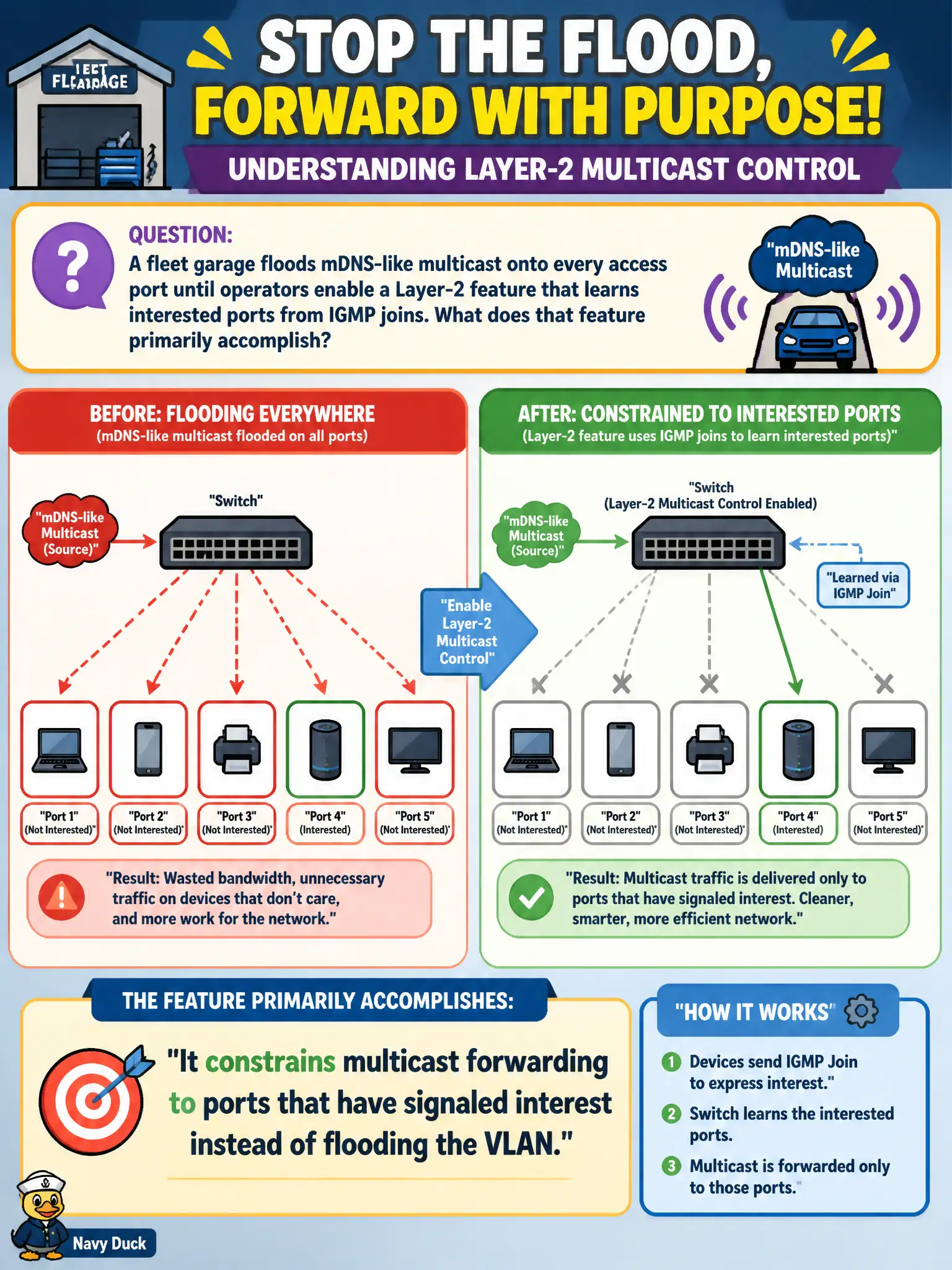
A fleet garage floods mDNS-like multicast onto every access port until operators enable a Layer-2 feature that learns interested ports from IGMP joins. What does that feature primarily accomplish?
Select an answer to reveal the explanation.
Short Explanation
Without help, a switch treats multicast like a party flyer and stuffs it in every mailbox on the floor. IGMP snooping listens for who actually RSVP’d and only delivers to those ports. Turn it on and the garage stops drowning in unwanted group traffic.
Full Explanation
When a fleet garage floods mDNS-like or other multicast onto every access port, the Layer-2 feature that learns interested ports from IGMP joins is IGMP snooping. Its primary accomplishment is constraining multicast forwarding to ports that have signaled interest (plus the multicast-router port) instead of flooding the VLAN. For civic operations yards, that containment stops cameras, printers, and discovery chatter from saturating every closet port.
Converting every multicast frame into a unicast ARP reply on the uplink confuses Layer-2 multicast optimization with ARP proxy tricks. IGMP snooping does not rewrite multicast into unicast ARP replies; that distractor fails by mixing unrelated control-plane behaviors.
Electing a designated PIM sparse-mode router on each access switch stack is a Layer-3 multicast routing role, not what IGMP snooping does on the access switch. Snooping builds L2 forwarding state from IGMP; it does not run PIM DR election as its primary function.
Replacing IGMP with static (*,G) mroute entries on every edge switch abandons dynamic membership learning. Static mroutes are a routing-state concept and are not the L2 interest-learning mechanism described in the stem.
Exam caveat: without a querier (router or switch IGMP querier), snooping entries can expire and many platforms fall back toward flooding—so enabling snooping alone is incomplete on routerless receiver VLANs.
Operational check: enable IGMP snooping on the garage access VLAN, join a test group from one port, and confirm show commands list only the interested port plus the mrouter port for that group. Record before/after flood behavior in the change ticket so on-call staff can prove containment for city fleet services.