
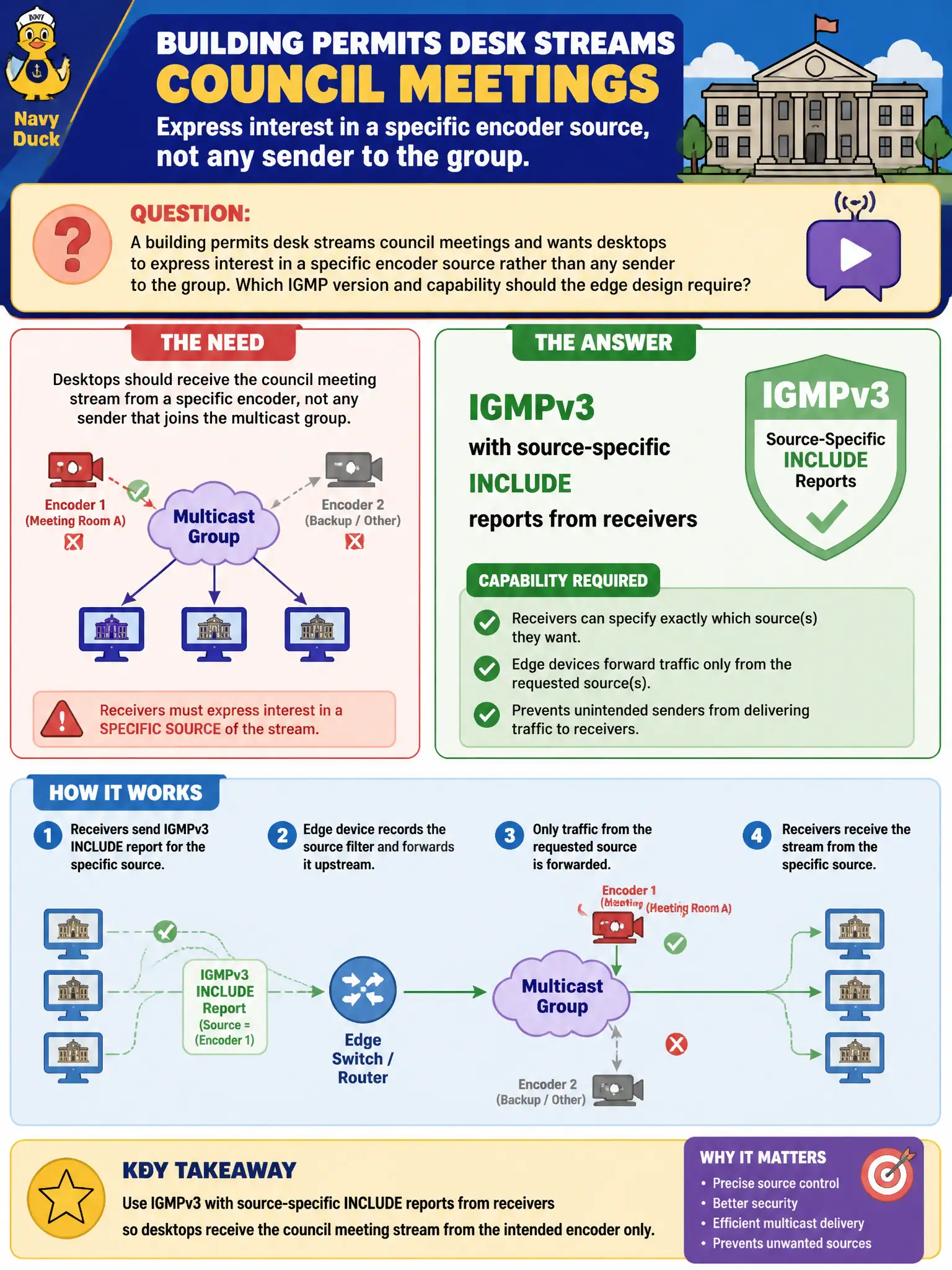
A building permits desk streams council meetings and wants desktops to express interest in a specific encoder source rather than any sender to the group. Which IGMP version and capability should the edge design require?
Select an answer to reveal the explanation.
Short Explanation
Think of the stream like a radio dial where you pick the station and the studio. IGMPv3 lets a desktop say “I want group G, but only from this encoder,” which is exactly what source-specific multicast needs. Older IGMP versions only name the group, so any talker can join the party.
Full Explanation
For a building-permits desk that streams council meetings, Source-Specific Multicast at the LAN edge requires receivers to name both the group and the encoder. IGMPv3 supplies that capability with INCLUDE (and EXCLUDE) source lists, so desktops can express interest in a specific civic encoder rather than any sender to the group. That is the correct edge requirement when the design goal is desktop-driven SSM rather than classic any-source membership.
IGMPv1 host membership reports without leave-group messaging only advertise group interest and lack modern leave/query refinements; they cannot convey per-source INCLUDE state, so they fail the SSM signaling requirement by concept.
IGMPv2 membership reports that only name the group address improve leave behavior over v1 but still signal (*,G)-style interest only. Without source lists, any talker to the group remains eligible, which is the opposite of encoder-pinned council streams.
CGMP client reports relayed only to Catalyst supervisor modules are a legacy Catalyst/router helper for constraining multicast at Layer 2 in older designs. CGMP is not the host protocol that carries IGMPv3 source filters and does not replace IGMPv3 INCLUDE signaling on modern civic edges.
Exam caveat: SSM commonly uses IPv4 232/8 (or IPv6 FF3x::/32) and needs IGMPv3 or MLDv2 end-to-end on the receiver VLAN; having an RP for ASM groups elsewhere does not satisfy per-source INCLUDE on the desktop VLAN.
Operational check: on a representative permits-desk access switch and first-hop router, confirm IGMPv3 is enabled toward hosts, generate an INCLUDE join for the council encoder, and verify the snooping/mroute state shows the specific (S,G) rather than a generic (*,G)-only entry. Document the encoder address and group in the municipal runbook so future changes keep source filtering intact for public meeting streams.