
After a rushed township annexation, a water utility finds two Area 0 fragments separated by a non-backbone area. What is the sound design takeaway before considering a virtual link?
Select an answer to reveal the explanation.
Short Explanation
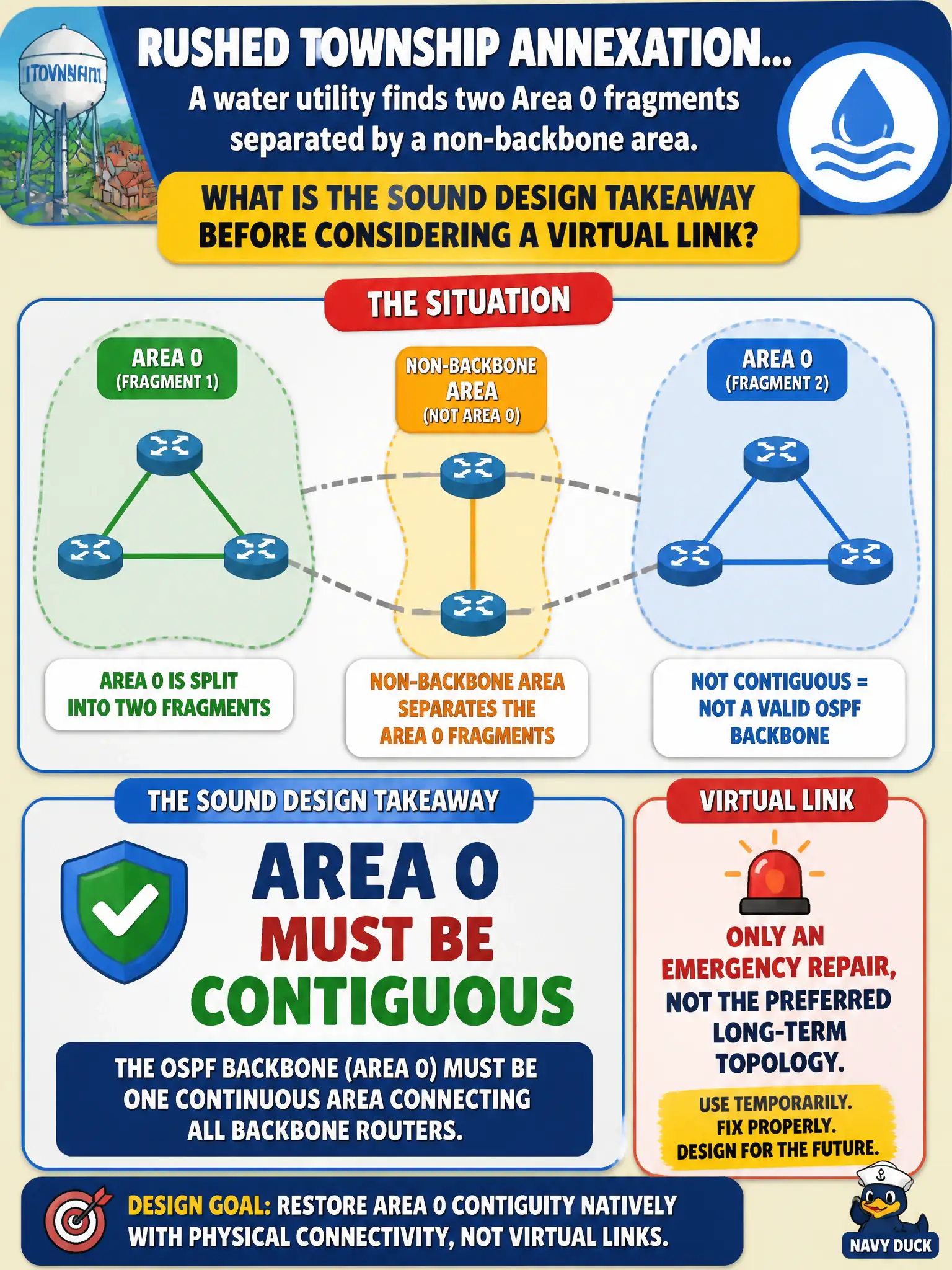
Area 0 is the town square—everyone’s roads should meet there. When annexation splits the square in two, a virtual link is duct tape across the alley, not a new city plan. Fix the backbone so it’s contiguous again.
Full Explanation
OSPF requires a contiguous backbone; partitioned Area 0 breaks normal inter-area path computation. Virtual links can temporarily stitch backbone fragments through a transit non-backbone area, but they add operational complexity and are not preferred greenfield design. When Area 0 splits, redesign for contiguous Area 0 (or redesign areas) rather than institutionalizing virtual links; totally stubby conversion does not heal a split backbone.
Virtual links are a repair tool with caveats—they depend on a stable transit area and complicate troubleshooting—so civic networks should treat them as interim bridges during remediation, not permanent architecture. Totally stubby areas reduce LSA types at leaves; they do not reconnect partitioned backbone fragments. Claiming the backbone can remain permanently split if virtual links exist forever invites fragile failure modes.
Exam caveat: both ends of a virtual link must see each other via intra-area routes through the transit area, and Area 0 adjacency over the virtual link must form cleanly. Operational check: if forced to use a virtual link, verify it comes up, confirm inter-area routes return, then prioritize physical or logical redesign so Area 0 is contiguous and the virtual link can be removed.