
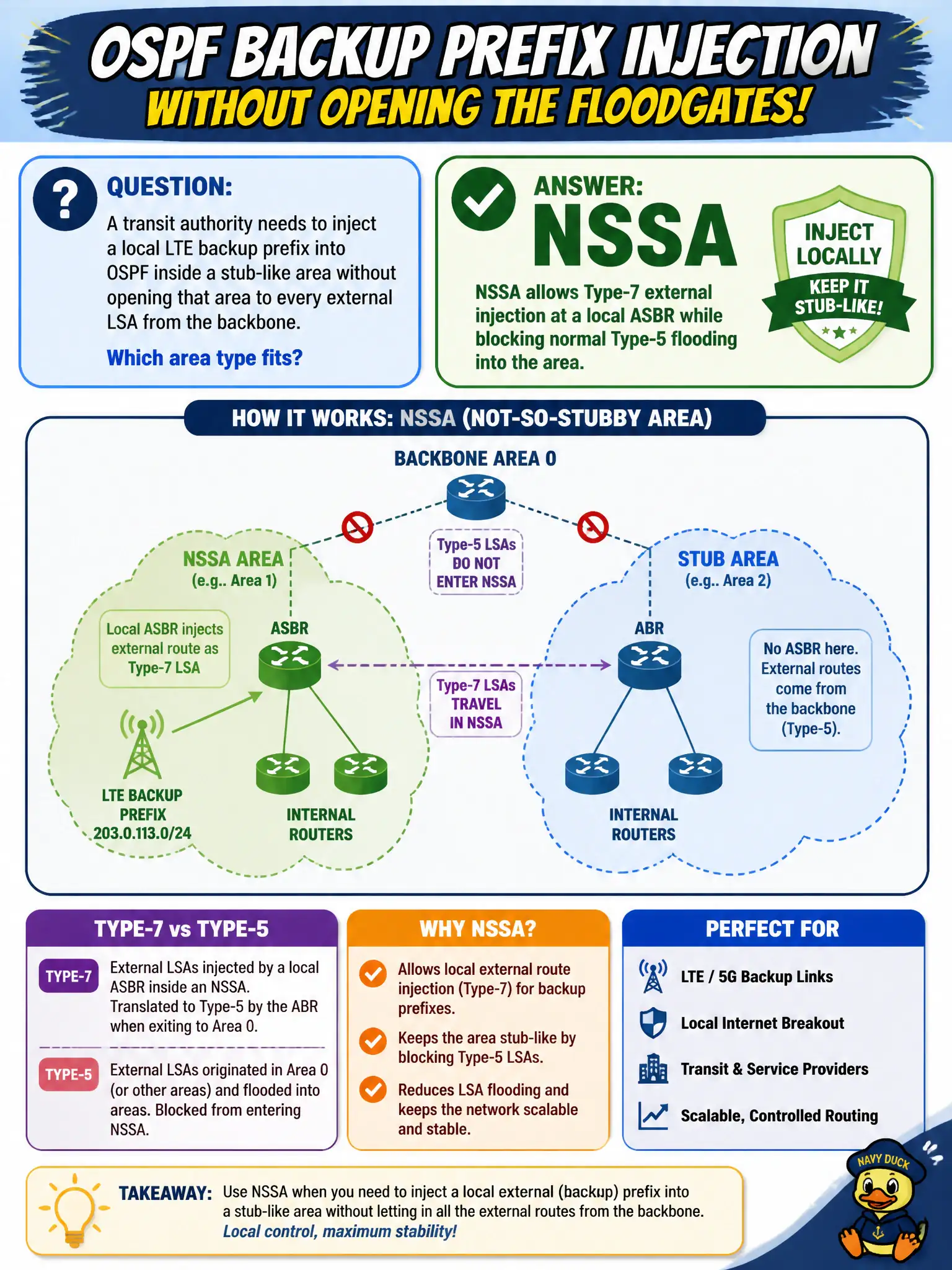
A transit authority needs to inject a local LTE backup prefix into OSPF inside a stub-like area without opening that area to every external LSA from the backbone. Which area type fits?
Select an answer to reveal the explanation.
Short Explanation
NSSA is the special side door on a stub neighborhood. You can roll one local LTE route in through that door (Type-7), but you don’t have to open the street to every external from the rest of the city. Stub-like peace plus one controlled injection.
Full Explanation
Not-so-stubby areas (NSSA) block regular Type-5 external LSAs from entering the area while still allowing a local ASBR to originate Type-7 externals that ABRs can translate into Type-5 for the backbone. A transit authority needing to inject a local LTE backup prefix into OSPF inside a stub-like area without opening that area to every external LSA from the backbone should choose NSSA. That matches site-specific external injection without accepting the full external set into the leaf area.
A totally stubby area does not provide that local external injection model, and it does not already flood all Type-5 externals from every ASBR—the distractor misstates totally stubby behavior. Externals are not confined exclusively to backbone Area 0. An “opaque-LSA area” reserved solely for MPLS TE without ASBR capability misstates OSPF area capabilities for this LTE injection use case.
Exam caveat: understand ABR Type-7 to Type-5 translation and NSSA default-injection options so LTE backups appear where intended without surprising Type-5 floods into the site. Operational check: configure the site as NSSA, redistribute LTE as Type-7, confirm translation at the ABR, and verify backbone externals do not flood into the NSSA as ordinary Type-5 LSAs.