
A museums department must force permit-office laptop traffic through a DPI path while leaving servers on normal destination-based routing. Which feature applies that exception?
Select an answer to reveal the explanation.
Short Explanation
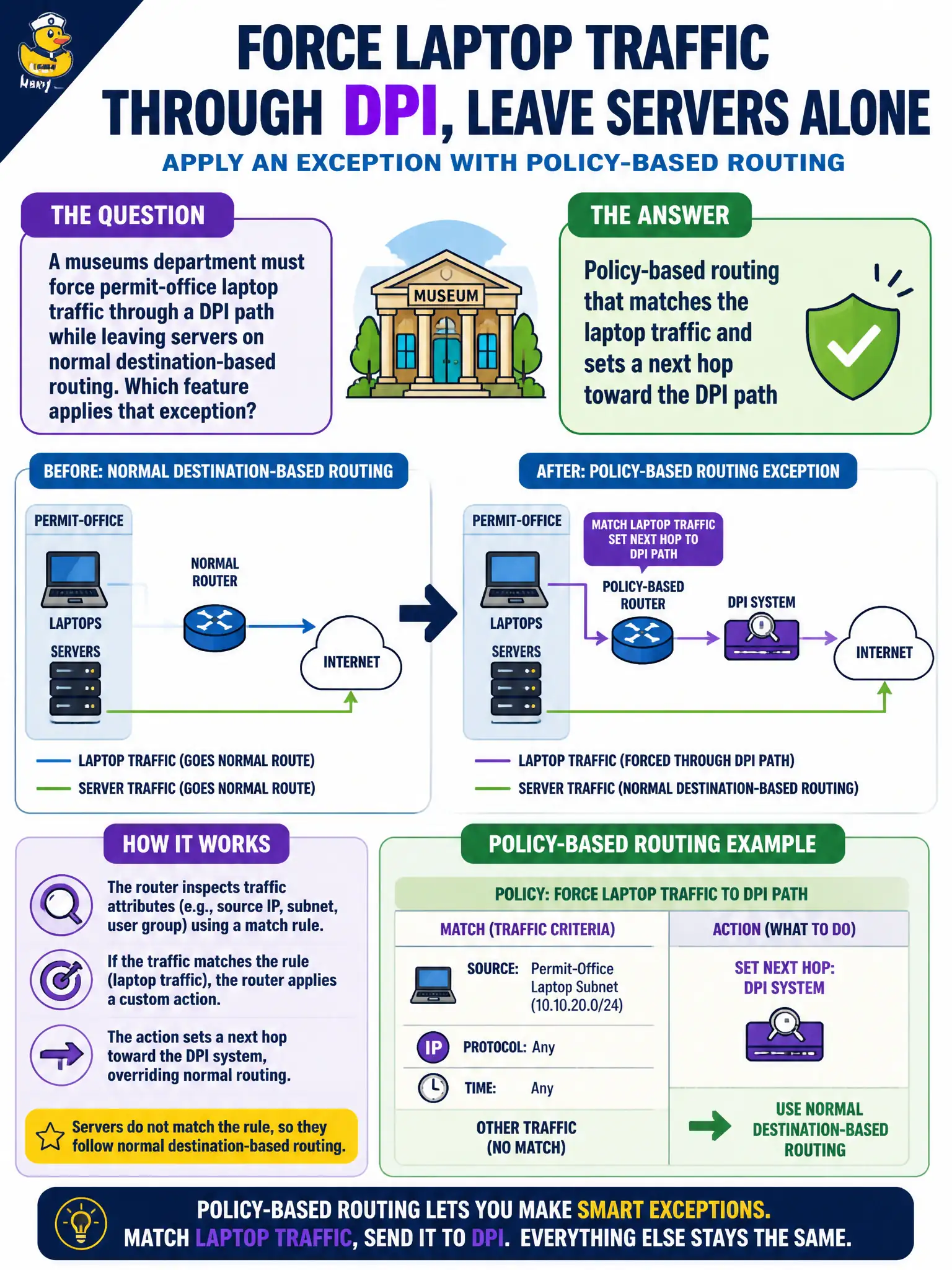
Normal routing is “follow the destination street signs.” PBR is the special detour sign for permit-office laptops only—send them past DPI while servers keep using the ordinary map. Match the right traffic, set the next hop, leave everyone else’s RIB alone.
Full Explanation
Policy-based routing matches traffic of interest and overrides destination-based routing for those packets by setting a next hop or outgoing interface. A museums department that must force permit-office laptop traffic through a DPI path while leaving servers on normal destination-based routing should apply PBR that matches the laptop traffic and steers it toward the DPI path. Servers continue ordinary forwarding unless they are also matched by the policy. This is the classic civic exception path when a subset of users must traverse an inspection cluster without redesigning the entire campus routing table.
Raising the servers’ OSPF administrative distance so laptops automatically detour does not selectively steer laptop flows and misunderstands AD as a per-host traffic-engineering tool rather than a RIB source selector. Extending the laptop VLAN across the DPI cluster with VTP enlarges a Layer-2 domain and still does not implement policy-based next-hop selection. UDLD aggressive mode on server access ports addresses unidirectional-link detection, not path selection for laptop sessions.
Exam caveat: PBR must be applied on the correct ingress interfaces, typically requires CEF, and needs careful ACL ordering so only intended traffic is redirected while return paths remain asymmetric-aware. Operational check: build an ACL for laptop subnets, set next-hop to the DPI appliance, verify laptop flows hit DPI while server flows do not, and confirm documented fail-open or fail-closed behavior if the DPI next hop is unreachable.