
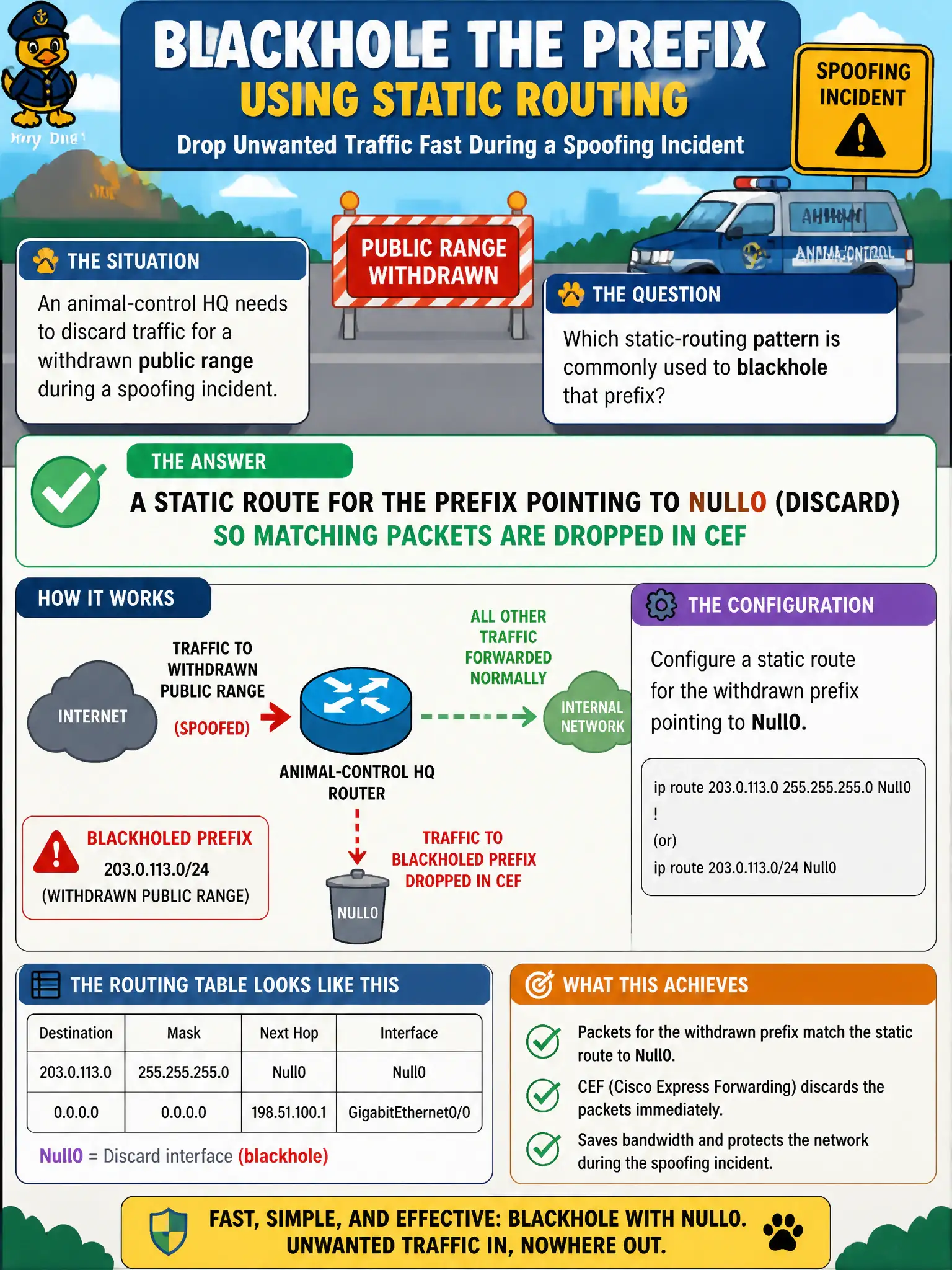
An animal-control HQ needs to discard traffic for a withdrawn public range during a spoofing incident. Which static-routing pattern is commonly used to blackhole that prefix?
Select an answer to reveal the explanation.
Short Explanation
Null0 is the network’s shredder chute—routes that point there make matching packets vanish on purpose. When a public range is withdrawn but spoofed traffic still shows up, a discard static is the clean blackhole. No need to invent fake next hops.
Full Explanation
A static route to Null0 installs a discard path so packets matching the prefix are dropped without needing a real next hop. That pattern is widely used for blackholing spoofed or withdrawn address space and for anchoring summaries. For animal-control HQ discarding traffic for a withdrawn public range during a spoofing incident, a Null0 static for the prefix is the common, CEF-friendly blackhole.
A default route pointing at the spoofed range’s last-hop MAC is operationally fragile and conceptually wrong for discarding a specific prefix. A floating static with AD 1 toward the Internet edge for every /32 invents massive configuration churn and may attract rather than discard traffic depending on design. A PBR rule that sets next-hop to the OSPF DR address only is unrelated to blackholing a withdrawn range and depends on DR presence.
Exam caveat: scope the Null0 static tightly to the incident prefix; overly broad discard routes can blackhole legitimate space, and remember to remove or adjust after the incident. Operational check: install the Null0 static, send test traffic to the prefix and confirm drops/counters, monitor for collateral damage, and document removal criteria when the spoofing window closes.