
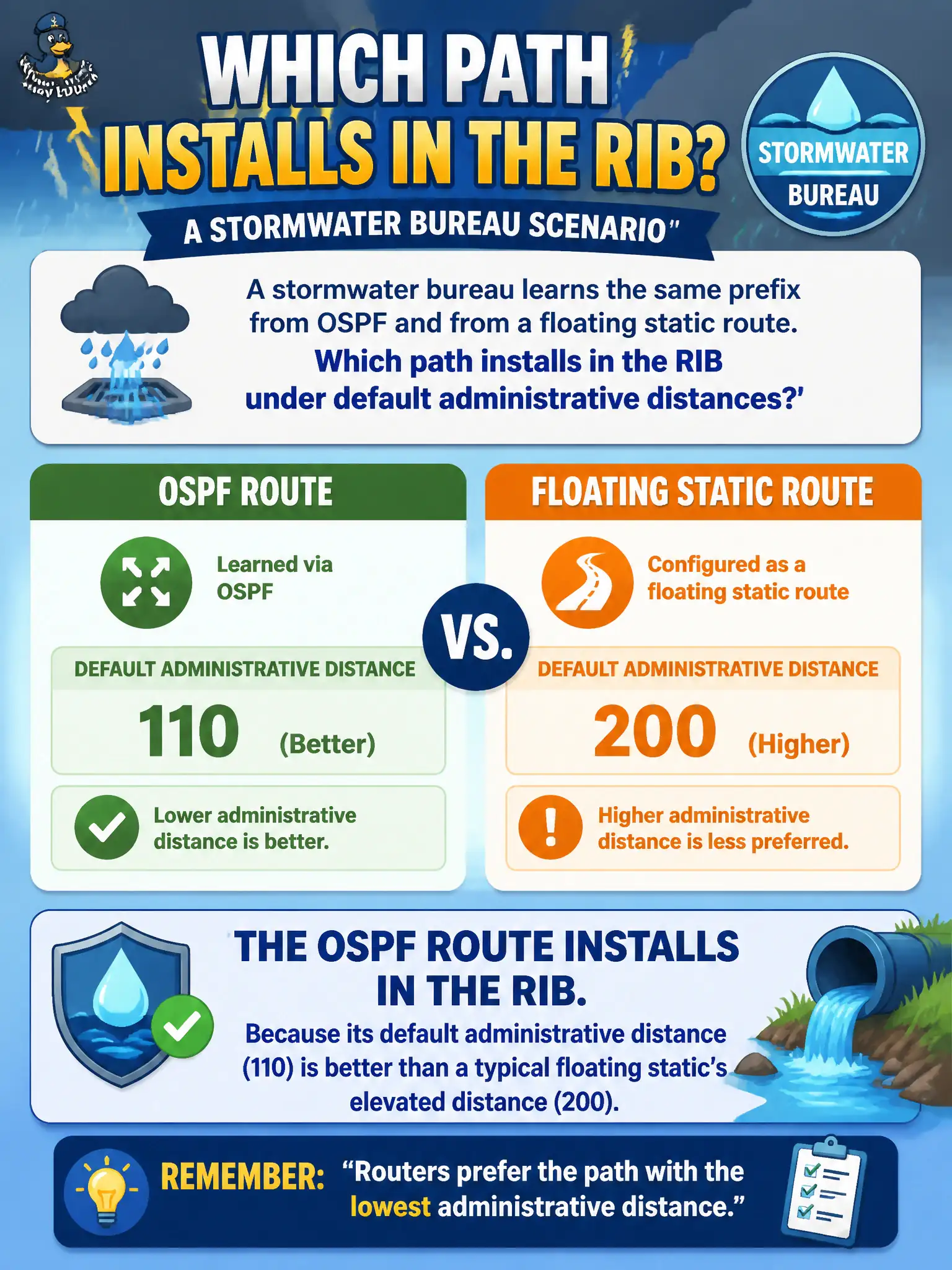
A stormwater bureau learns the same prefix from OSPF and from a floating static route. Which path installs in the RIB under default administrative distances?
Select an answer to reveal the explanation.
Short Explanation
Administrative distance is the trust score on the route report card. OSPF’s default score beats a floating static that’s intentionally hiked to 210 or similar. Keep the static in the back pocket for blackouts; let OSPF own the prefix while it’s healthy.
Full Explanation
When multiple routing sources offer the same prefix, Cisco IOS picks the source with the best (lowest) administrative distance. OSPF’s default AD (110) beats a floating static configured with a higher AD (commonly 200+), so a stormwater bureau learning the same prefix from OSPF and a floating static installs the OSPF route while the IGP is up. Floating means the static is deliberately worse so it appears only after OSPF withdraws.
Claiming the floating static always wins because static routes beat every IGP confuses a normal AD-1 static with a floating static that was raised above the IGP. Asserting both routes install equally with CEF per-packet spray is not the default outcome for identical prefixes from different sources—one RIB winner is selected by AD. Saying neither installs until BGP also advertises the prefix invents a dependency that does not exist for OSPF versus static selection.
Exam caveat: if someone configured a static at AD 1, it would beat OSPF; always verify the configured AD of the “floating” route. Operational check: show ip route for the prefix with OSPF up (expect OSPF), withdraw OSPF or shut the advertising path (expect floating static), and restore to confirm reversion without CEF equal-cost myths.