
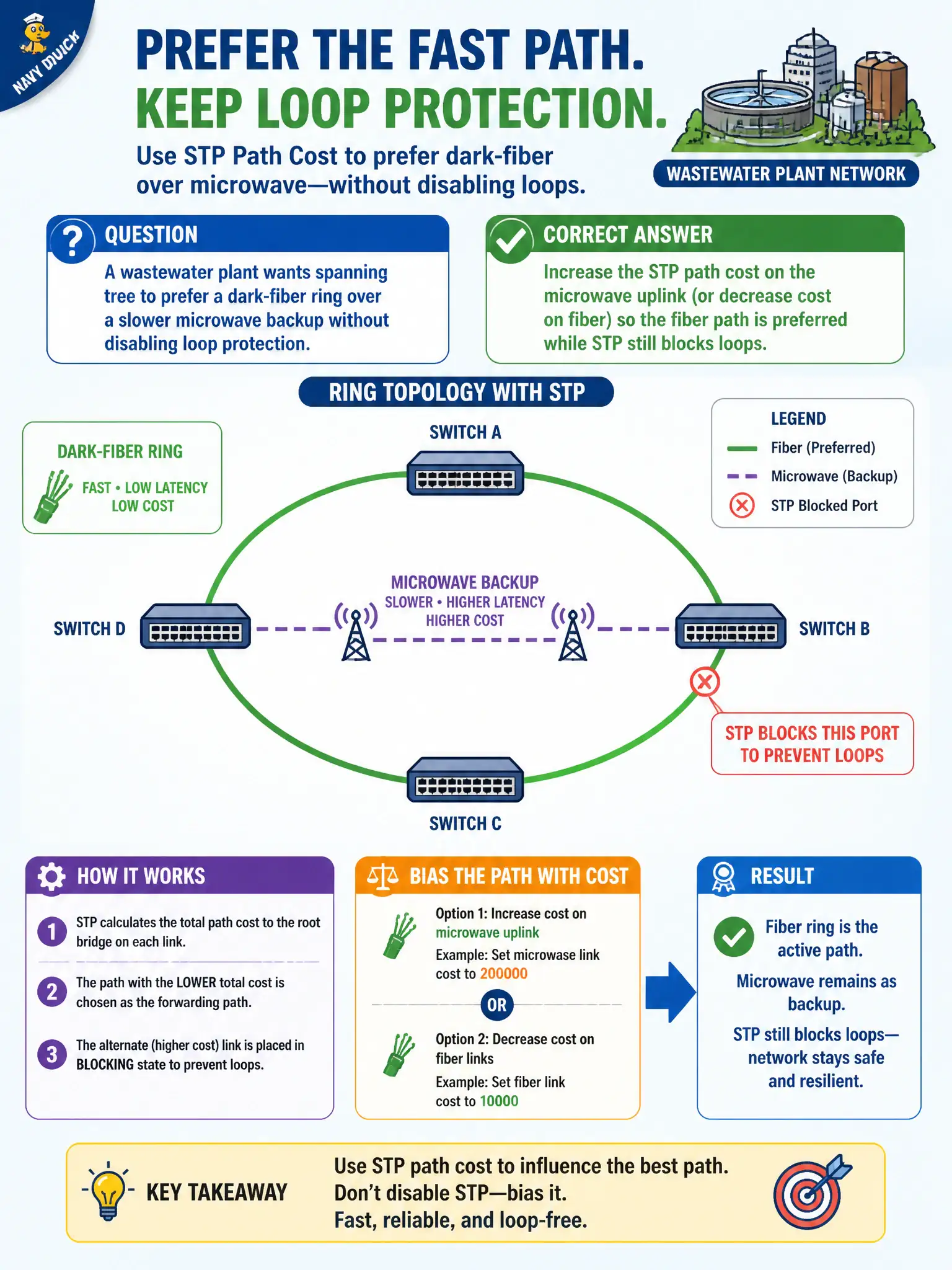
A wastewater plant wants spanning tree to prefer a dark-fiber ring over a slower microwave backup without disabling loop protection. Which mechanism correctly biases the path?
Select an answer to reveal the explanation.
Short Explanation
STP cost is the toll on each bridge path—raise the toll on microwave and cars take the dark-fiber ring. You’re steering preference, not deleting loop protection. Leave both links in the topology; just make fiber the cheap road.
Full Explanation
Spanning Tree selects paths using root path cost, so a wastewater plant that wants the dark-fiber ring preferred over slower microwave backup should raise the STP path cost on the microwave uplink (or lower cost on fiber). That biases STP while both links remain in the topology and loop prevention stays intact. Prefer fiber in steady state; keep microwave as a valid alternate when fiber fails.
Lowering the microwave link’s OSPF cost only fails because STP does not follow the IGP—Layer-2 path cost and OSPF metrics are separate control planes. Shutting down fiber interfaces weekly so STP forgets them is operationally destructive and does not implement preference. Setting both links to PortFast trunk so cost values are ignored is inappropriate on redundant inter-switch uplinks and undermines STP’s role.
Exam caveat: ensure root bridge placement is intentional; cost tweaks on non-root paths interact with root location, and per-VLAN or per-MST-instance costs must be applied consistently. Operational check: after adjusting costs, verify root port selection prefers fiber, confirm microwave becomes root port (or alternate) only after fiber failure, and document costs for both Rapid-PVST/MST instances in use.