
A fire district wants to bundle two 10G uplinks toward a distribution pair and must choose how the EtherChannel negotiates. Which choice best reduces silent misconfiguration risk during onboarding?
Select an answer to reveal the explanation.
Short Explanation
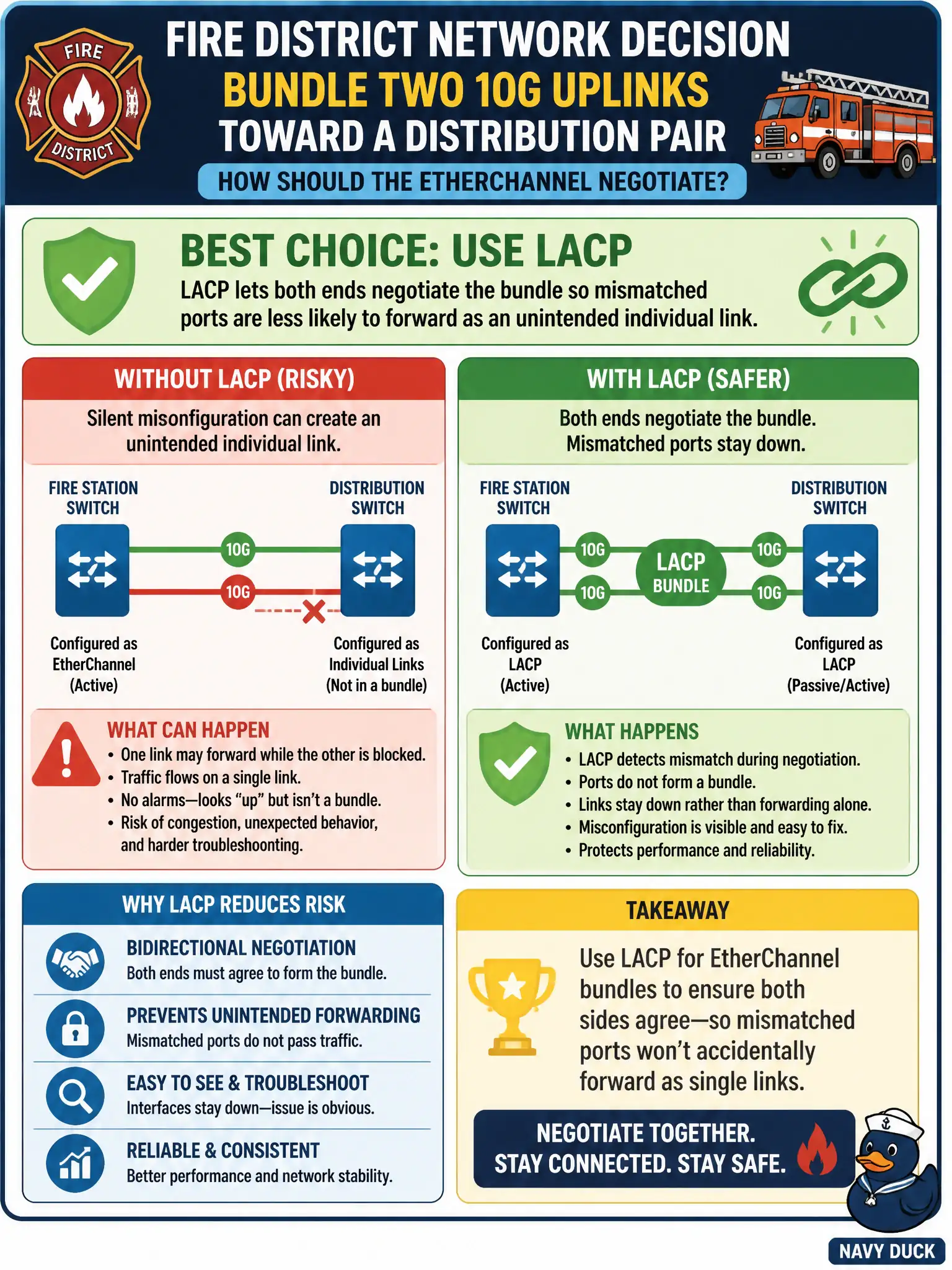
LACP is the handshake before two fire hoses get Y’d together. If one side isn’t ready, negotiation fails safe instead of half-forwarding. Static ‘on’ mode skips the handshake and can leave a nasty one-sided bundle during onboarding.
Full Explanation
LACP (channel-group mode active or passive) negotiates EtherChannel membership so incompatible or miswired members are less likely to form a broken bundle. For a fire district bundling two 10G uplinks toward distribution, negotiation reduces silent misconfiguration risk during onboarding: if the peer is wrong, LACP fails safe instead of half-forwarding. Prefer LACP for resilient, detectable bundling on civic distribution uplinks.
Forcing channel-group mode on with no protocol skips negotiation and can create unidirectional or inconsistent forwarding if the peer is miswired—speed of cutover is not worth silent data-plane damage. Bonding links only with STP cost tweaks never aggregates bandwidth into one logical channel; STP path cost does not create an EtherChannel. Configuring one side as LACP active and the other as static on does not negotiate correctly and recreates the mismatched-bundle hazard LACP exists to avoid.
Exam caveat: both ends should use compatible LACP modes (active/active or active/passive), matching speed/duplex/VLAN allow lists, and load-balance hashing appropriate to flows. Operational check: verify show etherchannel summary shows ports bundled via LACP, confirm partners agree, deliberately mismatch a test member and observe it does not silently forward as an independent link, and document member diversity across line cards or fiber paths where possible.