
A housing authority enabled a VTP mode that can overwrite the VLAN database across the domain and later found a VLAN pruned from an uplink after a mismatched revision. Which statement best captures the risk and safer practice?
Select an answer to reveal the explanation.
Short Explanation
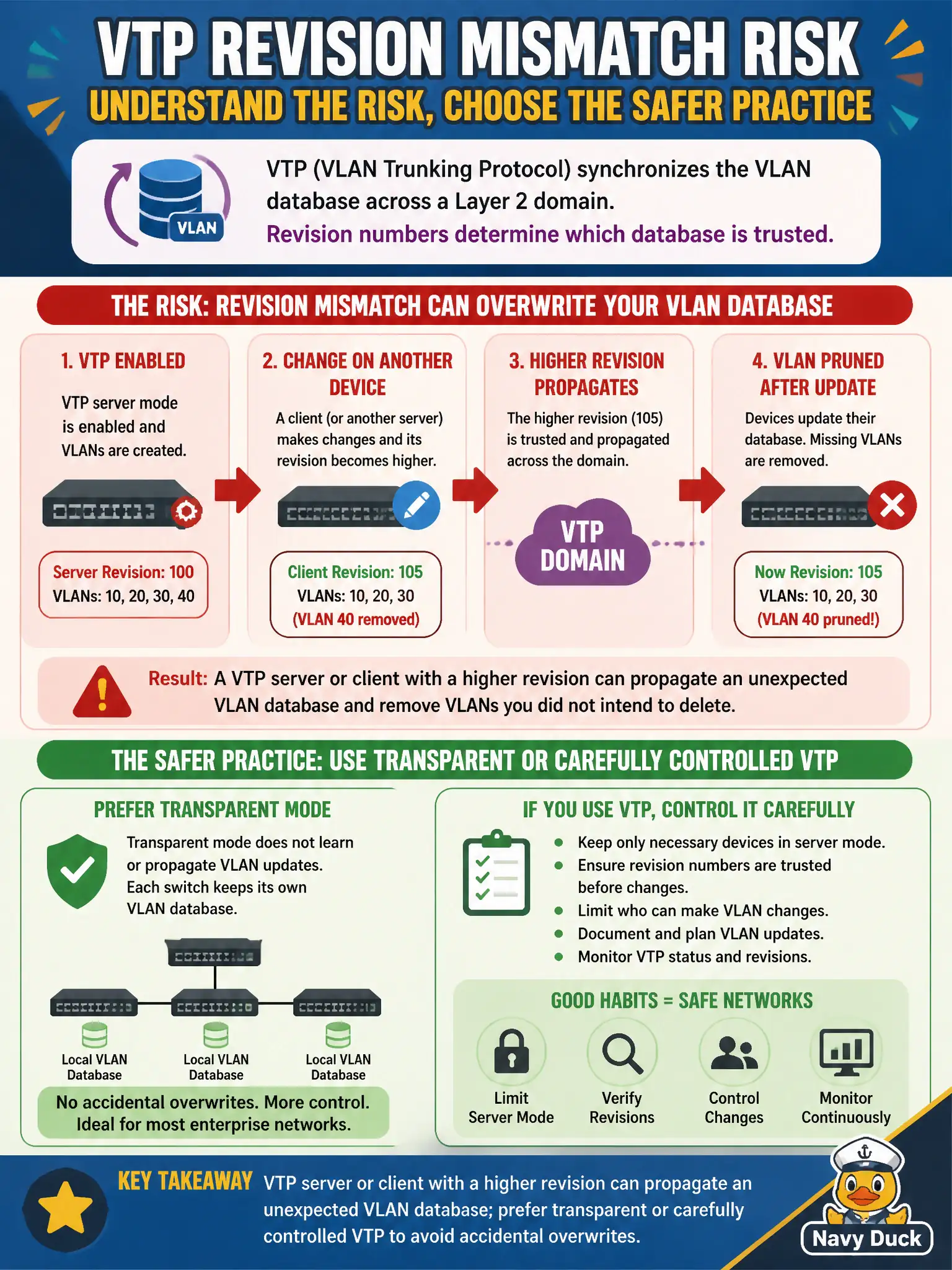
VTP with the wrong revision is like a master spreadsheet that overwrites every office copy overnight. Server and client roles will happily sync a bad database if the revision wins. Transparent mode—or tightly controlled VTP—keeps one closet’s mistake from rewriting the whole housing campus.
Full Explanation
In classic VTP, a switch in server or client mode with a higher configuration revision can overwrite VLAN databases across the domain, deleting or adding VLANs unexpectedly and breaking trunk allow lists—exactly the housing-authority failure when a mismatched revision pruned a VLAN from an uplink. Prefer VTP transparent mode, modern alternatives, or tightly controlled VTP with revision discipline and domain-name hygiene so a lab or closet switch cannot surprise the production VLAN database.
Claiming VTP transparent always overwrites clients and that spanning tree should be disabled instead reverses transparent behavior and proposes a dangerous non-sequitur: transparent does not push VLAN DB sync the same way, and disabling STP removes loop protection unrelated to VTP risk. Asserting VTP client mode never accepts updates makes revision numbers irrelevant is false—clients do accept updates from a higher-revision server. Saying VTP only affects voice VLANs and cannot change data VLAN membership misstates scope; VTP synchronizes the VLAN database used for data and voice alike.
Exam caveat: VTP versions and VTPv3 change some behaviors, but revision-hijack risk remains a classic exam and ops theme; many enterprises simply avoid VTP server/client in production. Operational check: inventory VTP mode and revision on every switch before inserting gear, prefer transparent, confirm critical VLANs still exist on trunks after any domain change, and never introduce a higher-revision switch from a lab without resetting its revision.