
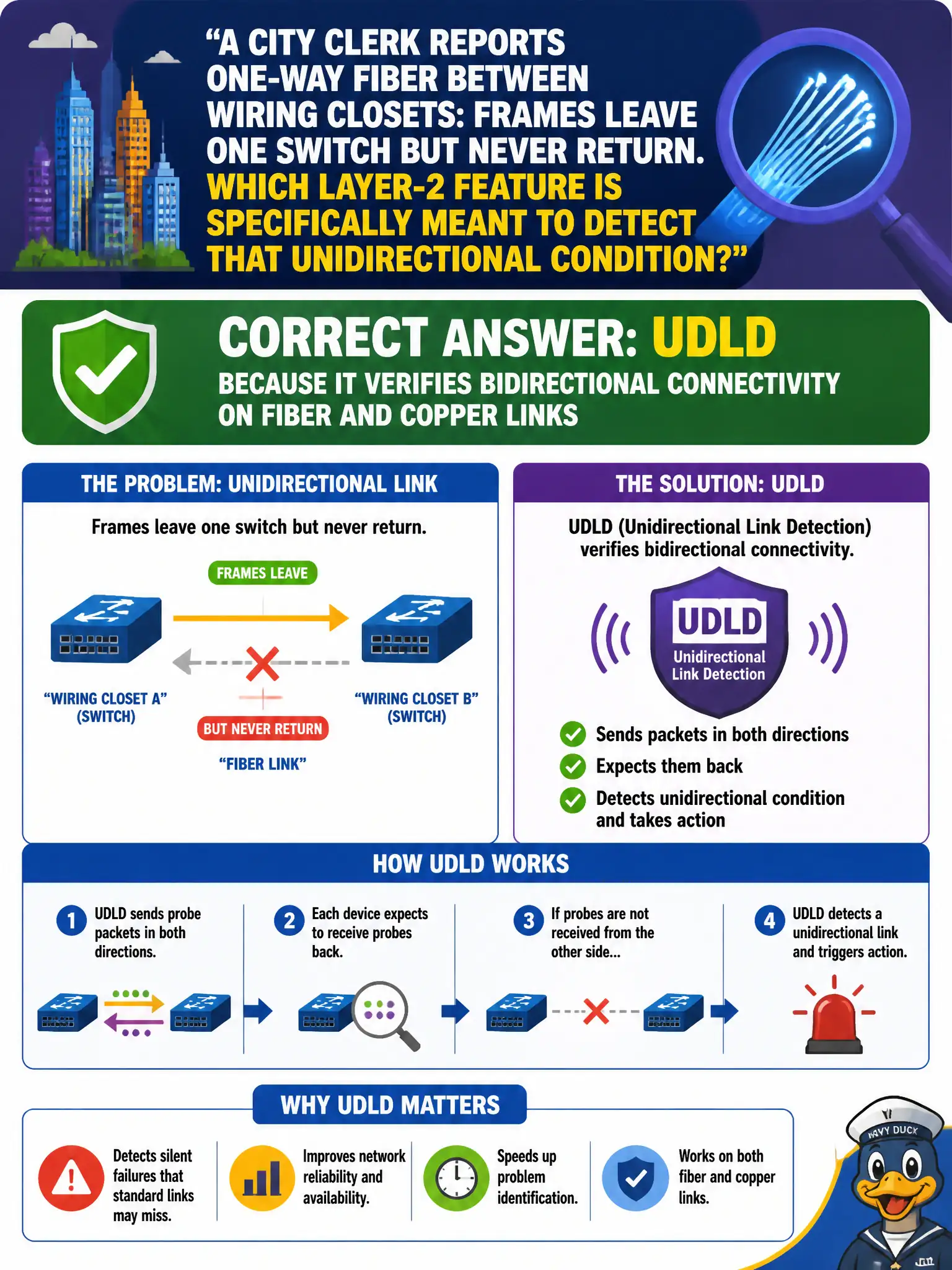
A city clerk reports one-way fiber between wiring closets: frames leave one switch but never return. Which Layer-2 feature is specifically meant to detect that unidirectional condition?
Select an answer to reveal the explanation.
Short Explanation
One-way fiber is like a hallway with doors that only swing outward—you can leave but never get back. Neighbor discovery chats won’t catch that trap. UDLD is the feature that checks both directions so a silent one-way link doesn’t keep pretending it’s fine.
Full Explanation
UDLD (Unidirectional Link Detection) exchanges probes so each side can confirm the link is bidirectional. When fiber or copper fails in only one direction—a classic city-clerk closet problem where light or signal passes one way—UDLD can detect the condition and errdisable the port before STP or EtherChannel treats the path as healthy and blackholes or loops traffic. That specific bidirectional verification is why UDLD is the feature meant for unidirectional link detection on civic fiber plants.
STP PortFast alone only changes edge-port timing so host ports skip classic listening and learning; it does not verify bidirectional connectivity on inter-switch fiber. CDP version 2 discovers Cisco neighbors and can surface native VLAN mismatch warnings, but neighbor discovery is not a unidirectional-link safety mechanism. LLDP MED advertises power, voice VLAN, and endpoint capabilities for inventory and phone onboarding; it likewise does not replace UDLD’s bidirectional probe model.
Exam caveat: UDLD has normal and aggressive modes with different failure reactions; enable and tune deliberately, and remember physical fiber cleaning and transceiver health still matter—UDLD detects symptoms, it does not splice fiber. Operational check: on suspect closet uplinks, verify UDLD is enabled consistently at both ends, confirm neighbors show bidirectional status, and after a one-way fiber fault inject or review logs for UDLD-driven errdisable rather than silent one-way forwarding.