
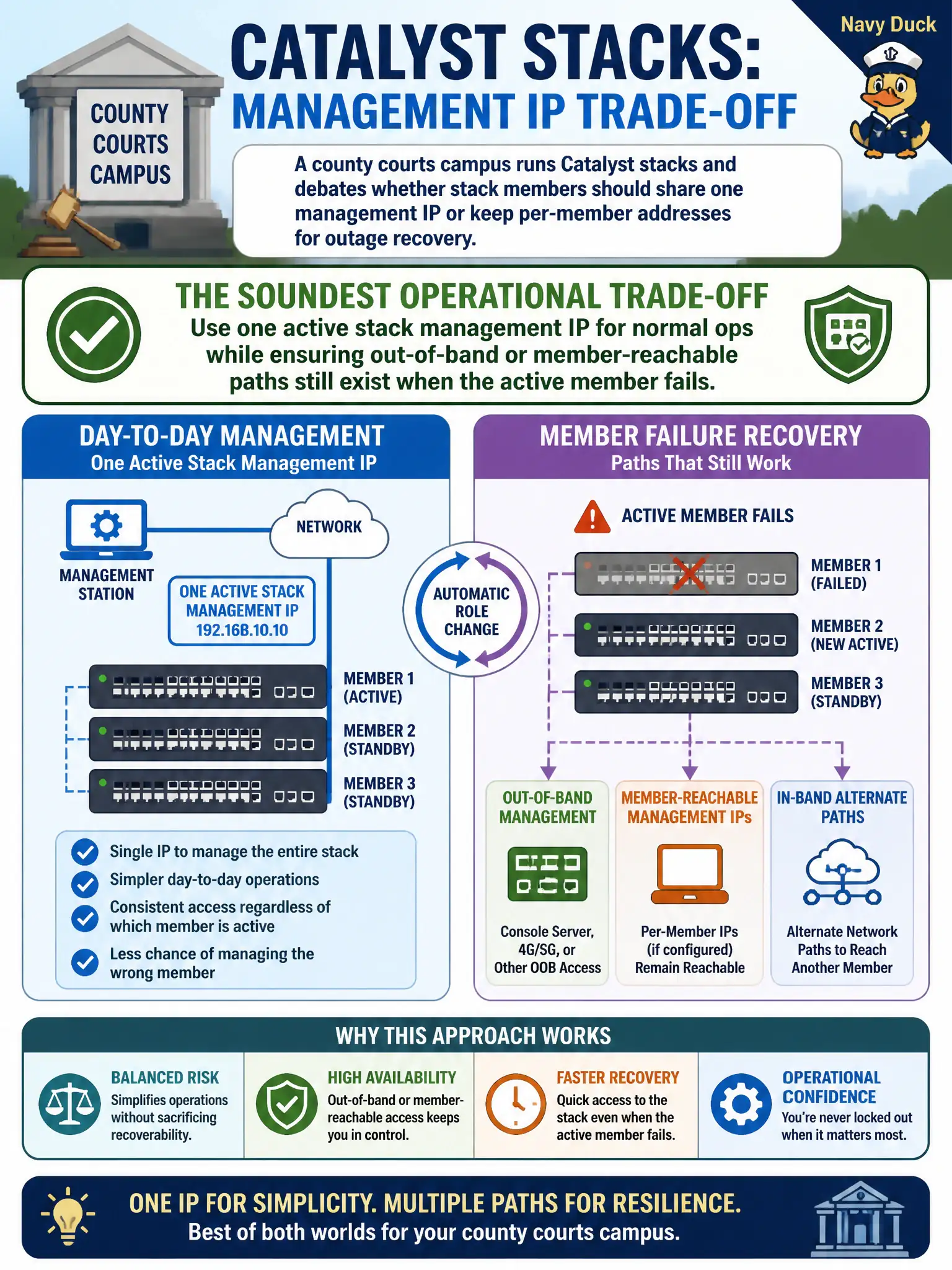
A county courts campus runs Catalyst stacks and debates whether stack members should share one management IP or keep per-member addresses for outage recovery. What is the soundest operational trade-off for day-to-day management versus member failure?
Select an answer to reveal the explanation.
Short Explanation
A stack’s management IP is like the courthouse main switchboard—one number for daily calls. When the active member drops, you still need a back door to the remaining gear. Shared active management for ops plus a recovery path for member loss is the practical balance.
Full Explanation
StackWise-style Catalyst systems typically present a single active management address for the logical stack, which simplifies monitoring and day-to-day configuration for a county courts campus. That convenience must not erase recovery: if the member owning management fails, operators still need console, out-of-band, or another path to surviving members so court applications are not stranded behind an unreachable management plane. The soundest trade-off is one operational management endpoint for normal ops plus explicit outage reachability to remaining members.
Assigning the identical management IP to every member so ARP never needs updating creates ARP conflicts and unpredictable reachability rather than high availability. Claiming stack management IPs are unsupported and that only console cables work misstates Catalyst stacking capabilities and would cripple remote operations across a courts campus. Disabling the stack management interface and managing only through data VLANs on user ports couples control-plane access to production VLAN health—exactly when a data-plane incident occurs, management may disappear.
Exam caveat: exact stack management behaviors vary by platform and software, but the design principle is stable: logical-stack simplicity for ops, plus a documented recovery path when the active management owner fails. Operational check: document the active management IP, verify SNMP/SSH to it in steady state, simulate or review failover so a surviving member remains reachable via OOB or alternate management path, and confirm user data VLANs are not the sole lifeline for stack administration.