
An airport authority must enable platform debugs on a busy Catalyst during an intermittent guest-Wi-Fi incident without hammering production CPU. Which practice best keeps troubleshooting safe?
Select an answer to reveal the explanation.
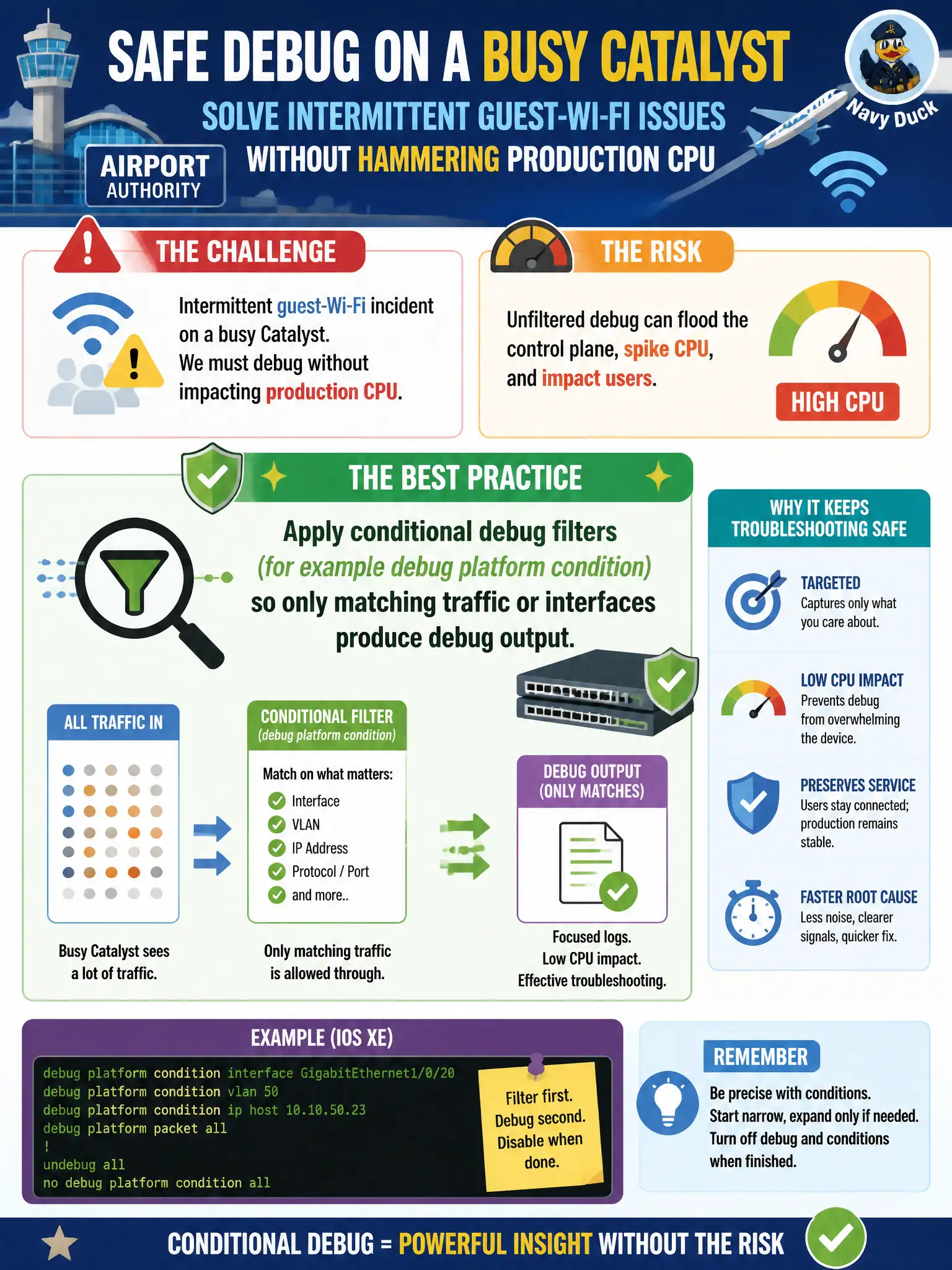
Short Explanation
Unfiltered debugs on a busy airport switch are like opening every PA speaker at once—ops drown and the platform suffers. Conditional debugs are the selective mic: only the matching passenger (flow/interface) gets logged so CPU stays healthy.
Full Explanation
Airport Catalyst troubleshooting during intermittent guest-Wi-Fi issues must enable platform debugs without hammering production CPU. Conditional debug filters such as debug platform condition limit output to matching traffic or interfaces, keeping troubleshooting safe on busy switches. That practice is the EI-appropriate answer when the stem stresses production safety.
Unrestricted debug all until the SSID recovers is a classic outage creator. Disabling CEF and process-switching all airport traffic into the logging buffer destroys forwarding performance. Redirecting every debug line to a broadcast syslog destination across the airfield LAN amplifies load and noise.
Exam caveat: even conditional debugs can hurt if the match is too broad; always prefer the narrowest interface, MAC, or IP condition available. Operational check: set a condition matching one test client or AP uplink, enable only the needed debugs, capture the intermittent event, then remove conditions and debugs promptly. Document CPU baselines before and during the session in the airport NOC ticket. Record the chosen control and the rejected alternatives in the municipal change record so future on-call staff understand which failure modes were avoided for city services.