
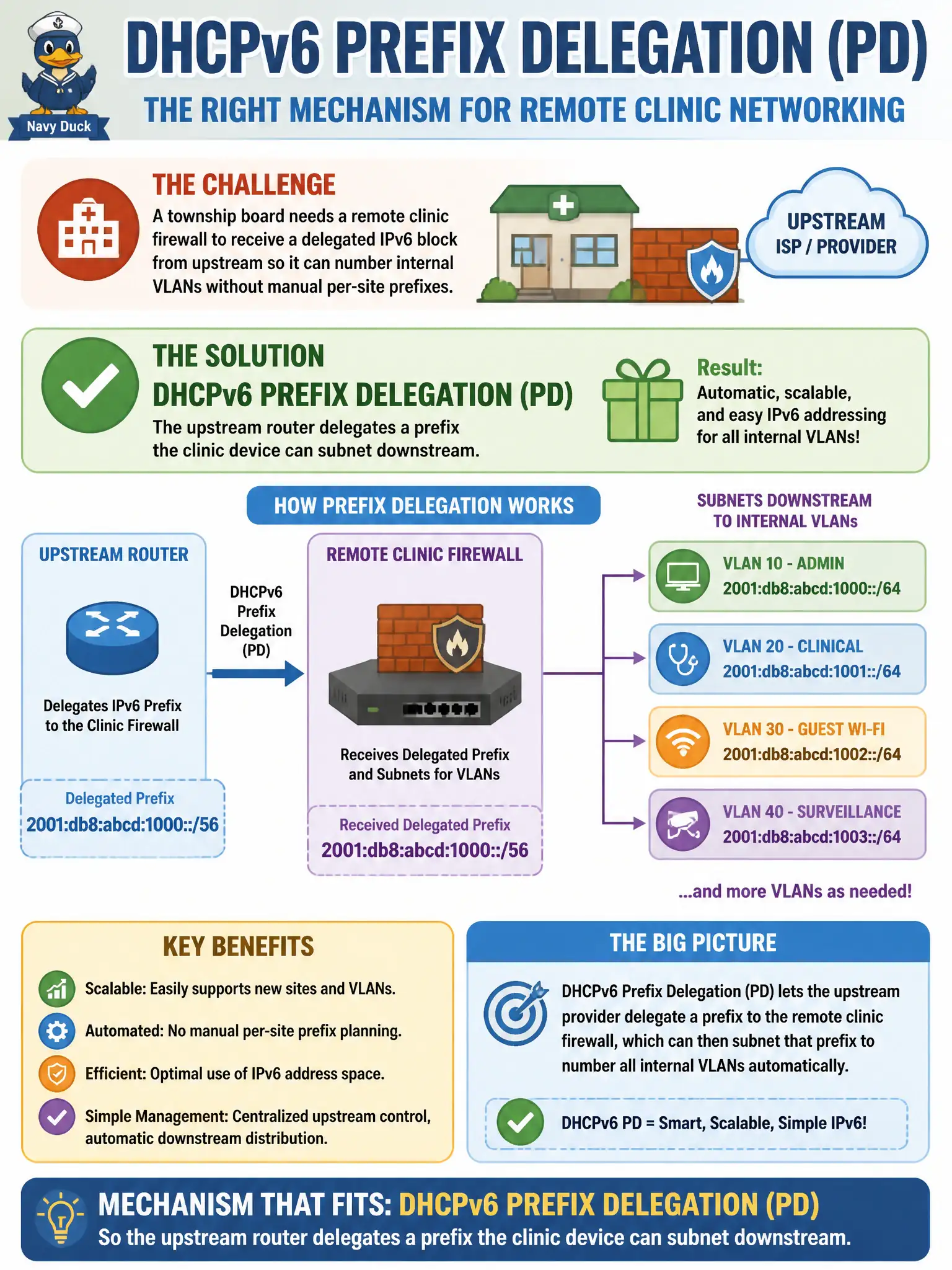
A township board needs a remote clinic firewall to receive a delegated IPv6 block from upstream so it can number internal VLANs without manual per-site prefixes. Which mechanism fits?
Select an answer to reveal the explanation.
Short Explanation
Prefix delegation is like the township handing the clinic a block of street numbers to subdivide inside the building. DHCPv6 PD ships that prefix downstream so the firewall can carve internal /64s. You are not stuck typing a unique prefix by hand for every remote site.
Full Explanation
A remote clinic firewall that must receive a delegated IPv6 block from upstream so it can number internal VLANs uses DHCPv6 prefix delegation (PD). PD lets the upstream router delegate a prefix the clinic device can subnet downstream without manual per-site /64 provisioning. That is the mechanism designed for hierarchical IPv6 numbering at civic edge sites.
IPv4 PAT overload exclusively does not delegate IPv6 prefixes. Anycast RP for multicast does not assign unicast /64s to firewalls. Static NAT66 one-to-one for every host is not hierarchical prefix assignment and does not scale like PD.
Exam caveat: PD hands a prefix (often /56 or /48 delegated further into /64s); it is not the same as stateful DHCPv6 IA_NA host address assignment alone. Operational check: enable DHCPv6 PD on the clinic WAN, confirm a delegated prefix appears, subnet it to internal VLANs, and verify hosts autoconfigure from the downstream RAs. Township WAN playbooks should record the delegated prefix length and how the clinic firewall slices /64s so later sites repeat the pattern safely. Record the chosen control and rejected alternatives in the municipal change record so future on-call engineers understand the failure modes avoided for city services.